



Why This Matters to Distributors: U.S. wholesalers added $13 billion in inventory in July, with stocks rising in both durable and nondurable goods. Wholesale inventories are now 5.7% higher than a year ago, putting more pressure on distributors to make sure sales keep pace with the products they are carrying.
U.S. wholesale inventories rose 1.3% in July, as distributors increased stocks of both durable and nondurable goods, according to new data from the U.S. Census Bureau.
Merchant wholesale inventories totaled seasonally adjusted $959.1 billion at the end of July, up from a revised $946.4 billion in June and $907 billion in July 2025. That put inventories 5.7% above year-earlier levels.
The monthly increase added about $12.7 billion to wholesalers’ inventories.
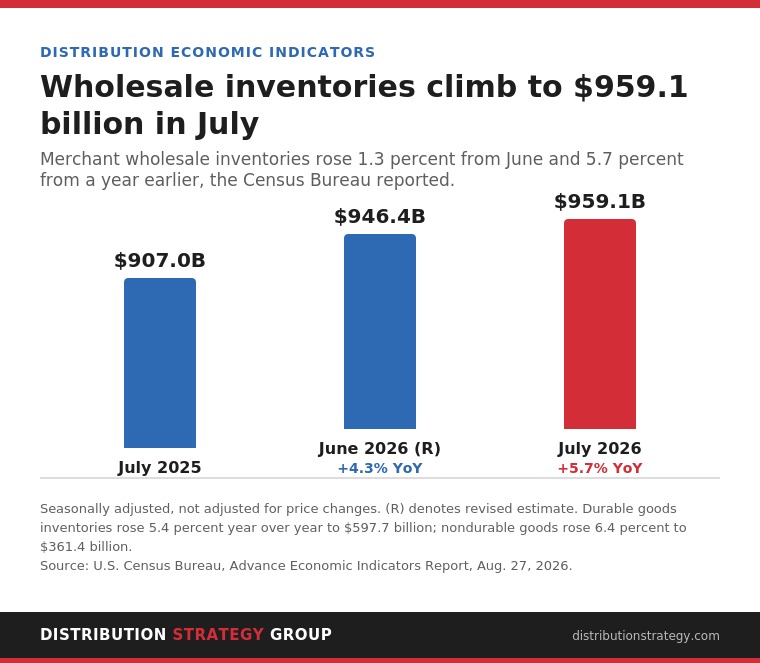
Durable goods inventories increased 1.2% to $597.7 billion and were 5.4% higher than a year ago. Nondurable goods inventories rose 1.6% to $361.4 billion and were up 6.4% year over year.
The July increase followed a much smaller gain in June. The Census Bureau revised June’s increase to 0.3% from an earlier estimate of 0.2%.
The report covers merchant wholesalers, including industrial distributors, wholesale merchants, jobbers, exporters, and importers. It excludes manufacturers’ sales offices and branches, as well as wholesale electronic markets and agents and brokers.
The inventory increase came as U.S. goods imports rose sharply in July.
Imports increased $11.4 billion from June to $318.2 billion, while exports fell $6 billion to $199.4 billion. The goods trade deficit widened to $118.8 billion from $101.4 billion in June.
Capital goods imports increased 11.3% from June to $140.1 billion and were 46.9% higher than a year ago. Industrial supplies imports moved in the opposite direction, falling 3.9% for the month and 11.7% from July 2025.
On the export side, capital goods increased 2.9% from June and 13.1% from a year earlier. Industrial supplies exports dropped 11.2% for the month but remained 18.4% higher than in July 2025.
The Census Bureau’s figures are advance estimates adjusted for seasonal and trading-day differences but not for price changes. Wholesale inventory estimates are based on a sample of about 4,200 U.S. wholesale firms.
The inventory increase does not necessarily indicate that distributors are overstocked. The advance report does not include wholesale sales or the inventory-to-sales ratio needed to measure how quickly wholesalers are moving the products they have on hand.
Those figures will provide a clearer indication of whether July’s inventory increase reflects distributors stocking for stronger demand or inventories accumulating faster than sales.
Do not miss any content from Distribution Strategy Group. Join our list.
Share this article:
