

Why This Matters to Distributors: Advance Auto Parts has reduced its distribution center network from 40 facilities to 15 and is now rebidding its transportation contracts with plans to use 70% fewer carriers. The company expects the carrier consolidation to save tens of millions of dollars as it also expands its market-hub network and standardizes operations inside its remaining distribution centers.
Advance Auto Parts has completed a more than two-year consolidation of its distribution network and is moving to sharply reduce the number of transportation carriers it uses as the auto parts company looks for additional supply chain savings.
The Raleigh, North Carolina-based company now operates 15 distribution centers, down from 40 when the consolidation began. Advance also has moved the remaining facilities onto a single warehouse management system.
The reduction is substantial even compared with where Advance expected it to be late last year. In December, the company said it was on track to operate 16 U.S. distribution centers by the end of 2025, down from 38 in 2023.
With the distribution center consolidation completed, Advance is turning its attention to transportation costs and productivity inside the remaining facilities.
The company is rebidding all its carrier contracts and expects to consolidate its freight with 70% fewer carriers. CEO Shane O’Kelly said the change is expected to generate “tens of millions of dollars in cost savings” and begin contributing to improved results in 2027.
Advance also is standardizing processes across its distribution centers. The company completed about 25% of its planned process changes during the second quarter and expects to finish the remaining work by mid-2027.
Those changes include reducing unnecessary product handling, improving shipment accuracy, and shortening inventory lead times. Advance has already standardized how its distribution centers receive products, replacing different procedures used across the network with a common process.
The work comes as higher transportation costs are affecting the business. Advance said higher freight and fuel costs reduced second-quarter results and expects those costs to remain elevated during the second half of the year.
Advance is simultaneously accelerating its market-hub expansion. The company had 38 market hubs after opening five during the first half and now expects to open 15 to 20 this year, up from its previous plan for 10 to 15. Nine are scheduled to open during the third quarter, and Advance continues to target 60 market hubs by mid-2027.
The hubs typically stock 70,000 to 80,000 products, and sometimes more, giving surrounding stores and customers access to parts that can be delivered the same day. Advance said markets with hubs have consistently performed better than markets without them.
The hubs are particularly important to Advance’s effort to increase sales to independent repair shops and other smaller professional customers. Sales to professional customers increased at a low single-digit rate during the second quarter, while sales to what Advance calls its Main Street Pro customers grew more than 2 percentage points faster than overall professional sales.
Advance also is concentrating sales and delivery efforts on repair shops close to its stores. O’Kelly said delivery times for professional orders averaged less than 40 minutes during each week of the second quarter. The company is targeting professional customers within one to three miles of its stores, where delivery times can be shorter.
The supply chain changes are taking place against a mixed sales environment.
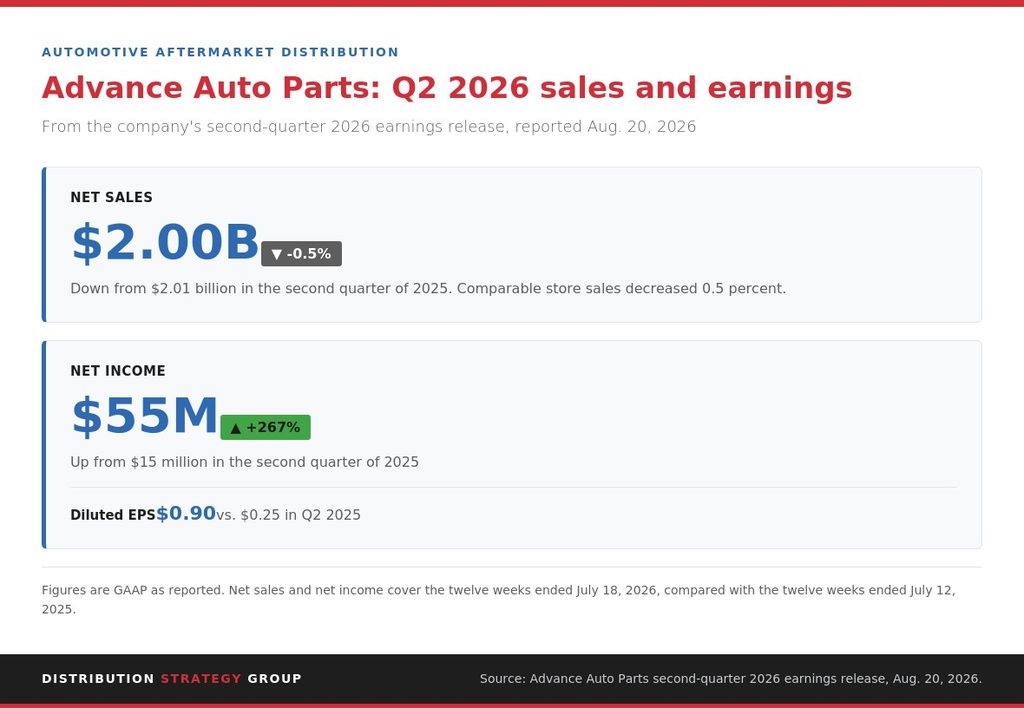
Second-quarter net sales fell 0.5% to $2 billion from $2.01 billion a year earlier. Net income increased to $55 million from $15 million, a 267% increase. Comparable-store sales also declined 0.5%.
For the first 28 weeks of the year, net sales increased 0.5% to $4.61 billion from $4.59 billion. Net income increased 105% to $80 million from $39 million.
The improvement in earnings partly reflects a much easier comparison with 2025, when Advance was absorbing significant costs associated with its restructuring and store closures. The company reported $41 million in restructuring-related expenses during the first 28 weeks of 2026, down from $148 million during the comparable period last year.
Professional sales were stronger than sales to do-it-yourself customers during the second quarter. Advance said tighter household budgets contributed to a low-single-digit decline in DIY sales, particularly during the final four weeks of the quarter. Professional sales remained positive.
Advance continues to expect 2026 net sales of $8.49 billion to $8.58 billion, with comparable-store sales increasing 1% to 2%.
As of July 18, Advance operated 4,311 company-owned stores, up from 4,305 at the beginning of the year. It also served 786 independently owned Carquest-branded stores.
The next phase of Advance’s supply chain overhaul will therefore be less about closing distribution centers and more about changing how products move through the network: fewer carriers, standardized warehouse processes, more inventory positioned closer to customers and faster delivery to professional repair shops.
Do not miss any content from Distribution Strategy Group. Join our list.
Share this article:
