

Why This Matters to Distributors: Fastenal, Grainger, Builders FirstSource, Winsupply, The Home Depot and other distribution focused companies are putting capital directly into artificial intelligence companies, technology, and talent. The deals point to a new stage in distributor AI strategies as companies look to own, influence, or gain closer access to technology tied to inventory, supply chains, sales, and other core operations.
Distributors are beginning to put money behind artificial intelligence in ways that go well beyond buying software licenses. Some of the biggest companies in distribution are acquiring AI companies, buying technology and intellectual property, or investing directly in businesses developing AI for distribution and other operationally complex industries.
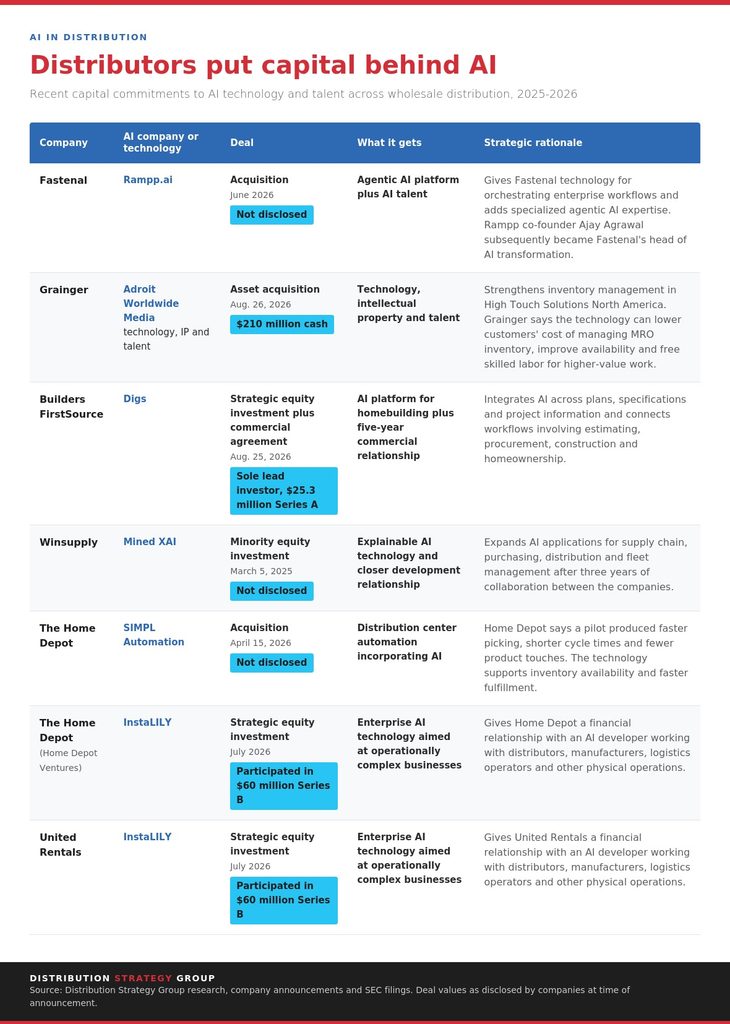
Fastenal acquired agentic AI company Rampp.ai in June. Grainger followed in August with a $210 million acquisition of technology, intellectual property, and talent assets from Adroit Worldwide Media. A day earlier, Builders FirstSource announced it was the sole lead investor in AI platform Digs’ $25.3 million Series A financing.
Winsupply had already acquired a minority stake in Mined XAI, an artificial intelligence company it had worked with for three years. The Home Depot is pursuing several approaches at once, acquiring automation technology that incorporates AI while investing in outside AI companies through Home Depot Ventures.
Home Depot Ventures and United Rentals also joined a $60 million Series B financing this year for InstaLILY, an AI company focused in part on industrial distribution, construction, and logistics. Together, the transactions show distributors are increasingly willing to put capital directly behind AI technology rather than relying exclusively on outside software vendors.
The transactions vary in size, structure, and purpose. Some are outright acquisitions, while others involve specific technology, intellectual property and talent or minority investments in AI developers.
But taken together, they point to a broader change in how distributors are approaching AI. Some large distributors are no longer looking only at how to use AI developed by somebody else. They are putting capital behind the companies, technology and people building it.
That shift comes as AI moves deeper into distribution operations. A 2026 McKinsey & Co. analysis found 60% of publicly traded distributors it examined had referenced AI in recent statements, presentations, or earnings calls, while 25% had identified AI investment as an explicit strategic priority.
A separate 2025 McKinsey survey of 300 distributors found logistics optimization and inventory management were the two areas where respondents expected AI and analytics to have the greatest impact. Demand and sales management, customer service and value-added services, labor productivity, procurement, and pricing also ranked among the leading applications.
McKinsey also found a significant gap between experimentation and broad adoption. While 90% of distributors surveyed had AI initiatives, only 11% had fully adopted the technology. The recent acquisitions and investments suggest some distributors are looking for ways to close that gap faster.
Fastenal Quietly Acquires an Agentic AI Company
Fastenal’s acquisition of Rampp.ai is one of the clearest examples of a major industrial distributor buying an AI company outright. Rampp.ai announced June 3 that it had been acquired by Fastenal, although Fastenal did not issue a separate investor relations announcement and financial terms were not disclosed.
Fastenal later confirmed the transaction to Distribution Strategy Group but declined to provide additional details about the acquisition or its strategic rationale. The company said the LinkedIn announcement and information contained in the post represented the extent of what it planned to share publicly about the transaction.
Fastenal also said the transaction was not of the nature that required separate public disclosure beyond what had already been communicated. The limited disclosure meant the acquisition attracted little attention when it occurred.
Founded in 2023, Rampp.ai developed an enterprise platform built around agentic AI, technology designed to take actions and coordinate workflows rather than simply generate information in response to prompts. Its platform was built around coordinating business processes that can cross multiple departments and enterprise systems.
The transaction also brought AI talent into Fastenal. Rampp.ai co founder and CEO Ajay Agrawal has since moved into Fastenal as head of AI transformation.
That is significant because the acquisition aligns with an AI roadmap Fastenal had already laid out publicly. At its 2025 investor day, Fastenal described a progression from generative AI to task agents that can perform work and automate workflows, and to more autonomous agents capable of independently planning and coordinating tasks.
Fastenal had also been discussing AI as a productivity tool before the Rampp.ai acquisition. The company has identified quoting and other internal processes as areas where AI can reduce manual work and increase speed.
The combination provides more context around a transaction that received little attention when it occurred. Fastenal did not simply acquire another enterprise software application. It acquired a company built around a technology that closely matches the next stage of AI development Fastenal had already identified, and it brought the company’s founder into Fastenal to work on AI transformation.
Grainger Pays $210 Million for Technology, IP, and Talent
Grainger took a different approach when it announced Aug. 26 that it had acquired technology, intellectual property and talent assets from Adroit Worldwide Media, or AWM, for $210 million in cash. Grainger did not acquire AWM itself, making the transaction an asset acquisition rather than a conventional purchase of the entire company.
Instead, Grainger bought specific assets it expects to use to strengthen inventory management within its High Touch Solutions North America business. Grainger said the acquired technology is expected to help customers reduce the total cost of managing maintenance, repair, and operations inventory, improve product availability and free skilled employees to perform higher value work.
The company said integration would begin immediately and that it expected to launch a commercial pilot within several months. Grainger also said the acquisition was not expected to contribute materially to near term financial results.
The deal illustrates another way distributors can accelerate technology development. Rather than continuing as a customer of an outside technology provider or acquiring an entire company, Grainger bought the technology, intellectual property, and talent it considered strategically important.
The size of the investment also stands out. At $210 million in cash, Grainger is putting significant capital behind technology aimed directly at one of distribution’s fundamental functions, managing inventory.
Inventory availability is central to a distributor’s value proposition, but carrying, replenishing, and managing that inventory also consumes capital and labor. Technology that improves visibility and availability while reducing the labor required to manage inventory potentially affects both customer service and operating costs.
Grainger’s decision to buy the technology and talent rather than simply license a product suggests it considers that capability important enough to bring closer to the company. It also provides one of the clearest examples of a major distributor using an acquisition to accelerate development of technology tied directly to its core business.
Builders FirstSource Leads $25.3 Million Digs Investment
Builders FirstSource is pursuing another model by investing directly in an AI company while entering a long-term commercial relationship with it. On Aug. 25, Builders FirstSource announced it was the sole lead investor in Digs’ $25.3 million Series A financing.
The building materials distributor simultaneously entered into a five-year commercial agreement with Digs intended to accelerate product development, strengthen integration between the companies’ platforms, and expand AI capabilities. The combination of an equity investment and a commercial agreement gives Builders FirstSource a relationship that extends beyond purchasing software.
Digs uses patented AI technology to connect information that is typically scattered across construction documents and systems. The companies said the platform can connect plans, specifications, product selections, approvals, warranties, conversations, and project histories into a sole source of project information.
The planned integration is expected to extend across estimating, procurement, construction, and homeownership. Builders FirstSource CEO Peter Jackson said the companies are combining Builders FirstSource’s scale, customer relationships, product data, and digital ecosystem with Digs’ AI platform to simplify workflows and improve productivity.
Builders FirstSource said the technology is intended to reduce disconnected workflows and manual work for homebuilders. The company serves more than 140,000 customers, giving Digs access to a potentially large base of construction industry users as the companies expand their relationship.
The transaction is particularly notable because the investment and commercial agreement are intertwined. Builders FirstSource is not merely investing money in an AI startup and waiting for the value of its stake to increase. It is helping finance the company while entering a five-year agreement to integrate the technology into its own digital ecosystem.
That potentially gives Builders FirstSource a closer role in the development of technology built around the workflows of its customers. It also fits a broader digital strategy aimed at connecting parts of the homebuilding process that historically have operated through separate documents, applications, and manual processes.
Winsupply Invests After Three Years of Working With Mined XAI
Winsupply provides another example of a distributor investing in an AI company after first working with it operationally. In March 2025, Winsupply announced what it described as the strategic acquisition of a minority stake in Mined XAI, an artificial intelligence company focused on turning complex data into business insights.
The investment followed three years of collaboration between the companies. Winsupply said the two companies were developing explainable AI applications for supply chain, purchasing, distribution, and fleet management.
“We have seen the impact of using AI in our operational processes and we anticipate this relationship will accelerate our overall business operations,” Robert DiTommaso, president of Winsupply’s Support Services Group, said when the investment was announced. The statement provided a direct explanation of why Winsupply decided to deepen the relationship.
The sequence matters because Winsupply did not invest in an unfamiliar AI startup and then begin searching for applications for its technology. The companies had already worked together for three years and identified applications tied directly to distribution operations.
The minority investment moved the relationship beyond the traditional customer and vendor model without requiring Winsupply to acquire the company outright. It also provides another indication of where distributors see potential AI value, including purchasing, supply chain management, distribution operations, and fleet management rather than simply customer facing chatbots or content generation.
Home Depot Buys Supply Chain Automation Technology
The Home Depot is using several approaches simultaneously, including acquisitions and venture investments. The company acquired SIMPL Automation, a Waltham, Massachusetts based automation and technology company whose systems combine advanced engineering with AI to improve distribution operations.
Home Depot had already tested SIMPL’s technology at its distribution center in Locust Grove, Georgia. The company said the pilot produced faster picking, shorter cycle times, and fewer product touches.
SIMPL also developed a patented storage and retrieval system designed to increase storage density. Home Depot said the technology allows it to position a broader assortment of high demand products closer to customers.
Home Depot tied the acquisition directly to its same day and next day fulfillment strategy. Amit Kalra, senior vice president of supply chain at Home Depot, said the company is focused on keeping products in stock and ready for delivery to customers’ homes and job sites.
Home Depot said the SIMPL acquisition is part of a broader supply chain technology strategy that includes AI powered inventory management, automation, advanced analytics, mobile technology, and live delivery tracking. That makes the transaction less about AI as a stand alone technology and more about using AI and automation to improve the physical movement of products through a distribution network.
The distinction is important for distributors. Some of the largest potential returns from AI may come not from a visible customer facing application but from improvements in picking, storage, replenishment, inventory placement, and fulfillment.
Home Depot and United Rentals Put Money Into InstaLILY
Home Depot is also investing in AI companies through Home Depot Ventures. In July, Home Depot Ventures and United Rentals joined as new strategic investors in InstaLILY’s $60 million Series B financing.
The round was led by Energize Capital, with existing investor Insight Partners increasing its investment. InstaLILY said the financing brought its total capital raised to $100 million.
Founded in 2023, InstaLILY develops AI technology for operationally intensive businesses and lists industrial distribution, construction, and logistics among the industries it serves. Its technology is designed to work within enterprise operations rather than function solely as a general purpose AI assistant.
The investment is notable because it brings two large companies with extensive physical operations, Home Depot and United Rentals, into the ownership structure of an AI developer serving those types of businesses. Both companies operate large networks where inventory, equipment, logistics and customer service are critical operating functions.
For Home Depot, the investment complements an AI strategy that already includes internal development, partnerships, and acquisitions. For United Rentals, it creates a financial relationship with an AI company serving businesses with complex equipment, service, and operational workflows.
Neither investment is equivalent to acquiring the company. But both move the companies beyond a conventional customer relationship with an AI provider and give them a direct financial interest in the development of technology.
Why Distributors Are Putting Capital Into AI
The transactions differ, but several common strategic themes are emerging. One is control over technology that is increasingly connected to core distribution processes.
Inventory management, purchasing, pricing, quoting, replenishment, routing, product data, and customer interactions influence sales, margins, working capital, service levels, and operating costs. As AI moves deeper into those functions, technology decisions increasingly become operating strategy decisions.
Buying technology or investing in the company developing it can provide a distributor with a closer relationship to a capability that may become increasingly important to its competitive position. It can also give the distributor more influence over how technology is developed and integrated with its own systems and data.
A second factor is talent. Advanced AI development requires engineers, data specialists and product developers with skills that distributors historically have not needed in large numbers.
Acquiring a company or its technology assets can bring those people into the organization faster than building a team entirely from scratch. That is particularly visible in the Fastenal and Grainger transactions.
Fastenal acquired Rampp.ai and subsequently brought its co founder and CEO into a senior AI transformation role. Grainger explicitly identified talent as one of the assets it acquired from AWM, along with technology and intellectual property.
The transactions are therefore not simply about acquiring software. They can also be about acquiring people who understand how to build, deploy, and improve that software.
Speed Is Becoming Another Factor
Speed is another reason distributors may be looking outside their organizations for AI capabilities. Building specialized technology internally can take years, while acquiring technology or investing in an existing partner can shorten the development cycle.
That is particularly true when the technology has already been tested in real operating environments. Home Depot piloted SIMPL’s technology before acquiring the company, while Winsupply worked with Mined XAI for three years before taking an ownership stake.
Builders FirstSource paired its investment in Digs with a five year commercial agreement intended to accelerate product development and integration. The relationship gives the distributor an opportunity to help shape technology that is being incorporated into its own digital ecosystem.
Those transactions suggest a pattern different from traditional venture investing. The distributors are not necessarily putting money into AI companies simply because they expect those investments to appreciate.
They are investing in technology that can be connected directly to their businesses. The potential return can therefore come from operating improvements as well as any financial value created by the investment itself.
Distribution Data Could Become Part of the Advantage
There is another reason ownership or a close development relationship may matter. Distributors possess large amounts of proprietary data that can make AI applications more useful and more specific to their businesses.
General purpose AI models are increasingly available to every company. Distributor data is not.
Distributors have years of information about products, customers, purchasing patterns, inventory movement, pricing, quotes, orders, delivery routes, and supplier relationships. That information can provide context that a general purpose AI model does not possess on its own.
Connecting AI to proprietary data and embedding the resulting intelligence into daily workflows could create capabilities that are more difficult for competitors to replicate than access to the underlying AI model itself. That is where many of the current investments are focused.
Grainger is targeting inventory management, while Winsupply identified supply chain, purchasing, distribution and fleet management. Builders FirstSource is connecting estimating, procurement, and construction workflows, while Home Depot is applying AI and automation to distribution center productivity, inventory, and fulfillment.
Fastenal’s acquisition moves further into agentic AI and enterprise workflow orchestration. Those investments are aimed increasingly at the mechanics of running a distribution business rather than simply generating text or answering questions.
The Money Is Moving Toward Core Operations
McKinsey’s research reinforces that direction. Its 2025 survey of 300 distributors found logistics optimization ranked first among areas where distributors expected AI and analytics to have the greatest impact, with inventory management ranking second.
Demand and sales management followed, along with customer service and value-added services, labor productivity and performance management, procurement, pricing, and end-to-end margin visibility. The survey results align closely with where distributors are putting capital.
Grainger’s acquisition centers on inventory, while Winsupply’s investment targets purchasing, supply chain and fleet operations. Home Depot’s SIMPL acquisition is aimed at distribution center productivity and fulfillment.
Builders FirstSource is connecting AI to workflows surrounding the sale and delivery of building materials and the construction process. Fastenal’s Rampp.ai acquisition potentially extends AI beyond individual tasks toward coordinating workflows across enterprise systems.
That represents a different stage of AI adoption from using generative AI to draft an email, summarize a document or answer an employee’s question. AI is moving closer to transactions, decisions, and physical operations.
Three Ownership Models Are Emerging
The transactions point to at least three approaches distributors are taking. Fastenal represents the acquisition model, in which a distributor buys an AI company and brings its technology and talent inside the organization.
Grainger represents the asset acquisition model, in which a distributor buys specific technology, intellectual property and talent without acquiring the entire company. Builders FirstSource, Winsupply, Home Depot and United Rentals illustrate variations of the strategic investment model, in which companies put capital into an AI business while maintaining a commercial, operational or development relationship with it.
Those strategies can coexist with another approach already widespread across distribution, developing AI internally and partnering with major technology companies without buying or investing in an AI provider. No single model is likely to fit every distributor.
The economics, technical requirements and strategic importance of an application will determine whether it makes more sense to build, buy, invest, or partner. The emergence of acquisitions and equity investments adds another option to that calculation.
From Technology Customer to Technology Owner
For decades, distributors have purchased much of their enterprise technology from outside providers. Enterprise resource planning systems, warehouse management software, customer relationship management platforms, ecommerce technology, and other applications have been purchased or licensed from technology vendors.
AI could alter that relationship in some areas. AI capabilities are rapidly becoming standard features in enterprise software, and simply having access to AI is unlikely to remain a meaningful competitive advantage as those capabilities become more widely available.
The differentiation may instead come from what a distributor does with the technology. That includes connecting AI to proprietary products, customer, pricing, and inventory data, embedding it into workflows, training systems around specific operating processes and determining where AI can take actions rather than simply provide recommendations.
For some companies, those capabilities may be important enough to own. For others, a strategic investment may provide enough influence and access without requiring an acquisition.
Many distributors will continue to rely primarily on technology partners, and acquisitions will not make sense for every company or application. But the transactions by Fastenal, Grainger, Builders FirstSource, Winsupply, Home Depot and United Rentals show that the industry’s AI strategy is becoming more sophisticated.
The conversation is moving beyond which AI tools distributors should use. Distributors are increasingly deciding which AI capabilities are important enough to buy, invest in or own.
Do not miss any content from Distribution Strategy Group. Join our list.
Share this article:
