


Bottom line: The distribution workforce is aging out faster than companies can hire replacements, and the knowledge walking out the door with it is among the hardest assets to rebuild. Over the next five years, the highest-value job artificial intelligence can do in your business may be capturing and scaling what your veterans know before they leave.
Treat that as a workforce strategy because that’s what it is. The distributors, wholesalers and merchants that frame AI this way are already pulling ahead. The ones still running AI primarily as an IT project risk losing twice: first the people, then the knowledge they take with them.
Walk into almost any trade counter or branch in the UK and find the person everyone relies on. In a builders’ merchant, electrical wholesaler or industrial distributor, it is often someone in their 50s. They know which fittings actually cross-reference, which customer pays in 30 days and which one needs chasing, and which substitute to offer when a product is out of stock.
Almost none of it is written down.
I ran branch and call center operations at Grainger for the better part of a decade, and those were the people who kept the place standing. Last year, I watched a regional distributor lose three of them in a single quarter to retirement. The replacements were capable. They just didn’t know what the people who left knew. Service scores slipped, returns crept up, and the branch manager spent his days answering questions that used to answer themselves.
That’s the real AI story in our industry right now, and it has almost nothing to do with chatbots.
The Clock You’re Actually Racing
Here’s the uncomfortable part. The retirement wave may be the most important workforce issue on your five-year horizon, and many distribution leaders are managing it primarily as a hiring problem when it is also a knowledge problem. You can’t recruit your way out of a demographic cliff.
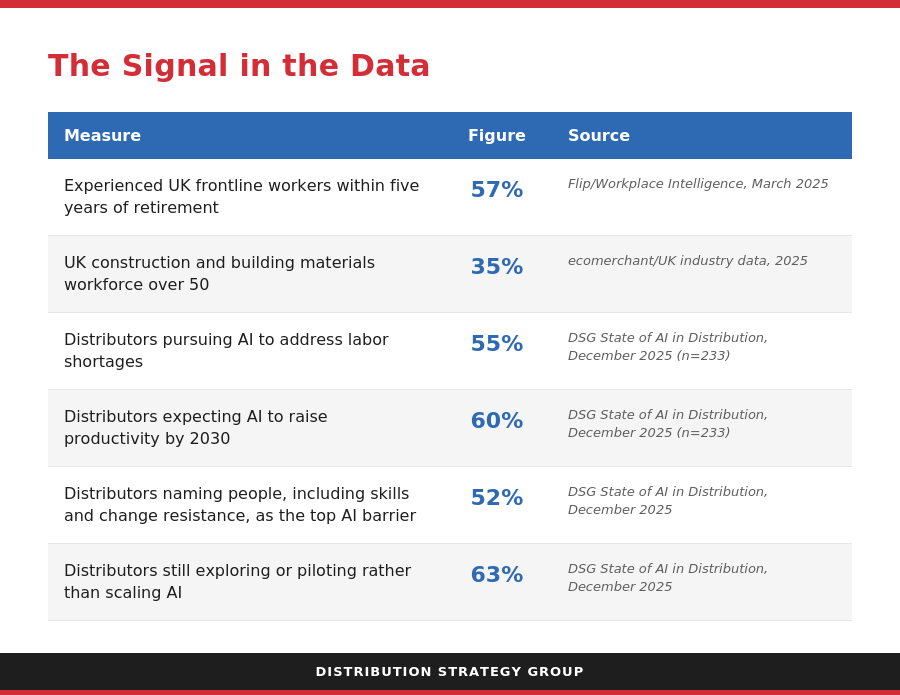
Look at the numbers in the trades that feed our sector. In UK construction and building materials, 35% of the workforce is over 50 and only 20% is under 30, with the average bricklayer now 52, according to 2025 data cited by ecomerchant. By 2035, more than a third of today’s workforce will reach retirement age, and roughly 750,000 workers are due to leave by 2036. Over the same period, the sector needs 251,500 additional workers by 2028 just to meet demand, against more than 140,000 unfilled vacancies as of December 2025.
The math doesn’t balance. The people aren’t there to hire.
This runs straight through the broader workforce supporting distributors, wholesalers and merchants. A March 2025 study by Flip and Workplace Intelligence, covering 500 UK frontline managers and employees in manufacturing and retail, found that 57% of the most experienced frontline workers are within five years of retirement. Sixty-eight percent of their managers fear vital expertise will be lost when those people go, and 78% aren’t confident their company is ready for the skills gap that follows.
The Organization for Economic Cooperation and Development made the broader demographic challenge clear in its 2025 Employment Outlook: Developed economies increasingly face labor scarcity as populations age and the ratio of older people to working-age populations rises.
Now set AI against that backdrop.
The Signal in the Data
Read that table from top to bottom and the strategy begins to write itself. The people who hold your operating knowledge are leaving. Distributors, wholesalers and merchants know they face a labor problem, and they increasingly see AI as a way to keep productivity rising with a workforce that may be smaller and less experienced.
What many haven’t done is connect those two problems directly.
Where Distributors Get Stuck
Three hard truths, and I’ve watched all three play out.
They buy tools before they capture knowledge. The instinct is to start with a chatbot or forecasting model. But your veteran employee’s know-how is part of the knowledge base AI needs, and if you don’t capture it while that person is still on the payroll, no model can magically recover it later.
In our December 2025 State of AI in Distribution survey, 52% of distributors named people as the biggest barrier to AI: a skills gap at 33% plus change resistance at 19%. Leadership buy-in ranked last. Read that carefully. The executives are increasingly convinced. The organization is struggling to execute.
They frame AI as replacement, and the workforce hears it. Almost no distributor in our data actually expects AI to become primarily a headcount-cutting exercise. Sixty percent expect it to increase the productivity of the people they retain. But if your branch team believes the model exists to replace them, they have little incentive to feed it what it needs.
That creates a dangerous contradiction. The veteran employees whose knowledge you most need to capture may be the least inclined to share it if the project is presented as a way to eliminate jobs.
They wait for clean data and a big platform. Nearly two-thirds of distributors, 63%, are still exploring or piloting rather than scaling AI. The leaders didn’t wait for perfect conditions.
As Grainger Chief Technology Officer Jonny LeRoy put it: “We’ve learned you’ve got to break down your problem into smaller chunks.”
That’s the difference. This is the kind of problem worth working through with people who have already done it, which is a large part of why we built the AI Forum for Distributors in the first place.
What This Means for Your Operation
Reframe the whole thing.
AI is part of your knowledge-retention strategy and your productivity strategy for a workforce that is going to change whether you prepare for it or not. For a UK builders’ merchant, an electrical wholesaler, a European industrial distributor or a multinational distribution group, the terminology may differ, but the operational challenge is the same.
The companies getting this right treat every approaching retirement as a body of knowledge at risk, and they act while the employee is still there to teach the organization.
They point AI first at high-volume, knowledge-dependent interactions: quoting, substitutions, order entry and technical lookups. Email order automation is already the most widely adopted customer-facing AI application in our survey, at 62%, precisely because it handles high volume and its return is relatively easy to see.
The appetite to invest is there. Sixty-five percent of distributors plan to increase AI spending over the next 24 months, with 88% naming productivity as their No. 1 reason for adopting it.
The leaders prove the point. Of more than 300 distributors we analyzed for The AI Execution Gap, only six reached the top AI maturity tier. One of them is Sonepar, the Paris-based global electrical distributor, which has committed more than €2.5 billion to logistics and €1 billion to its Spark digital platform.
The distance between those six and everyone else comes down to execution discipline, not simply budget or software.
What Changes Monday Morning
You can start this week. Five moves.
- Build a retirement heat map. List everyone within five years of leaving and identify what only they know. That becomes your knowledge-risk map and helps establish your AI priorities.
- Pick one knowledge-heavy, high-volume workflow. Product substitutions or quoting are strong first targets. Sit with your best person and capture how they do it, including the decisions, exceptions and judgment calls that never made it into the process manual.
- Start with retrieval, not transformation. Getting technical product information, previous orders and account history in front of a new employee in seconds is a modest, provable win. It also takes pressure off your veterans immediately.
- Put one senior owner on it. Don’t leave it to IT alone. Our data shows that technology-led efforts can stall when they aren’t tied closely enough to business outcomes. Name a senior person accountable for the result.
- Measure a commercial number, not activity. Quote turnaround time, first-contact resolution or return rate. If you can’t tie the work to a number a branch manager, managing director or commercial director cares about, it won’t hold.
Notice what’s not on that list: a moonshot, a platform overhaul or a two-year roadmap.
Individually, these moves are modest. Running together, they build the muscle to capture institutional knowledge faster than your people retire.
That’s the game.
Come Work It Through With Your Peers
None of this is theoretical, and none of it is easy to build from a report alone. It is much easier in a room full of leaders wrestling with the same demographic math you are.
That’s what the AI Forum for Distributors, UK and EU is built for. It takes place Oct. 15, 2026, at the National Conference Centre in Birmingham, England, bringing together managing directors and senior commercial, operations, technology and digital leaders from distributors, wholesalers and merchants across the UK, Ireland and continental Europe.
The focus is practical: what’s actually working in distribution, lessons directly from distribution leaders, and a vetted group of technology companies already working in the sector.
Whether your company calls itself a distributor, wholesaler, builders’ merchant, electrical wholesaler or merchanting group, the problem is the same. If some of your best people are within five years of walking out the door, the time to build the capability that preserves what they know is now, not after they’ve gone.
Register for the AI Forum for Distributors, UK and EU, and come build it with people facing the same challenge.
Share this article: