



Why This Matters to Distributors: Manufacturers added 16,000 jobs in August, including gains in machinery and fabricated metals, while wholesale trade employment was little changed. The numbers point to continued activity in key distributor end markets even as distributors remain cautious about adding workers.
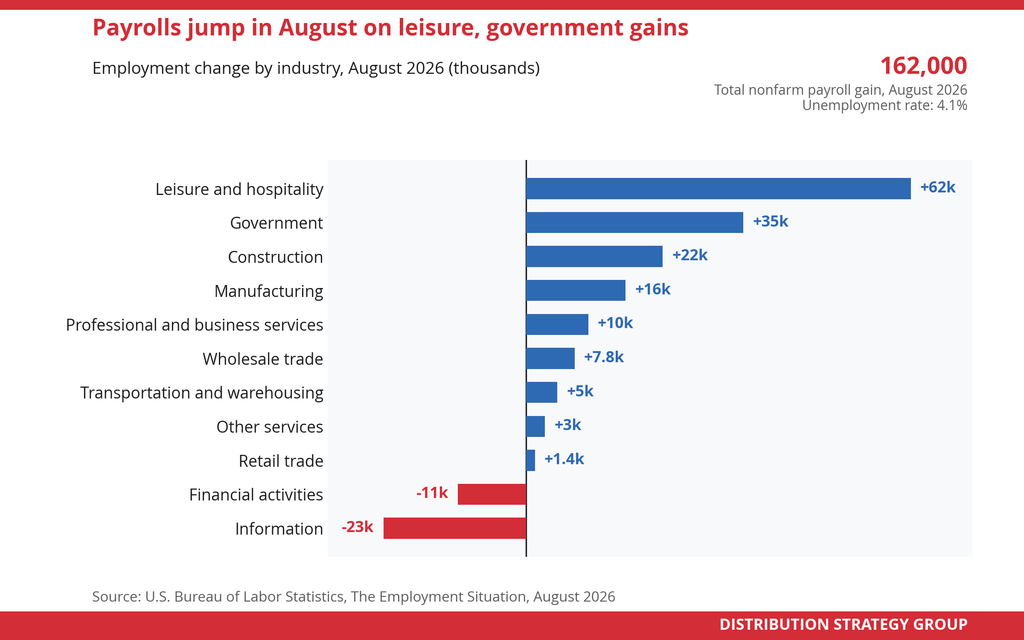
U.S. employers added 162,000 jobs in August, with manufacturers increasing payrolls and the unemployment rate holding steady as the labor market posted its strongest monthly gain in more than a year.
Manufacturing added 16,000 jobs during the month, continuing a recovery that has added 58,000 jobs since manufacturing employment reached a recent low in December 2025, the U.S. Bureau of Labor Statistics said Sept. 4.
The gains were concentrated in sectors closely tied to industrial distribution. Machinery manufacturers added 6,000 jobs, while fabricated metal products manufacturers added another 6,000.
The manufacturing gains came as overall nonfarm payroll employment increased by 162,000 in August. That compares with an average monthly gain of just 31,000 over the previous 12 months.
The unemployment rate remained at 4.1%, with about 7 million people unemployed.
The August numbers offer a stronger labor market signal for the industrial economy after several months of weak overall job growth. They also come as other economic indicators point to a more uneven manufacturing environment.
The Institute for Supply Management reported this week that U.S. manufacturing continued to expand in August, although growth in new orders, employment and order backlogs slowed from July. The latest employment data suggests manufacturers are still adding workers despite that moderation in demand.
Hiring among distributors was more subdued.
Wholesale trade employment changed little in August, according to BLS. Transportation and warehousing, another sector closely tied to distribution activity, also recorded minor change.
Construction employment increased by 22,000, which BLS characterized as little changed. Nonresidential specialty trade contractors added 8,000 jobs and continued an upward employment trend.
The combination presents a mixed picture for distributors. Manufacturers are adding workers to machinery and fabricated metals, while construction remains stable. Those sectors represent significant customers for industrial, electrical, construction and maintenance, repair, and operations distributors.
Distributors themselves, however, are not adding workers at the same pace.
Outside the industrial economy, job growth was concentrated in several sectors. Food services and drinking places added 59,000 jobs, compared with an average monthly increase of 12,000 during the previous 12 months. Local government education added 42,000 jobs, reversing a decline in July.
Health care employment continued to trend higher, adding 13,000 jobs in August.
Information was a significant weak spot, shedding 23,000 jobs. Employment declined by 8,000 in computing infrastructure providers, data processing, web hosting, and related services, 7,000 in publishing and 5,000 in broadcasting and content providers.
The labor force also expanded. The labor force participation rate increased to 61.6% from 61.4% in July, although it remained 0.5 percentage points below its January level.
The number of people working part time for economic reasons declined by 414,000 to 4.4 million. Those workers wanted full-time employment but were working fewer hours because their hours had been reduced or they could not find full-time jobs.
Wages continued to rise. Average hourly earnings for private sector workers increased 10 cents, or 0.3%, to $37.75 in August. Average hourly earnings were up 3.1% from a year earlier.
BLS also revised previous payroll estimates higher. July employment was revised to a gain of 21,000 from a previously reported decline of 23,000. Combined revisions to June and July added 55,000 jobs to previously reported payroll levels.
For distributors, the August report points to continued demand across important industrial end markets without a corresponding surge in distributor hiring. Manufacturing employment is moving higher, particularly in machinery and fabricated metals, while wholesale trade and transportation and warehousing payrolls remain flat.
That gap could indicate distributors are taking a cautious approach to labor even as activity among some of their customers improves. It also puts a greater emphasis on productivity as distributors look to handle demand without significantly expanding payrolls.
Do not miss any content from Distribution Strategy Group. Join our list.
Share this article:
