



Why This Matters to Distributors: Wholesale sales grew faster than inventories in August, leaving distributors with less stock relative to monthly revenue. Results varied widely, however, with strong annual sales gains in electrical products, metals and computer equipment contrasting with modest grocery growth and declining alcohol sales.
U.S. wholesale sales increased 15.6% in August from a year earlier, with electrical products, metals and computer equipment posting some of the largest gains. Inventories rose 6.4%, reducing the amount of stock wholesalers held relative to sales, according to the U.S. Census Bureau.
Sales totaled a seasonally adjusted $817.5 billion, up 1.8% from July, the bureau reported Oct. 8. Inventories reached $964.2 billion at month’s end, up 0.5% from July.
The industry’s inventory-to-sales ratio fell to 1.18 from 1.19 in July and 1.28 a year earlier. Wholesalers held $1.18 in inventory for each dollar of monthly sales, compared with $1.28 in August 2025.
Durable goods distributors accounted for most of the monthly sales increase. Sales rose 2.5% from July to $414.8 billion, up 20.3% from a year earlier, while inventories increased 0.8% during the month and 6.3% annually.
That difference pushed the durable goods inventory-to-sales ratio down to 1.45 from 1.64 a year earlier. The decline was evident across several major categories, including electrical products, metals, and machinery.
Electrical sales reached $115.9 billion, up 3.6% from July and 35.9% from August 2025. Inventories increased 23.3% annually, and the category’s inventory-to-sales ratio fell to 0.87 from 0.96.
Metals sales rose 32.6% from a year earlier to $23.7 billion, while computer equipment sales increased 29.6% to $36.9 billion. Machinery sales grew 13.7% to $61.3 billion.
Other durable goods categories recorded smaller annual gains. Hardware sales increased 7.7% to $23.5 billion, and automotive sales rose 5.2% to $55.3 billion. Lumber sales grew 3.4% to $18.4 billion but declined 0.3% from July.
Nondurable goods sales totaled $402.6 billion, up 1% from July and 11.1% from a year earlier. Inventories were unchanged during the month at $362 billion and rose 6.6% annually.
Petroleum sales increased 32.3% from August 2025 to $99.8 billion, while chemical sales rose 17.8% to $15.6 billion. Drug sales increased 9.1% to $112 billion.
Grocery sales grew just 0.9% from a year earlier to $81.8 billion, trailing a 1.9% increase in inventories. Alcohol sales declined 2.6% to $15.1 billion, despite rising 1.4% from July.
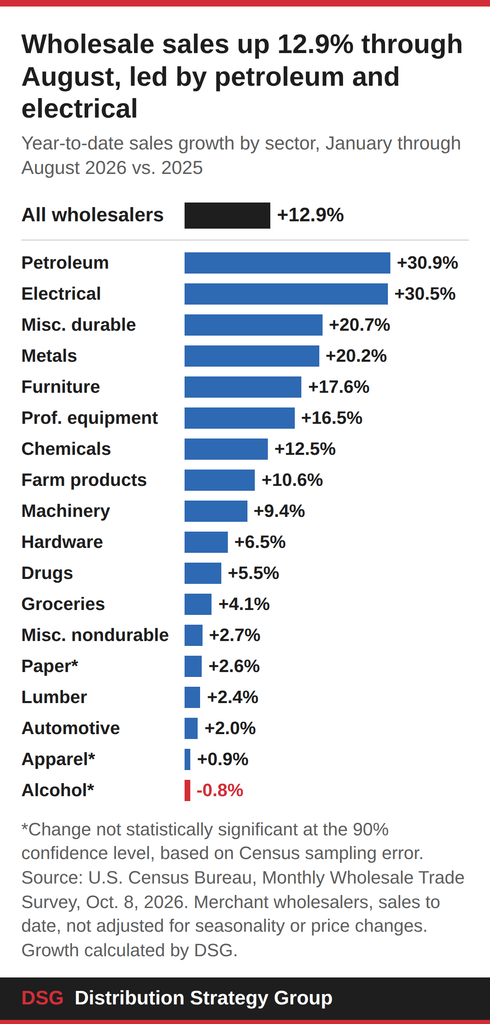
For the first eight months of 2026, wholesale sales totaled $6.26 trillion, up 12.9% from the same period in 2025, according to the report’s unadjusted figures. Durable goods sales increased 15.6% to $3.1 trillion, while nondurable goods sales rose 10.4% to $3.16 trillion.
The bureau revised August’s monthly inventory increase to 0.5% from its advance estimate of 0.7%. It also raised July’s monthly sales growth estimate to 1% from 0.8%.
The monthly figures are adjusted for seasonal and trading-day differences but not price changes. The sales gains therefore reflect changes in dollar value and do not establish how much more merchandise wholesalers sold.
The survey covers merchant wholesalers that sell goods on their own account, including industrial distributors, importers, and exporters. It excludes manufacturers’ sales branches and offices, along with wholesale agents and brokers.
Do not miss any content from Distribution Strategy Group. Join our list.
Share this article:
