



Why This Matters to Distributors: U.S. manufacturing continued to expand in September, with new orders and backlogs strengthening and customer inventories remaining low. But manufacturers are confronting sharply higher material costs, product shortages, and slower supplier deliveries, creating a mixed environment for distributors managing demand, inventory, and pricing.
U.S. manufacturing remained firmly in expansion territory in September as new orders and backlogs accelerated, but a sharp increase in raw material prices added new pressure to manufacturers and their supply chains.
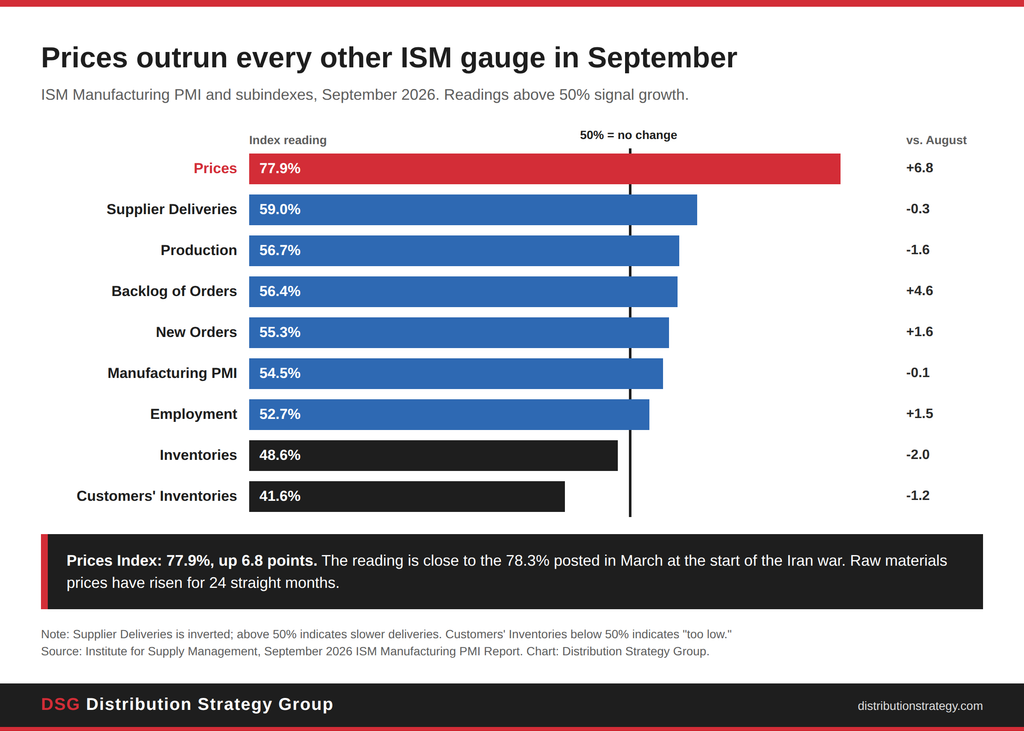
The Institute for Supply Management’s Manufacturing Purchasing Managers’ Index registered 54.5% in September, unchanged from 54.6% in August. Manufacturing has now expanded for nine consecutive months following a 10-month period of contraction. A reading above 50% indicates expansion.
Beneath the headline number, several measures of demand strengthened. The New Orders Index rose 1.6 percentage points to 55.3%, while the Backlog of Orders Index climbed 4.6 points to 56.4%. Employment increased by 1.5 points to 52.7%.
Production remained strong at 56.7%, although it declined from 58.3% in August.
The biggest change came in prices.
ISM’s Prices Index jumped 6.8 percentage points to 77.9% from 71.1% in August, with raw material prices increasing for a 24th consecutive month. 59% of manufacturers reported paying higher prices, up from 46.2% in August.
ISM attributed the increase primarily to higher steel and aluminum prices, tariffs on imported goods and rising petroleum-based product costs related to the conflict in the Middle East. All six of the largest manufacturing industries reported higher raw material prices.
The increases were widespread. Manufacturers reported higher prices for aluminum, copper, electrical and electronic components, freight, fuel, packaging materials, resins, semiconductors, steel, and zinc. ISM listed no commodities as declining in price.
Demand indicators, meanwhile, remained broadly positive. New orders expanded for the ninth consecutive month, with five of the six largest manufacturing industries reporting increases. Ten of the 18 industries tracked by ISM reported new-order growth, including electrical equipment, appliances, and components; computer and electronic products; plastics and rubber products; primary metals; fabricated metal products; transportation equipment; and machinery.
Order backlogs also strengthened. The Backlog of Orders Index rose to 56.4% from 51.8% in August. Computer and electronic products, transportation equipment, food, beverage and tobacco products, and machinery were among the largest industries reporting higher backlogs.
Customer inventories remained low, another potential indicator of future production and replenishment demand. ISM’s Customers’ Inventories Index declined to 41.6% from 42.8% in August.
Eleven industries reported customer inventories as too low, including primary metals, computer and electronic products, electrical equipment, fabricated metal products, plastics and rubber products, machinery, and wood products. ISM said customer inventories in “too low” territory are considered positive for future production.
The Supplier Deliveries Index registered 59%, compared with 59.3% in August. A reading above 50% indicates slower deliveries. Supplier deliveries have now slowed for 10 consecutive months.
Twelve industries reported slower supplier deliveries, including primary metals, computer and electronic products, fabricated metal products, machinery, electrical equipment, plastics and rubber products and transportation equipment.
Manufacturers also reported shortages of electrical and electronic components, memory products, printed circuit boards, and several categories of steel.
Some manufacturers described a market in which demand is outpacing their ability to secure materials and increase production.
One fabricated metal products manufacturer told ISM that orders remained above forecast through the end of the year, while worker shortages and worsening steel availability were limiting production. A machinery manufacturer cited artificial intelligence and data center demand as factors stretching domestic steel capacity and pushing up raw material and finished-goods costs.
Overall, 12 of the 18 manufacturing industries tracked by ISM reported growth in September. Electrical equipment, appliances, and components led the list, followed by nonmetallic mineral products, primary metals, plastics and rubber products, computer and electronic products and fabricated metal products.
Transportation equipment, machinery, and chemical products also expanded. Printing and related support activities and textile mills were the only industries reporting contraction.
Manufacturers’ own inventories moved lower despite the stronger demand indicators. The Inventories Index dropped 2 percentage points to 48.6%, moving back into contraction territory after registering 50.6% in August.
Purchasing lead times also remained elevated. The average commitment lead time for maintenance, repair and operating supplies increased one day to 49 days. Capital expenditure lead times increased five days to 176 days, while production material lead times held at 84 days.
Despite the expansion in manufacturing activity, purchasing and supply executives remained cautious about business conditions.
ISM said 60% of respondent comments in September were negative and 40% were positive. Among the negative comments, 46% mentioned pricing volatility, 34% cited tariffs, 30% referenced the Iran war and 21% mentioned increasing lead times. Respondents frequently cited more than one factor.
The September results extend a manufacturing recovery that began early this year. The PMI has remained above 50% every month since January, after ending 2025 at 47.9%.
For distributors, the underlying indicators point to continued industrial demand but a more difficult supply and pricing environment. Rising new orders, growing backlogs and low customer inventories could support additional purchasing and replenishment, while higher material costs, shortages and longer supplier lead times increase pressure on product availability, sourcing, and pricing.
Do not miss any content from Distribution Strategy Group. Join our list.
Share this article:
