



Why This Matters to Distributors: Distribution merger and acquisition activity picked up in the second quarter, with U.S. deal volume increasing 7.7% from a year earlier. But the bigger shift may be in what buyers are looking for. Technical capabilities, exposure to data center and infrastructure spending, and growth driven by sales volume rather than price increases are becoming more important in determining which distributors attract buyers and higher valuations.
U.S. distribution merger and acquisition activity accelerated in the second quarter as strategic and financial buyers stepped up acquisitions and placed greater emphasis on distributors with technical capabilities and exposure to faster-growing industrial markets.
U.S. deal volume reached 70 transactions during the quarter, up 7.7% from the second quarter of 2025 and above 2025 quarterly averages, according to PMCF Investment Banking’s Distribution M&A Pulse. The investment bank said activity remains below previous cycle highs but cited improving buyer confidence and available capital as factors supporting continued consolidation. PMCF-Pulse-Distribution-2026-Q2
Strategic buyers accounted for 50 transactions, up from 41 a year earlier. Financial buyers completed 10 deals, twice the five recorded during the same period last year. Buyer type was undisclosed in another 10 transactions. PMCF-Pulse-Distribution-2026-Q2
Industrial, maintenance, repair and operations and safety distributors accounted for 50% of second-quarter transactions, making it the most active segment tracked by PMCF. Building products represented 23.4% of deals, followed by food and beverage at 9.4%, electrical products at 7%, chemicals and gases at 5.5%, and other distribution businesses at 4.7%. PMCF-Pulse-Distribution-2026-Q2
The U.S. and Canada accounted for 58.6% of global distribution transactions tracked by PMCF during the quarter, while Europe represented 38.3%. PMCF-Pulse-Distribution-2026-Q2. The report points to a shift in the characteristics of buyers value in distribution companies.
Technical expertise and services surrounding a product offering are becoming more important differentiators, according to PMCF. The firm identified automation integration, engineered systems, field service, vendor-managed inventory and lifecycle support as capabilities increasingly influencing customer value and acquisition interest. PMCF-Pulse-Distribution-2026-Q2
Distributors with significant engineering and service capabilities can also be valued more like industrial service providers than traditional distributors, PMCF said. The report cited Applied Industrial Technologies as one company positioned around increased automation adoption and demand for technical support inside customer facilities. PMCF-Pulse-Distribution-2026-Q2
Acquirers are also paying closer attention to how distributors generate growth.
After several years of inflation and tariff-related price increases, PMCF said buyers increasingly want companies to separate revenue growth generated by higher prices from growth produced by greater sales volume and market-share gains. Buyers view volume growth and share gains as stronger indicators of underlying demand and competitive position. PMCF-Pulse-Distribution-2026-Q2
That distinction could become more important in acquisition due diligence as buyers determine how much of a distributor’s recent revenue growth is sustainable rather than the result of price increases.
Data center investment is also influencing distribution growth and acquisition opportunities well beyond the electrical sector.
Investment in data centers, power-grid infrastructure and domestic manufacturing is generating demand for cooling and filtration equipment, fluid power components, fasteners, safety products, and maintenance services, according to PMCF. Distributors can participate in the initial construction of those facilities and in recurring spending required to operate and maintain them. PMCF-Pulse-Distribution-2026-Q2
PMCF cited Wesco International and W.W. Grainger as examples of that broader exposure. The report said Wesco generates more than 20% of its revenue from data center-related activity, while Grainger has reported strong project-driven demand from contractors supporting new facility construction despite having limited direct exposure to the sector. PMCF-Pulse-Distribution-2026-Q2
The stronger deal market comes as valuations of publicly traded distributors have increased.
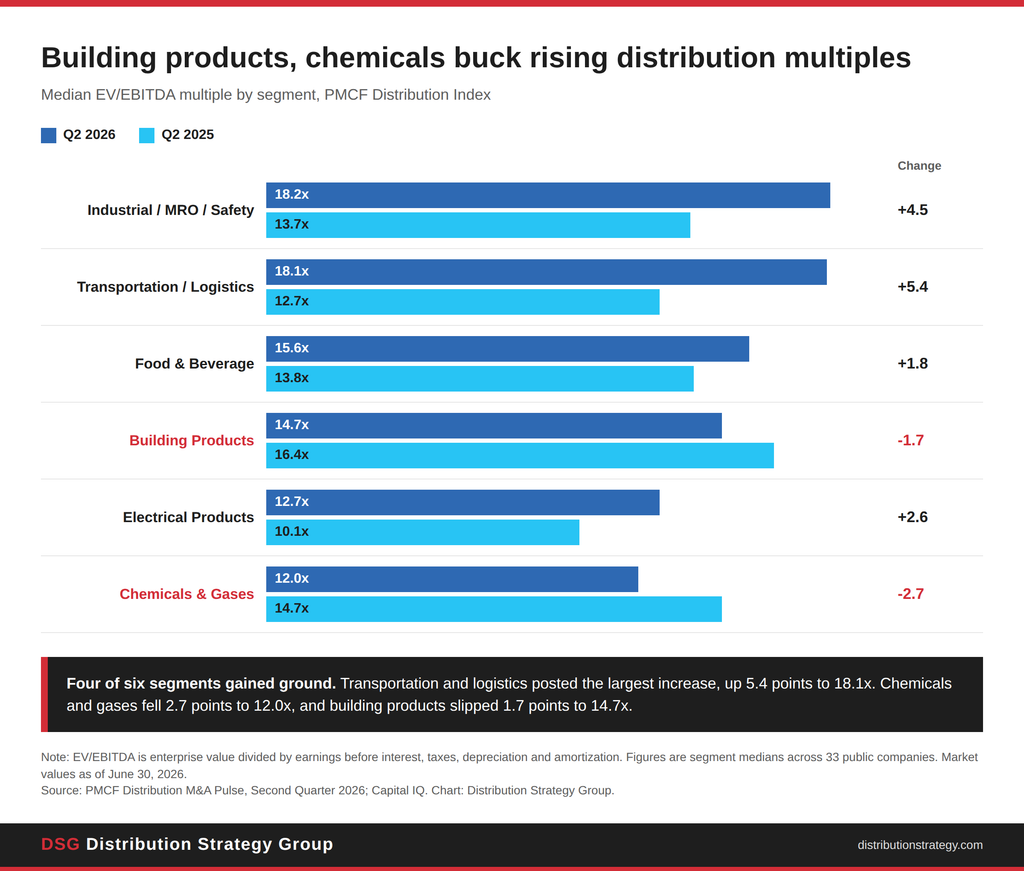
The average valuation multiple across PMCF’s Distribution Index rose to 16.2 times operating earnings in the second quarter from 13 times a year earlier. The median increased to 15 times from 12.9 times. PMCF-Pulse-Distribution-2026-Q2
PMCF’s Distribution Index also generated a 29.1% total return during the 12 months ended in June. Transportation and logistics and electrical products led performance, which PMCF attributed in part to improving freight conditions, data center investment, grid modernization, and electrification. PMCF-Pulse-Distribution-2026-Q2
The index includes publicly traded companies across industrial and MRO, electrical products, building products, chemicals and gases, transportation and logistics, and food and beverage distribution. Companies tracked include W.W. Grainger, Fastenal, Applied Industrial Technologies, Core & Main, MSC Industrial Supply, Wesco, Rexel, Ferguson, Watsco, Sysco and US Foods. PMCF-Pulse-Distribution-2026-Q2
PMCF said elevated public-market valuations and approximately $1.3 trillion in undeployed global private equity capital are helping support the acquisition environment. Industry fragmentation also continues to provide opportunities for consolidation. PMCF-Pulse-Distribution-2026-Q2
Among the second-quarter transactions highlighted in the report were Rexel’s acquisition of Revere Electric Supply, Beijer Ref’s acquisition of AM Distributors and Veritiv’s acquisitions of Quick Pak and Stickel Packaging Supply. PMCF-Pulse-Distribution-2026-Q2
The numbers point to a distribution M&A market that is becoming more active, but also more selective. Scale and product breadth remain important, but PMCF’s analysis indicates buyers are increasingly examining what sits behind a distributor’s growth: whether it is winning additional volume, adding technical and service capabilities, and participating in markets where investment is producing sustained demand.
Do not miss any content from Distribution Strategy Group. Join our list.
Share this article:
