



Why This Matters to Distributors: Ferguson’s third-quarter results highlight the widening gap between commercial and residential construction demand. Nonresidential sales increased 15%, compared with 6% residential growth, as the company expanded its industrial, HVAC, and water infrastructure businesses. Eleven acquisitions representing approximately $1.5 billion in annual sales are also strengthening Ferguson’s technical capabilities and geographic reach, increasing competition for distributors serving specialized markets.
Ferguson’s 15% increase in nonresidential sales and its acquisition of 11 businesses this year underscore how commercial construction, industrial projects and water infrastructure are creating growth opportunities for distributors despite continued weakness in residential construction.
The Newport News, Virginia-based distributor reported third-quarter sales of $9.03 billion, up 9.5% from $8.25 billion a year earlier, and raised its full-year sales forecast to approximately 7% growth. Acquisitions, including the purchase of industrial distributor FloWorks, contributed to the increase as Ferguson expanded its presence in industrial flow control, heating and cooling equipment, and water treatment.
The results also illustrate the uneven conditions facing wholesale distribution. Ferguson’s commercial and industrial businesses are growing faster than their residential operations, while acquisitions are expanding the company’s product offerings, technical expertise, and geographic coverage.
Sales from existing operations increased 7% during the quarter, while acquisitions added 2.7 percentage points to growth. The sale of businesses in Canada reduced growth by 0.2 percentage points.
Net income declined 6.3% to $598 million from $638 million a year earlier, despite higher sales. Operating profit increased 4.9% to $885 million from $844 million.
For the first nine months of 2026, sales increased 6% to $25.25 billion from $23.82 billion. Net income rose 3.8% to $1.68 billion from $1.62 billion.
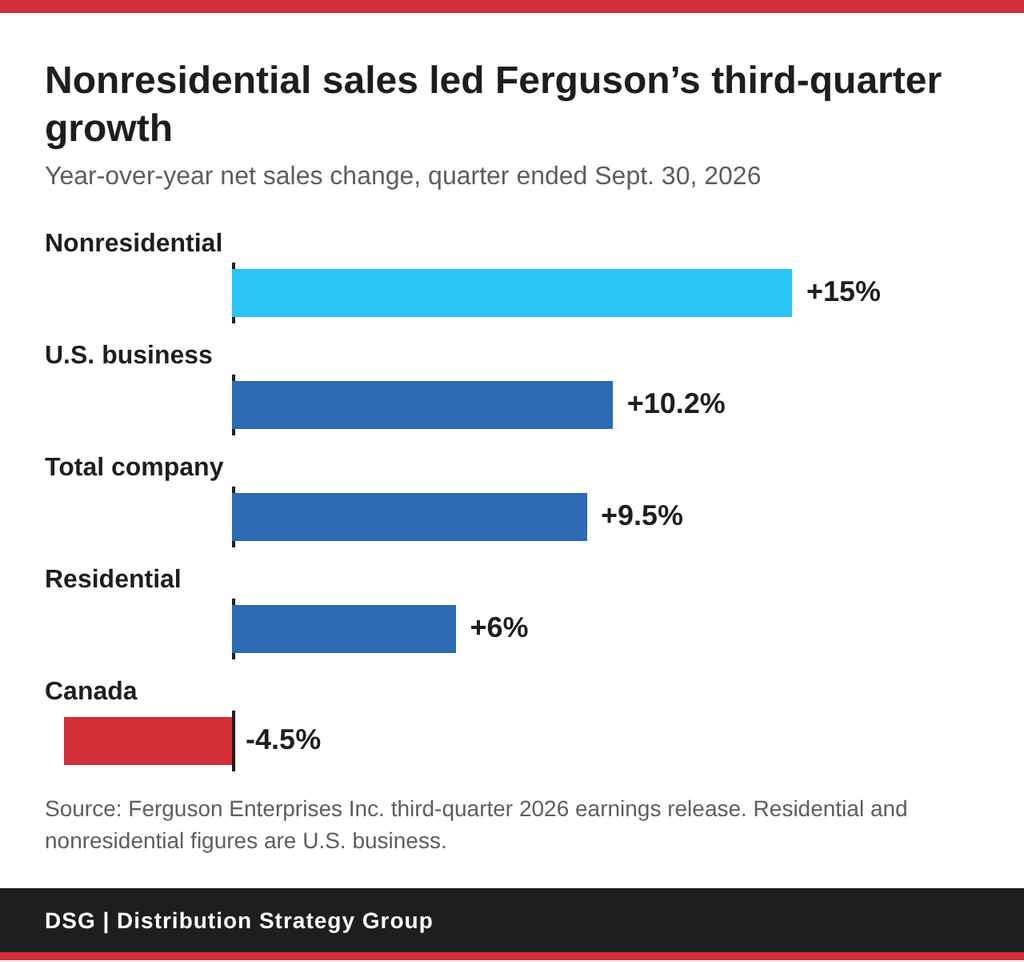
“Our expert associates delivered strong third quarter results, with non-residential sales up 15% and residential growth of 6%,” CEO Kevin Murphy said. “We continue to invest organically and through acquisitions to expand our value-added solutions and geographic footprint.”
Ferguson’s U.S. business generated $8.62 billion in third-quarter sales, an increase of 10.2% from $7.82 billion a year earlier. Sales from existing U.S. operations increased 7.4%, while acquisitions contributed another 2.8 percentage points.
Nonresidential sales increased 15%, supported by commercial construction, industrial customers and large projects requiring specialized products and services.
Ferguson said orders awaiting fulfillment increased and bidding activity remained strong for large projects, even as conditions varied across its construction markets.
“We grew non-residential sales by 15% this quarter as our scale, expertise, multi-customer group approach and value-added solutions drove strong share gains in a mixed market,” the company said in its earnings announcement.
The growth is significant for distributors supplying commercial contractors, industrial facilities, and infrastructure projects. Those customers often require specialized inventories, technical assistance, and coordinated deliveries, providing opportunities for distributors to compete on service and expertise rather than price alone.
Residential markets remained more difficult. Ferguson reported 6% residential sales growth despite weak new home construction and continued softness in repair, maintenance, and improvement spending.
Residential customers account for half of Ferguson’s U.S. sales. The difference between residential and nonresidential growth reflects the challenges facing distributors with greater exposure to homebuilding and remodeling.
The company’s Canadian business also faced weaker conditions. Sales declined 4.5% to $405 million, reflecting business divestitures, currency changes and continued residential market weakness.
Ferguson continued expanding through acquisitions, completing three transactions during the third quarter and another after Sept. 30.
The four deals brought their total to 11 acquisitions in 2026, representing approximately $1.5 billion in combined annual sales.
The largest recent addition was FloWorks, an industrial distributor specializing in valves, flow control equipment, and related services. Ferguson completed the acquisition Aug. 31.
FloWorks operates more than 60 locations and 25 service centers across the United States and Canada. The acquisition expands Ferguson’s industrial distribution business and strengthens its ability to serve customers requiring specialized valves, flow control equipment, and technical services.
Ferguson also acquired Brax Co., which operates three locations in Southern California and specializes in pumps and pump repair.
In heating, ventilation and air conditioning (HVAC), Ferguson acquired Rogers Supply Co., adding 12 locations across Illinois and Indiana. The acquisition expands its ability to supply contractors purchasing both plumbing and HVAC products.
Following the quarter, Ferguson acquired Canyon Systems Inc., establishing a water and wastewater treatment business serving six Western states.
The transactions extend Ferguson’s presence in markets where technical knowledge, equipment maintenance and specialized services are important to customers.
They also illustrate how large distributors are using acquisitions to enter specialized markets, expand existing operations, and establish relationships with new customer groups.
For regional and independent distributors, the expansion could mean increased competition from a national company with a broader product assortment, additional technical capabilities, and a larger distribution network.
Ferguson’s acquisitions are also changing the range of services the company can provide.
FloWorks adds industrial valve and flow control expertise, while Brax expands pump repair capabilities. Canyon Systems gives Ferguson a stronger presence in water and wastewater treatment, and Rogers Supply extends its HVAC distribution network.
The additions broaden Ferguson’s business beyond supplying products for new construction.
Industrial facilities, commercial buildings, and water systems require equipment replacement, maintenance, and repair throughout their operating lives. Those activities can generate demand even when new construction slows, although they remain subject to customer spending decisions.
The acquisitions also give Ferguson access to more specialized customer relationships.
Industrial flow control, commercial HVAC, and water treatment often require technical assistance with equipment selection, installation, and maintenance. Distributors with those capabilities can provide services beyond conventional product fulfillment.
Ferguson’s expansion reflects a broader competitive issue for wholesale distribution: Technical expertise and specialized services can help distributors strengthen customer relationships and compete in markets where product availability alone may not be enough.
Ferguson increased its full-year sales forecast to approximately 7% growth, compared with its previous expectation for mid-single-digit growth.
The revised forecast reflects stronger year-to-date results and the addition of FloWorks, which closed Aug. 31.
The company also expects operating profit, excluding certain expenses, to represent 9.6% to 9.8% of sales, compared with its previous forecast of 9.5% to 9.8%.
Ferguson plans to spend approximately $425 million on buildings, equipment, and technology during 2026, compared with its earlier estimate of $375 million to $425 million.
During the third quarter, the company spent $108 million on those investments and approximately $1.7 billion on acquisitions, including FloWorks.
“While our markets remain mixed, our year-to-date performance and the addition of FloWorks enable us to raise our full year guidance,” Murphy said.
He identified water infrastructure, large construction projects, heating and cooling needs, and aging housing as long-term sources of demand.
Ferguson’s higher sales did not translate into higher quarterly net income. The company reported a 6.3% decline in net income, partly reflecting differences in tax benefits between the two periods. The share of sales remaining after product costs also declined to 30.9% from 31.3% a year earlier.
Those results illustrate the pressure distributors can face from supplier pricing, operating expenses, and acquisition-related costs, even as sales increase.
Ferguson’s third-quarter results point to a construction and industrial distribution market in which growth opportunities vary by customer and product category.
Commercial construction, industrial projects, and water infrastructure provide stronger demand than residential building activity. Ferguson’s 15% non-residential sales increase, compared with 6% residential growth, illustrates that difference.
The company’s acquisitions also show how large distributors are pursuing growth by adding specialized products, technical services, and established customer relationships.
FloWorks, Brax and Canyon Systems expand Ferguson’s ability to serve industrial and infrastructure customers, while Rogers Supply strengthens its HVAC business.
The strategy could increase competitive pressure on independent distributors operating in those markets, particularly as Ferguson combines acquired businesses with its existing distribution network.
At the same time, the results demonstrate the value of serving multiple customer groups. Distributors with exposure to commercial construction, industrial maintenance, water infrastructure, and equipment replacement have more potential sources of sales than companies concentrated in a single construction market.
Ferguson’s expansion also suggests that technical expertise and service capabilities will remain important competitive factors as larger distributors broaden their operations.
The company’s stronger sales and reduced quarterly net income provide a reminder that growth alone does not guarantee higher profits. Managing product costs, operating expenses and acquisitions remains important as distributors expand.
For the industry, Ferguson’s results reinforce two developments: Commercial and infrastructure customers are providing important growth opportunities, and large distributors are using acquisitions to compete for a greater share of those markets.
Do not miss any content from Distribution Strategy Group. Join our list.
Share this article:
