


Why This Matters to Distributors: Watsco is connecting technical support, purchasing and contractor sales tools to strengthen customer relationships. Its strategy raises the competitive stakes for distributors whose online services focus primarily on orders. Its results also underscore the need to measure whether technology investments improve profitability as well as sales.
Watsco is expanding artificial intelligence tools for employees and contractors as digital sales grow faster than overall revenue, broadening its role in how customers research products, purchase equipment and sell to homeowners.
The heating, ventilation, air conditioning, and refrigeration distributor said that its internal AI platform, Ask.Watsco, supports more than 2,700 employees. A separate customer-facing model, AL.watsco, provides product information and recommendations. Both draw on customer, product and vendor data developed over 15 years.
Watsco has invested approximately $280 million in digital platforms over five years. Ecommerce sales increased 10% in the third quarter and 12% through September. Online sales totaled $2.75 billion over the preceding 12 months, accounting for 37% of revenue.
The strategy positions Watsco to participate in more of the work surrounding an equipment purchase. Connecting technical assistance with ordering could help contractors identify products and resolve questions before completing a transaction, giving them additional reasons to use the distributor’s systems.
For competing distributors, the implication is that digital service increasingly encompasses the information customers need to make purchasing decisions. Product availability and online ordering remain essential, but technical assistance can influence where an order goes.
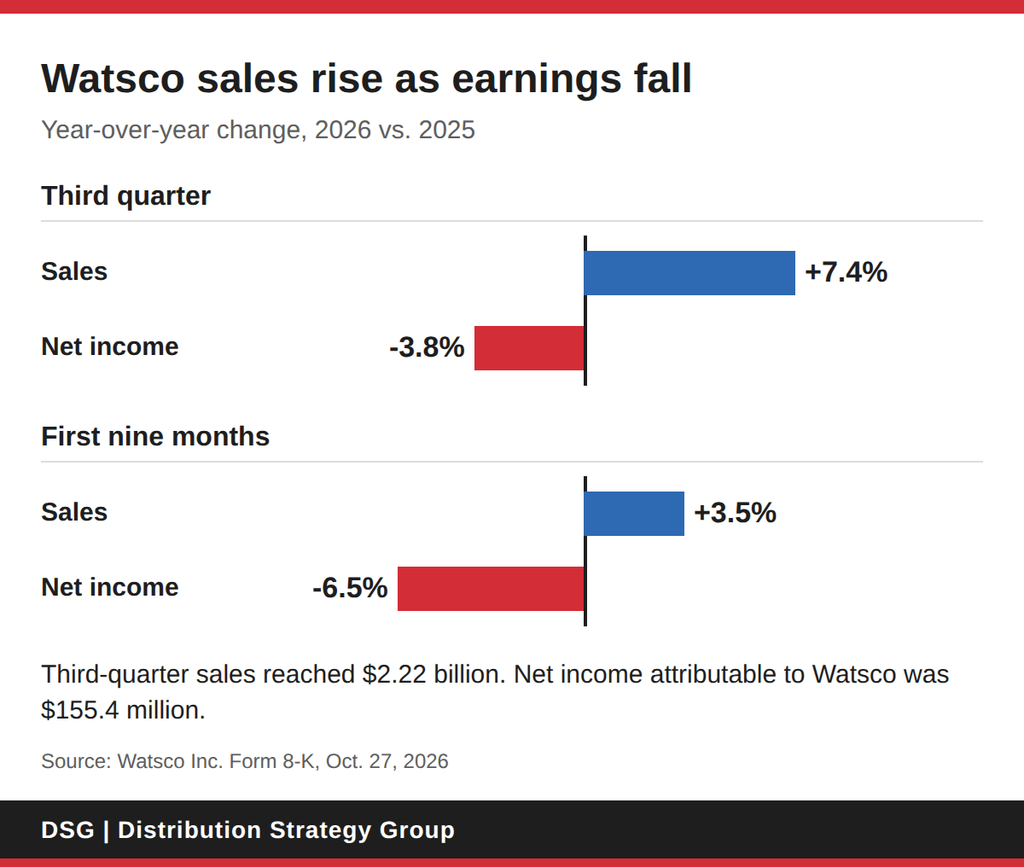
Watsco’s financial results show that expanding digital activity has not prevented earnings from declining.
Third-quarter sales increased 7.4% to $2.22 billion, from $2.07 billion a year earlier. Net income attributable to Watsco fell 3.8% to $155.4 million, from $161.6 million.
For the first nine months, sales rose 3.5% to $5.86 billion, from $5.66 billion. Net income attributable to Watsco declined 6.5% to $397.8 million, from $425.2 million.
Those results highlight an important distinction when evaluating technology investments. Faster online growth shows increased purchasing through a channel, but it does not establish how much additional business the technology generated or whether those transactions became more profitable.
Watsco’s earlier disclosures illustrate the work behind its digital services. In July, the company said its mobile applications and ecommerce platform combined product sourcing, technical assistance, inventory availability, and pricing.
It also reported adding more than 10,000 product records associated with the transition to equipment using newer refrigerants. Those records included specifications, warranty information, and technical documentation.
That investment in product information is relevant to distributors evaluating AI. An assistant’s usefulness depends partly on whether it can retrieve complete, current information about the products a company sells. In technical categories, missing specifications or outdated documentation can undermine the service an automated tool is intended to provide.
The financial context also matters. In its July update, Watsco said larger manufacturer price increases in 2025 had temporarily benefited gross profit margins. More conventional pricing in 2026 reduced that benefit, contributing to pressure on profitability.
Technology performance therefore needs to be assessed separately from changes in supplier pricing and other market conditions. Rising online sales alone cannot establish whether an AI investment is producing an adequate return.
Watsco’s digital strategy also extends into contractors’ sales activities. Its OnCallAir platform allows contractors to prepare and present proposals to homeowners.
In July, Watsco reported that contractors generated $1 billion in sales through OnCallAir during the first half, up 14% from a year earlier. That figure measures contractor sales through the platform and is separate from Watsco’s distribution revenue.
Helping contractors prepare proposals gives Watsco a role earlier in the sales process before an equipment order is placed. For distributors, that approach offers a way to strengthen customer relationships by supporting the work that generates demand for their products.
The operating test is whether those services help employees resolve questions faster, reduce contractors’ administrative work and generate additional business at an acceptable cost. Watsco’s results demonstrate growing digital activity, while the decline in earnings reinforces the importance of measuring sales growth and profitability separately.
Distributors looking to evaluate AI tools and their applications can attend Distribution Strategy Group’s Applied AI for Distributors, June 22-24, 2027, at the Renaissance Schaumburg Convention Center Hotel outside Chicago. The conference will bring together distribution leaders, technology providers and industry practitioners to discuss implementation and measurable results. Register here
Do not miss any content from Distribution Strategy Group. Join our list.
Share this article:
