
Editor’s note: the authors of this article are Brian Hopkins, Chief Operations Officer, Distribution Strategy Group, and Brooks Hamilton, Principal, AI Strategy Consulting.
On a recent episode of AI News and Gurus, we had a conversation about the evolution of work in distribution. Brooks made a point that stuck with me: AI is giving us a preview of what’s going to happen across corporate roles by watching what’s already happening in software development. Cycle times that used to take hours now take minutes. Tasks that required by teams now require one person with the right tools. And the way we think about measuring output, managing people, and creating value is fundamentally shifting.
That conversation got us thinking about a phrase we hear constantly in distribution: “higher-value work.”
AI will manage the routine tasks. AI will automate the repetitive stuff. And your people? They’ll move to higher-value work.
It sounds good. It feels right. But if you ask most people what that higher-value work looks like, what those roles are, what those people do every day, what skills they need, you get vague answers. More strategic. More analytical. More client driven.
That’s not a job description. That’s hope.
The Productivity Equation Has Changed
Throughout my career in distribution, we’ve always looked for ways to be more productive. New systems, better processes, automation where it made sense. And when we found those efficiencies, we knew what came next: we’d reassign people to other work that needed doing.
Automate order entry? Great—now those people can spend more time on customer outreach. Streamline the warehouse pick process? Perfect—redeploy that labor to receiving or quality checks. The math was straightforward. Productivity gains freed up capacity, and there was always a backlog of work waiting to absorb it.
When I was running service center operations at Grainger, we used productivity gains from new technology to “self-fund” new initiatives. Free up capacity through efficiency, then redeploy that capacity to grow revenue or add a new service element. It was a proven formula: invest in productivity, harvest the gains, reinvest in growth. The cycle worked because there was always somewhere valuable to put the people whose tasks had been automated.
AI changes that equation in a fundamental way.
The work we would have reassigned people to in the past. Some of it will simply go away. AI doesn’t just automate the task in front of you, it automates tasks across the board, including many of the “next level” tasks we used to move people into. Customer outreach? AI can help with that. Quality analysis? AI can help with that too. The reassignment destinations are shrinking.
This is why defining higher-value work isn’t just a nice-to-have conversation for distribution leaders. It’s an urgent one. If you can’t clearly articulate what roles your people should evolve into—with specific responsibilities, specific skills, and specific value creation—you’re going to find yourself with productivity gains and nowhere meaningful to deploy them.
We want to make this concrete. Because the evolution of roles in distribution isn’t hypothetical anymore. It’s happening. And one of the clearest examples is the emergence of what we’d call the Skill Developer—a role that didn’t exist five years ago but will be essential in the next five.
The Old Model: Experts in Silos
In traditional distribution organizations, knowledge lives in silos. Your pricing experts know pricing. Your operations people know operations. Your sales team knows customers. And if you wanted to solve a problem that crossed those boundaries—say, faster and more accurate pricing that responds to market conditions—you needed a project.
You’d assemble a team. You’d have meetings. You’d document requirements. You’d send those requirements to IT. IT would scope it, prioritize it against 47 other requests, and maybe—maybe—you’d get something in 18 months that sort of did what you needed.
By then, the problem had changed. Or you’d found a workaround. Or you’d just accepted that this was how things were.
That model is breaking down. Not because people failed—but because technology has shifted what’s possible.
Enter the Skill Developer
The Skill Developer sits at the intersection of business knowledge and AI capability. They’re not traditional IT. They’re not traditional business analysts. They’re something new, someone who understands the business problem deeply enough to define it precisely and understands AI tools well enough to build solutions that work. They don’t need to write a requirements document and wait six months for someone else to build it—they can prototype a solution before most organizations finish scheduling the kickoff meeting. That speed comes from eliminating the translation layers that slow traditional projects do. Think of them as bilingual—fluent in the language of the business user who’s frustrated with a broken process, and equally fluent in the language of the AI tools that can fix it. That fluency in both directions is what makes the role work. Without business knowledge, they’d build solutions that miss the point. Without the AI capability, they’d just be another person with an innovative idea and no way to execute it.
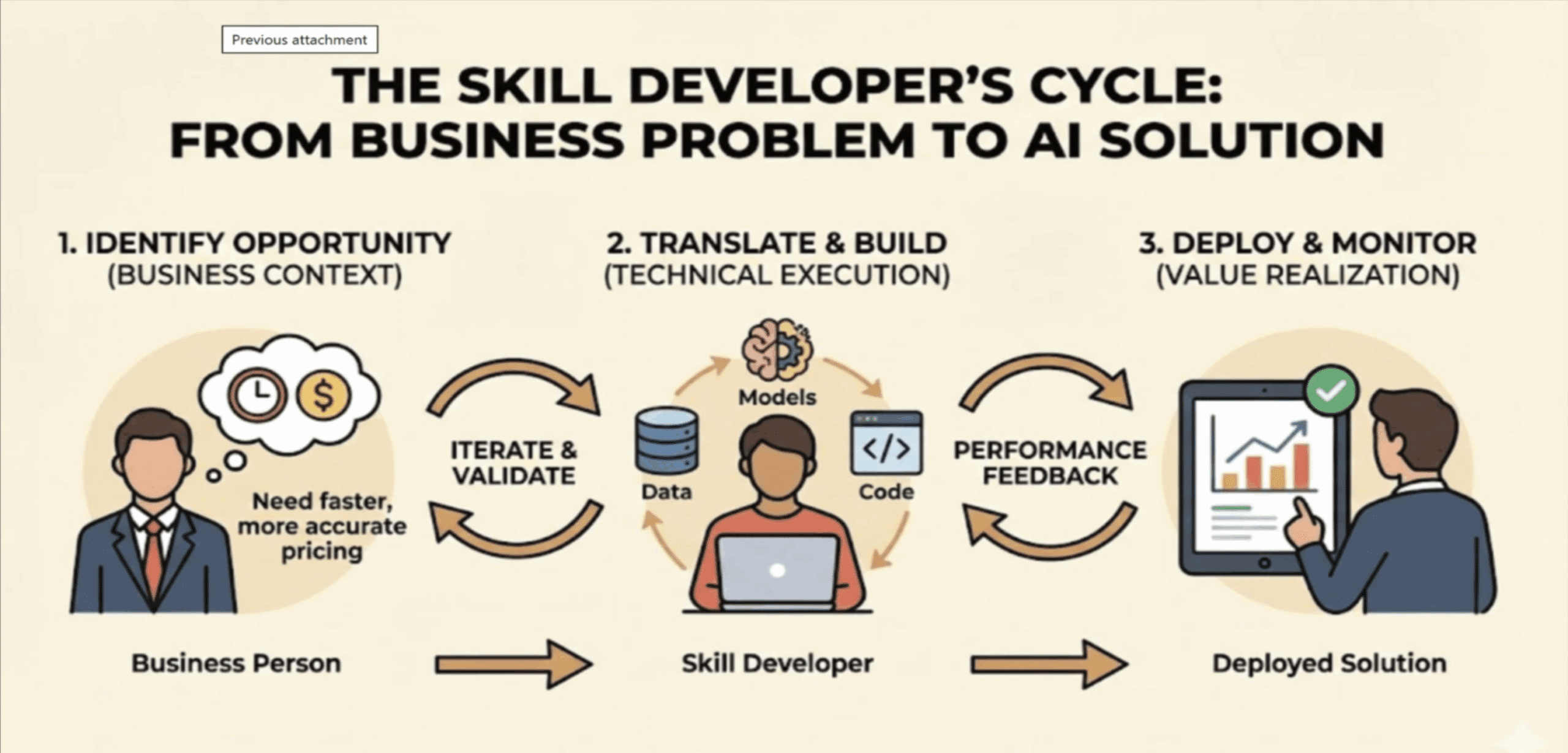
The cycle works like this:
Stage 1: Identify Opportunity. This is where business context matters most. Someone in the organization recognizes a problem worth solving—”we need faster, more accurate pricing” or “we’re losing customers and don’t know why until it’s too late” or “our warehouse team spends three hours a day on tasks that should take thirty minutes.” This isn’t about technology. It’s about understanding the business well enough to see where the friction is.
Stage 2: Translate and Build. This is where the Skill Developer earns their title. They take that business problem and translate it into something AI can work with. They connect data sources. They configure models. They write prompts and build workflows. They iterate—testing, adjust, and refining until the solution solves the problem. This used to require a team of developers and months of work. Now it can often be done by one person with the right skills in days or weeks.
Stage 3: Deploy and Monitor. The solution goes live—but it’s not finished. The Skill Developer watches how it performs, gathers feedback from users, and feeds that back into the cycle. Real-world usage reveals gaps that testing never could. The solution evolves. It gets better. And often, solving one problem reveals another opportunity to pursue.
Why This Matters for Distribution
Distribution is full of problems that fit this model perfectly. Pricing complexity. Inventory optimization. Customer churn prediction. Quote generation. Product recommendations. Demand forecasting. These aren’t problems that need massive enterprise software implementations. They need people who understand the problem and can build targeted AI solutions to address it.
And here’s the critical insight: the best Skill Developers will come from inside distribution, not from outside it.
You can teach someone how to use AI tools. You can’t easily teach someone 15 years of distribution knowledge—the nuances of customer relationships, the quirks of supplier behavior, the realities of warehouse operations, the patterns that indicate a customer is about to leave. That context is what separates a generic AI solution from one that works in your environment.
The people who know your business best are the people best positioned to build AI solutions for it. They just need to develop new skills—and permission to use them.
This Is Where Productivity Goes
Remember the productivity equation problem we mentioned earlier? The Skill Developer role is part of the answer.
When AI automates routine tasks across your organization, you need somewhere meaningful to deploy that freed-up capacity. The Skill Developer role absorbs productivity gains by creating more productivity gains. It’s a virtuous cycle: the more AI solutions you deploy, the more opportunities you discover, the more Skill Developers you need to pursue them.
This is the latest version of the self-funding model. Instead of redeploying capacity to add a service element or grow revenue through traditional means, you’re redeploying capacity to build the AI capabilities that generate the next round of productivity gains. The cycle still works—but the destination has changed.
This isn’t the only answer, there will be other evolved roles in customer success, in strategic account management, in operational optimization. But the Skill Developer illustrates the pattern: higher-value work means work that compounds the value AI creates, rather than work that AI will eventually do itself.
What This Means for Distribution Leaders
If you’re running a distribution organization, this evolution has practical implications:
Start identifying your potential Skill Developers. Look for people who already bridge gaps, the pricing analyst who taught herself SQL, the operations manager who builds elaborate spreadsheets to solve problems, the sales support person who’s always asking “why” about processes that don’t make sense. These people have a mindset. They just need the tools and the opportunity.
Invest in AI literacy across the organization. Not everyone needs to become a Skill Developer. But everyone needs to understand enough about AI to identify opportunities for it. The businessperson in Stage 1 of the cycle needs to know what’s possible before they can imagine what’s needed.
Create space for iteration. Notice that the diagram has feedback loops everywhere—between the businessperson and the Skill Developer, between building and deploying, between performance and refinement. AI solutions aren’t waterfall projects. They’re iterative. If your organization only knows how to do big, long, formal projects, you’ll struggle to capture the value AI offers.
Redefine what “technical” means. The Skill Developer role blurs the line between business and IT. That’s uncomfortable for organizations built around clear boundaries. But the companies that figure out how to support this hybrid role—where it reports, how it’s measured, what career paths look like—will move faster than those still arguing about whether it belongs in IT or operations.
Define the destination before you start the journey. Don’t wait until AI has freed up capacity to figure out where that capacity should go. Have the conversation now. What roles will your organization need in three years? What skills will those roles require? What does the career path look like for someone evolving from their current role into one of these new ones? If you can’t answer those questions, your people can’t either—or they’ll fill that uncertainty with fear.
This Is Higher-Value Work
When people talk about AI freeing employees for “higher-value work,” this is what it looks like. Not vague strategic thinking. Not undefined analytical work. But concrete roles with concrete responsibilities: identifying business problems, translating them into AI solutions, deploying those solutions, and continuously improving them based on real-world feedback.
The Skill Developer isn’t the only new role AI will create. But it’s one of the most important for distribution—because it’s the role that turns AI from a theoretical capability into practical business value.
AI will absolutely create productivity gains in distribution. But the old playbook—find efficiency, reassigning people to other work, won’t work the same way it used to. The “other work” is shrinking. The roles people need to evolve into require definition, development, and deliberate investment.
That’s not a slogan. That’s the work in front of every distribution leader right now.
The question isn’t whether this evolution is coming. It’s whether you’re defining the destination clearly enough for your people to get there—or leaving them to figure it out on their own.
Share this article:

Leave a Reply