


Why This Matters to Distributors: Global Industrial’s results show distributors continuing to lean on strategic accounts, digital procurement tools, and MRO expansion to drive growth while managing tariffs, fuel costs, and uneven industrial demand. The company’s comments also highlight how pricing automation and customer specialization are becoming more important across industrial distribution.
Global Industrial Co. reported higher first quarter sales and profit as growth in strategic accounts, ecommerce and Canada helped offset rising transportation and fuel costs.
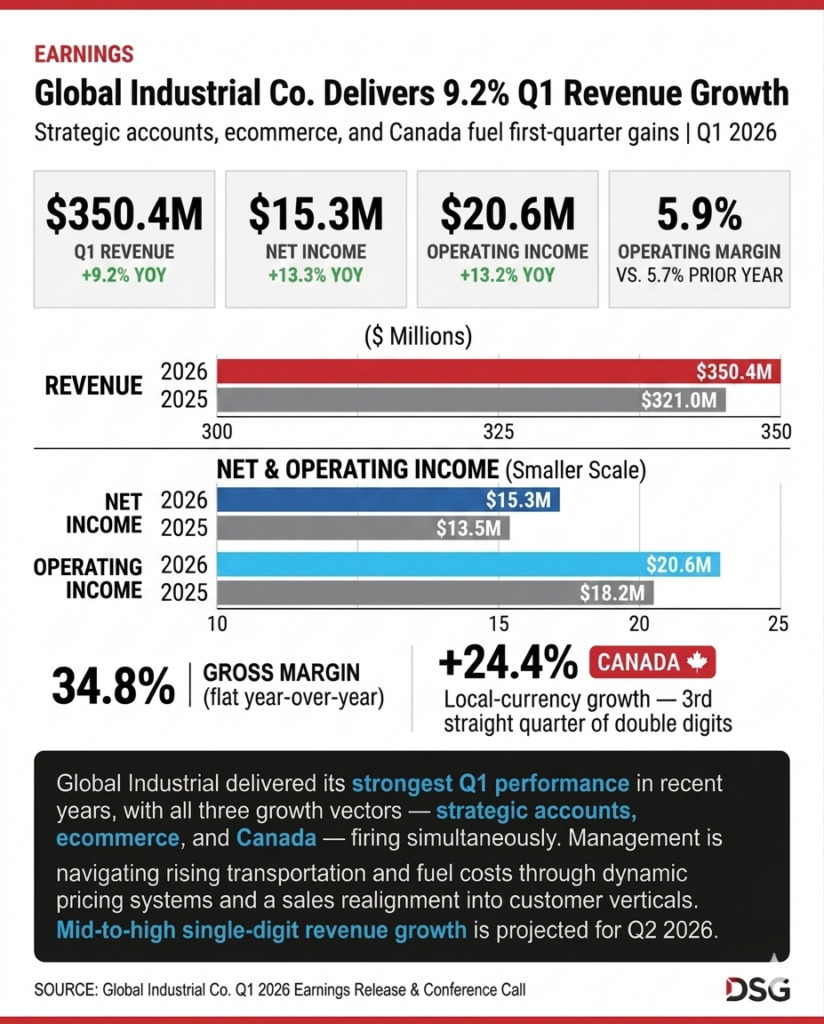
The Port Washington, New York based distributor said first quarter sales increased 9.2% to $350.4 million from $321.0 million a year earlier. Net income from continuing operations rose 13.3% to $15.3 million from $13.5 million.
Operating income increased 13.2% to $20.6 million from $18.2 million. Operating margin improved to 5.9% from 5.7%, while gross margin was flat at 34.8% compared with 34.9% a year earlier.
“We delivered a strong start to 2026 as we benefited from solid execution and continued momentum across the business,” CEO Anesa Chaibi said during the company’s earnings call. “We generated growth each month during the period and have seen this top-line momentum carry into the second quarter.”
Chaibi said results were driven by both price increases and volume gains, particularly among large strategic accounts and ecommerce customers. Canada revenue increased 24.4% in local currency, marking the third consecutive quarter of double-digit growth.
The company said it continues reorganizing sales and merchandising teams around customer verticals to deepen specialization and improve account penetration.
“Our sales realignment into customer verticals is progressing well, allowing us to better meet our customers’ needs through deeper specialization and tailored experiences,” Chaibi said.
Global Industrial also said it is expanding e-procurement and integrated ecommerce capabilities as more customers shift purchasing into digital procurement systems.
“We are also continuing to expand our e-procurement and integrated ecommerce capabilities, which are helping us to deepen relationships, improve retention, and position us to capture greater share of wallet over time,” Chaibi said.
Executives pointed out maintenance, repair and operations, or MRO, products, and consumables, as a growing opportunity for expanding customer spending.
“It is MRO. It’s natural adjacent categories for what we do,” Chaibi told analysts. “We’re not going to go too far afield and beyond what our core business is.”
Chief financial officer Tex Clark said the company expects revenue growth in the second quarter to remain in the mid to high single digits, though fuel surcharges and transportation costs are expected to pressure margins in coming months.
“We continue to closely monitor the macroeconomic and geopolitical environment, including developments in the Middle East and their impact on transportation and manufacturing costs, as well as the evolving tariff landscape,” Clark said.
Executives also said the company has adopted more dynamic pricing systems to respond faster to tariff and cost changes.
“What we have inherently in the business now is initiative-taking pricing,” Chaibi said. “We are watching real time and reacting dynamically from a margin perspective.”
Do not miss any content from Distribution Strategy Group. Join our list.
Share this article:
