


Why This Matters to Distributors: U.S. manufacturing remained in expansion territory in July, supporting demand for industrial distributors. But slower growth in production and new orders, rising costs and worsening supplier delays point to a more challenging operating environment as manufacturers manage tariff pressures and supply chain disruptions.
U.S. manufacturing expanded in July, but growth slowed for a second consecutive month as production and new orders moderated and supply chain disruptions intensified, according to preliminary data released Friday by S&P Global.
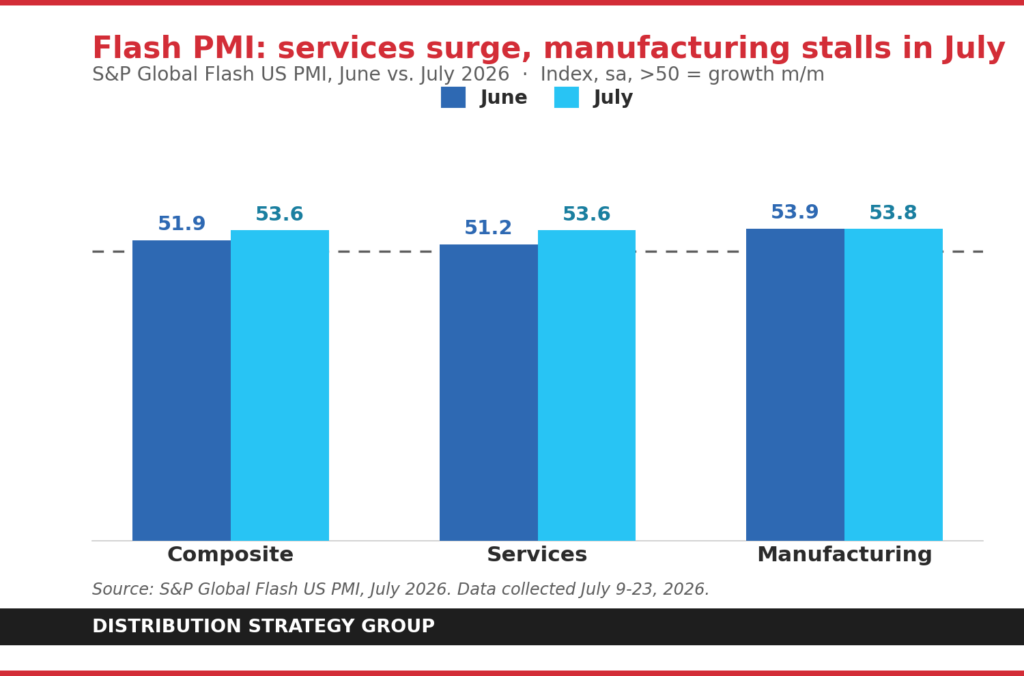
The S&P Global Flash U.S. Manufacturing Purchasing Managers’ Index slipped to 53.8 in July from 53.9 in June, its lowest reading in four months. A reading above 50 indicates expansion. The index remained among the highest levels recorded during the past four years despite the slight decline.
Manufacturing output continued to grow but slowed to its weakest pace since March. New orders also increased at the slowest rate in four months, while exports declined again, indicating domestic demand continued to drive factory activity. Companies cited stronger-than-usual Fourth of July spending, FIFA World Cup-related activity and increased investment in sales, marketing and product development as supporting demand.
Manufacturers continued building inventories as a precaution against higher prices and concerns about the availability of materials tied to the conflict in the Middle East. However, S&P Global said fewer companies reported stockpiling than in previous months, contributing to slower manufacturing growth.
Supply chain conditions deteriorated further during the month. Manufacturers reported the sharpest increase in supplier delivery times since August 2022, extending a streak of worsening lead times to 11 consecutive months. The report attributed the delays to shipping disruptions around the Strait of Hormuz, demand for safety stock and tariff-related supply constraints.
Input cost inflation accelerated to its highest level since May 2025 as manufacturers reported higher energy, shipping, and raw material costs, along with tariff-related price increases from suppliers. Companies continued passing those costs on to customers, with overall selling price inflation reaching its highest level since August 2022.
Manufacturers also increased hiring during the month, helping lift overall business employment for the first time in three months. Hiring remained modest, however, as excessive costs and an uncertain trading environment caused some companies to delay filling vacant positions.
“US businesses reported a good start to the third quarter, the ‘flash’ PMI survey data broadly consistent with GDP growing at an annualized 2.0% against a 1.2% pace signalled for the second quarter,” Chris Williamson, chief business economist at S&P Global Market Intelligence, said in the report. “The month saw an encouraging return to hiring by companies, with employment rising for the first time in three months.”
Williamson said the manufacturing sector showed signs that the inventory buildup seen in recent months was beginning to fade even as supply chain disruptions and price pressures intensified.
“It was also worrying — though not unexpected — to see manufacturing growth weaken as some of the stock building seen in prior months showed signs of fading,” Williamson said. “Instead, July saw a concerning intensification of supply chain delays and accompanying renewed upturn in price pressures, constraining growth and subduing demand.”
For distributors serving industrial customers, the report points to continued manufacturing expansion but a more measured pace of activity. Slower production growth, moderating demand, and persistent supply chain disruptions could lead manufacturers to manage inventories more cautiously while continuing to contend with higher operating costs.
The manufacturing survey contrasted with stronger growth in the broader economy. S&P Global’s Flash U.S. Composite Output Index rose to 53.6 in July from 51.9 in June, reaching its highest level in eight months as stronger services activity offset slower manufacturing growth.
Do not miss any content from Distribution Strategy Group. Join our list.
Share this article:
