


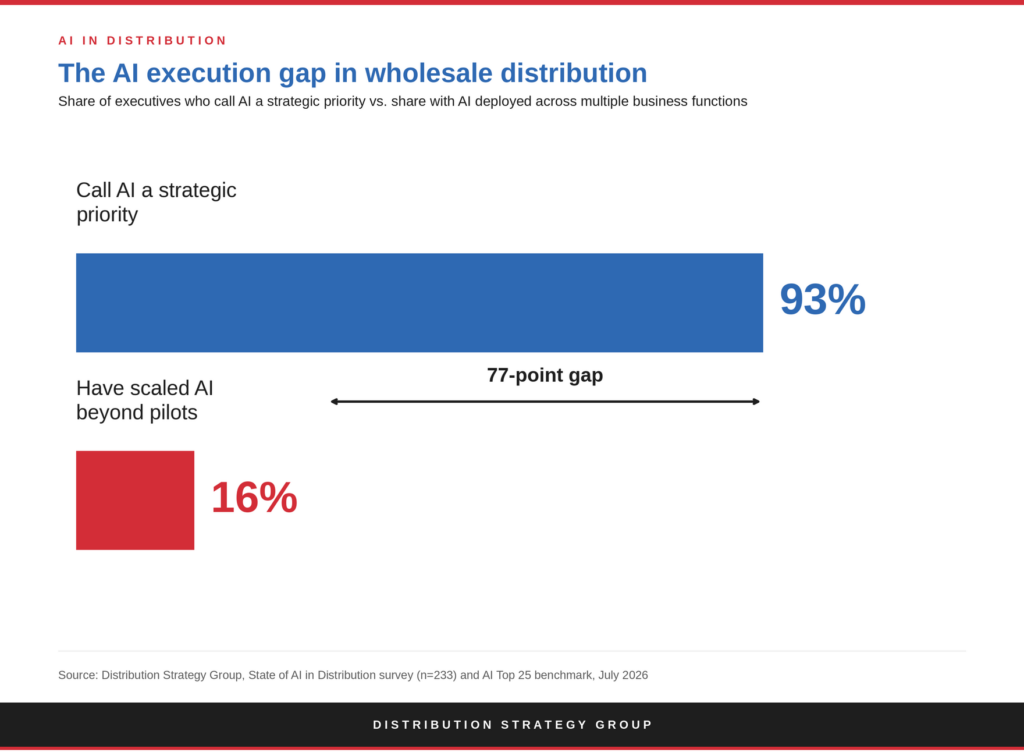
Why This Matters to Distributors: Only 16% of wholesale distribution executives have scaled artificial intelligence beyond pilot projects, even though 93% consider it a strategic priority, according to Distribution Strategy Group research. The firm’s two-year AI Top 25 benchmark found that successful deployments depend less on company size or technology spending than on disciplined execution, including executive ownership, strong data, and scaling AI across the business.
Artificial intelligence has become a strategic priority across wholesale distribution, but few companies have deployed it on a scale, according to new research from Distribution Strategy Group.
The firm’s AI Top 25 benchmark identified 26 North American distributors with evidence of sustained AI deployments in production. At the same time, DSG’s State of AI in Distribution survey found that 93% of wholesale distribution executives consider AI a strategic priority, while only 16% have implemented it across multiple business functions.
The findings highlight what DSG describes as a 77-percentage-point gap between companies’ AI ambitions and operational execution.
“What we mean by this gap is that companies are convinced AI matters, but they’re still in pilots or conceptual stages rather than execution,” Jonathan Bein, DSG co-founder and managing partner said on a DSG webinar announcing the findings and key takeaways. “We believe that gap will narrow over the next several years because many of today’s pilots will eventually become production deployments.”
The AI Top 25 is the result of a two-year research project that evaluated more than 300 North American distributors using earnings call transcripts, executive interviews, customer case studies, and vendor documentation rather than self-reported claims. Researchers identified 26 distributors that met DSG’s standard for sustained production use, exceeding the project’s original goal of recognizing 25 companies.
Despite differences in revenue, ownership structure and end markets, the companies shared six recurring management practices:
- Assigning clear executive ownership of AI strategy.
- Moving successful pilot projects into production.
- Investing in data quality and governance.
- Integrating AI across multiple business functions.
- Measuring business outcomes rather than technology activity.
- Treating AI as a long-term business capability rather than a short-term initiative.
Executive accountability emerged as the strongest common characteristic among the AI leaders.
“All these folks named a single owner,” said Brian Hopkins, DSG’s chief operating officer. “If you have budget authority, you’re the owner. You’re not a committee.”
Researchers also found that leading distributors avoid allowing pilot projects to become permanent experiments.
“They stopped piloting a couple years ago and started making sure it worked across the business,” Hopkins said.
For the benchmark, DSG excluded distributors whose AI initiatives remained limited to pilot programs, announced partnerships or planned deployments without evidence of production use.
The benchmark’s Platinum tier includes W.W. Grainger, Wesco International, Sonepar, Fastenal, Ingram Micro and ADI Global Distribution. While their AI strategies differ, each has integrated AI into core business operations and tied deployments to measurable business results.
Among the examples highlighted in the research:
- Ingram Micro said AI-driven sales increased more than 60% year over year in its largest markets through its Xvantage digital platform.
- Wesco International processes about 40% of its 3 million annual invoices without human intervention using AI-enabled accounts payable automation.
- Sonepar has committed €1 billion (about $1.2 billion) over five years to a digital transformation program with Microsoft, Publicis Sapient and Hitachi Solutions that includes AI deployed across its sales organization.
- W.W. Grainger uses AI to support product search, product content management, and customer service across its sales organization.
- Fastenal evaluates AI investments against measurable workforce productivity improvements rather than technology adoption alone.
- ADI Global Distribution reported lower null-search rates and higher online conversion after deploying AI-powered search technology.
The research found that data quality, rather than software selection, often determines whether AI initiatives can scale successfully. More than half of survey respondents identified employee skills shortages or organizational resistance as their biggest obstacles to AI adoption, with data quality ranking close behind.
Many of the distributors recognized in the AI Top 25 spent years standardizing product information, customer records, and other core business data before expanding AI deployments across the enterprise.
Researchers also found that leading distributors increasingly connect AI applications across sales, purchasing, operations, and customer service instead of limiting them to individual departments.
“The companies that started this process are now taking multiple AI use cases and putting them together simultaneously,” Hopkins said. “That’s going to be a differentiator over the next couple years.”
For distributors, the findings suggest the competitive advantage in AI is shifting from access to technology to organizational execution. Generative AI platforms and cloud-based tools are becoming widely available, but the companies making the greatest progress have paired those technologies with executive accountability, disciplined data management, and a structured approach to scaling successful applications.
DSG expects the execution gap to narrow as more distributors move AI initiatives from pilot projects into production and adopt AI agents capable of automating increasingly complex workflows across sales, purchasing, and customer service. Future editions of the benchmark will track whether today’s leaders maintain their advantage as AI adoption expands across the industry.
Do not miss any content from Distribution Strategy Group. Join our list.
Share this article:
