

Why This Matters to Distributors: BFG Supply’s bankruptcy puts another major U.S. distribution business into a court-supervised sale process less than a month after Republic National Distributing Co. filed Chapter 11. The cases are unrelated, but both show how liquidity problems, debt and operating pressures can quickly force large distributors to sell businesses, restructure obligations or wind down operations.
BFG Supply Co. LLC and 16 affiliated companies filed for Chapter 11 bankruptcy protection Aug. 18 and are seeking a buyer for all of the horticultural and lawn and garden distributor’s assets.
The Indianapolis-based company listed estimated assets and liabilities of $100 million to $500 million each and more than 100,000 creditors in its voluntary petition filed in U.S. Bankruptcy Court for the District of Delaware.
The filing puts another sizable U.S. distributor into bankruptcy court weeks after Republic National Distributing Co., one of the nation’s largest wine and spirits distributors, filed Chapter 11 on July 26. RNDC is pursuing potential asset sales and an orderly wind-down of its remaining operations. It listed assets of $500 million to $1 billion and liabilities of $1 billion to $10 billion.
The two cases involve different industries and circumstances. But together they underscore the pressure that can build when declining business conditions, high debt and tightening liquidity leave distributors with fewer options outside a court-supervised sale or restructuring.
BFG Heads to Court After Liquidity Tightens
BFG, founded in 1972, is a major supplier to the horticultural and lawn and garden industries, distributing greenhouse and nursery supplies, controlled-environment agriculture products, greenhouse structures and horticultural equipment.
The scale of the business makes the bankruptcy significant for the Green Industry. BFG says its national distribution network includes 17 warehouse and manufacturing locations and more than 1.5 million square feet of warehouse space, supported by its own delivery fleet. The company serves more than 10,000 customers across all 50 states and parts of Canada.
BFG says it has relationships with more than 1,000 vendor partners and offers more than 100,000 products, including more than 30,000 stocked in its warehouses. Its sales organization includes more than 150 representatives.
Court filings cited a series of operating and financial problems from fiscal 2024 through 2026, including declining revenue, tightening vendor credit, working capital constraints and broader pressure in the horticultural market.
BFG employed about 700 people at its peak but had reduced its workforce to about 461 employees as its financial condition deteriorated, according to court documents.
Adam Zalev, BFG’s chief restructuring officer, signed the bankruptcy petition on behalf of the company and its debtor affiliates.
A 17th affiliate, De Cloet Greenhouse Mfg. Ltd., is organized in Ontario and is seeking recognition of the U.S. Chapter 11 proceedings in Canada under the Companies’ Creditors Arrangement Act.
The bankruptcy petition indicates that no funds are expected to be available for unsecured creditors after administrative expenses are paid, potentially leaving suppliers with substantial losses.
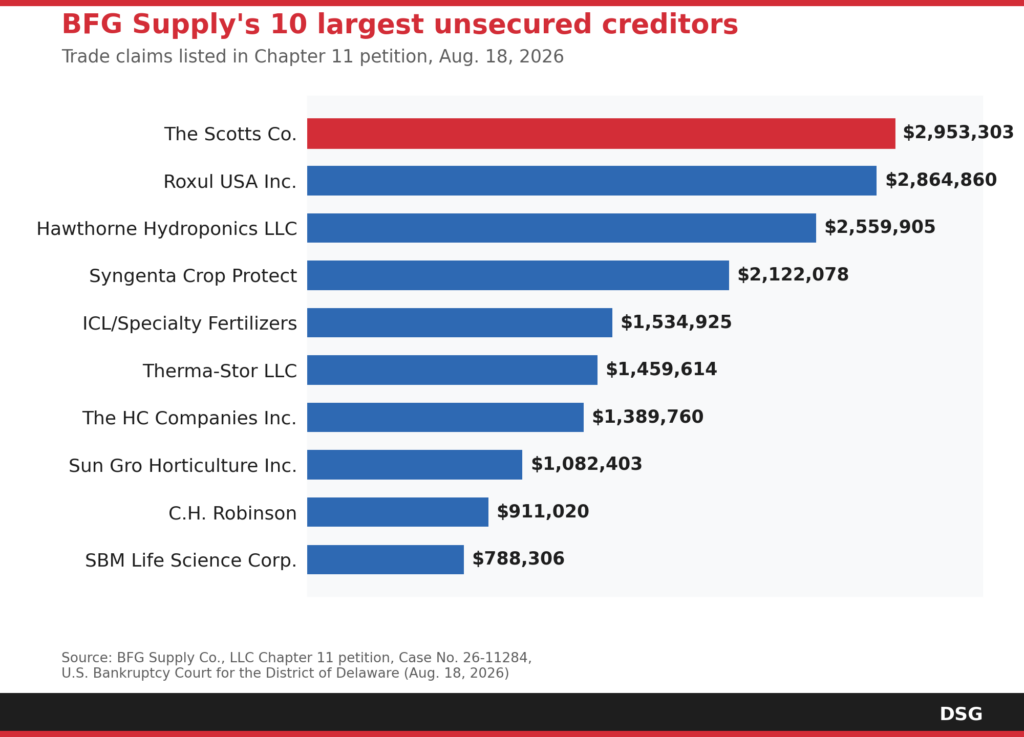
BFG’s consolidated list of its 30 largest unsecured claims includes several major suppliers.
The Scotts Co. is listed with a $2.95 million trade claim, followed by Roxul USA Inc. at $2.86 million, Hawthorne Hydroponics LLC at $2.56 million, Syngenta Crop Protect at $2.12 million and ICL/Specialty Fertilizers at $1.53 million.
BFG Holdings I Inc. owns 100% of BFG Supply, according to its corporate ownership filing. The company is backed by private equity firm Pamplona Capital Management.
Sale or Liquidation?
BFG is seeking to use Chapter 11 to pursue a going-concern sale of some or all its assets. If a buyer cannot be found for portions of the business, the process could include liquidation, according to court documents.
The company is also seeking financing to maintain operations during the bankruptcy process.
Corporate governance documents filed with the petition authorize a proposed superpriority secured debtor-in-possession credit facility, with Bamboo Purchaser Inc. as borrower and ACF Finco I LP serving as administrative and collateral agent.
BFG has assembled a group of restructuring, investment banking and liquidation advisers to oversee the process.
Cole Schotz P.C. is serving as restructuring counsel. Reflect Advisors is providing Zalev as chief restructuring officer, SSG Advisors LLC is serving as investment banker, A&G Realty Partners LLC is advising on real estate and Epiq Corporate Restructuring LLC is serving as claims agent.
SB360 Capital Partners LLC and Tiger Capital Group LLC have been retained as liquidation consultants. Cassels Brock & Blackwell LLP is representing the companies in the Canadian proceeding.
The retention of liquidation advisers does not mean BFG will necessarily be liquidated. The Chapter 11 process allows the company to seek buyers for its operations or individual assets while continuing to operate under bankruptcy court supervision.
Acquisition Growth Preceded Financial Problems
The bankruptcy follows several years of expansion at BFG.
The distributor acquired Greenhouse Megastore in December 2021 and purchased a portion of Central Garden & Pet Co.’s wholesale distribution business in July 2023, expanding its products, customers and distribution footprint.
BFG completed a $300 million recapitalization in late 2025, but signs of financial stress continued.
Ares Capital Corp.’s first-lien investment in BFG was placed on nonaccrual status in October 2025. Octus, a credit and restructuring news service, previously reported that BFG was preparing for a bankruptcy filing and in-court sale process as the company laid off employees and declined new orders amid severe financial strain.
BFG also canceled its 2026 Marketplace Expo East and West trade shows before the bankruptcy filing.
The Chapter 11 case now turns attention to whether BFG can find a buyer willing to preserve a significant portion of its distribution operation or whether assets will have to be sold separately.
For customers and suppliers, the size of that network raises the stakes. A breakup could affect more than 10,000 customers and a distribution system spanning 17 locations, while potentially shifting product lines and customer relationships to competing distributors.
RNDC Filing Adds to Distributor Stress
BFG’s bankruptcy comes less than a month after RNDC filed Chapter 11 in the Southern District of Texas.
RNDC said it entered bankruptcy July 26 to explore potential sale transactions and conduct an orderly wind-down of its remaining operations. National Distributing Co. Inc. and most of RNDC’s joint ventures were not included in the filing.
RNDC had already sold significant portions of its business before entering Chapter 11, including 11 markets transferred to Reyes Beverage Group in a transaction completed in May.
At its peak, RNDC generated more than $12 billion in annual revenue and operated across 40 states, according to bankruptcy reporting. Its Chapter 11 petition listed more than 100,000 creditors.
While BFG and RNDC operate in very different distribution markets, both entered Chapter 11 with plans centered on asset sales rather than a traditional standalone reorganization.
That distinction matters for distributors and suppliers. Bankruptcy cases built around sales and wind-downs can quickly shift customers, brands, inventory and market share to competitors while leaving unsecured vendors exposed to unpaid trade debt.
Suppliers Face Millions in Exposure
BFG’s suppliers face the most immediate consequences.
Scotts, Syngenta, ICL and other companies listed among BFG’s largest unsecured creditors collectively have millions of dollars tied up in the bankruptcy. With BFG indicating that no funds are expected to remain for unsecured creditors after administrative expenses, recovery on those claims could be limited or nonexistent.
The filing could also prompt manufacturers to take a closer look at the credit they extend to other distributors, particularly companies with significant debt or those that have expanded rapidly through acquisitions.
For distributors, the broader issue is not acquisitions themselves but whether the cash generated by an expanded business can support its debt, inventory requirements, payroll and other operating expenses when market conditions weaken.
BFG’s next steps will center on court approval of its financing and the sale process. The outcome will determine how much of a network encompassing more than 1.5 million square feet of warehouse space, 17 locations, more than 10,000 customers and more than 1,000 vendor relationships survives under new ownership and how much ultimately is liquidated.
Coming so soon after RNDC’s Chapter 11 filing, BFG also provides another reminder that scale alone does not insulate a distributor from liquidity pressure — and that when cash and supplier credit tighten, the transition from restructuring to asset sales can happen quickly.
Do not miss any content from Distribution Strategy Group. Join our list.
Share this article:
