



Why This Matters to Distributors: U.S. industrial production increased for a second straight month in July, with stronger output in electrical equipment, machinery, fabricated metals, and construction supplies. But manufacturing conditions remain uneven. High capacity utilization could tighten supply in some electrical and machinery categories, while excess capacity in chemicals and primary metals gives distributors more leverage on pricing and availability.
U.S. industrial production rose 0.2% in July, extending a modest expansion in manufacturing as several markets important to industrial distributors posted stronger gains.
The Federal Reserve said Aug. 18 that its industrial production index reached 103.0% of its 2017 average, up 1.1% from July 2025. Production increased 0.3% in June.
Manufacturing output, which accounts for the largest share of industrial production, increased 0.2% in July. Mining production also rose 0.2%, while utilities output increased 0.5%.
The headline manufacturing number was held back by a 2.1% decline in motor vehicle and parts production. Excluding that category, factory output increased 0.4%.
For distributors, the industry-level numbers show a more divided industrial economy. Production and capacity utilization are rising in several electrical and industrial markets, while chemicals, primary metals and parts of the building materials sector continue to operate with substantial unused capacity.
Electrical and Machinery Production Accelerates
Electrical equipment, appliances, and components production rose 1.3% in July and was 6.2% higher than a year earlier, one of the strongest year-over-year increases among the manufacturing industries tracked by the Fed.
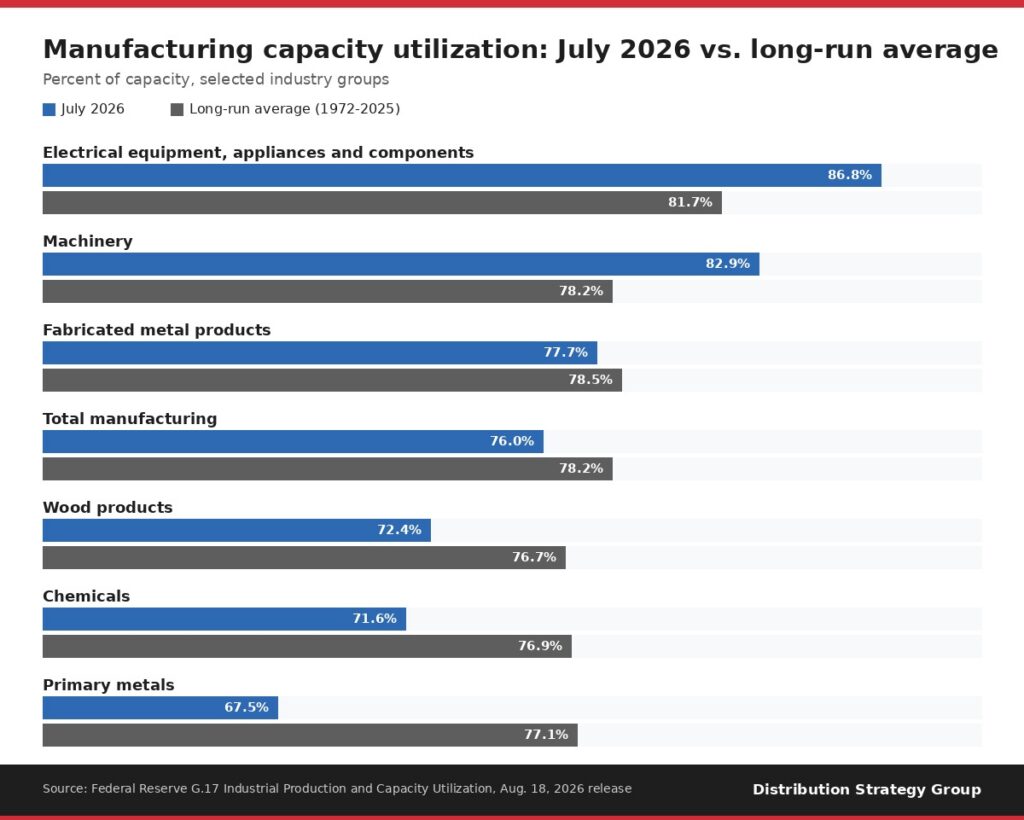
Capacity utilization in the category reached 86.8%, compared with its long-run average of 81.7%.
That combination matters for electrical distributors. Manufacturers are producing more while operating well above their historical utilization levels, potentially leaving less flexibility to absorb another increase in demand without adding production capacity, shifts, or other resources.
Machinery production increased 0.8% in July and 4.4% from a year earlier. Capacity utilization reached 82.9%, also above its long-run average.
Fabricated metal products production increased 1.2% for the month and 2.8% from a year earlier, with capacity utilization reaching 77.7%.
The gains point to continued demand across markets served by industrial, MRO, automation, and electrical distributors.
Broader market data reinforced that trend. Business equipment production increased 0.8% in July, including gains in information processing and industrial equipment. Defense and space equipment output rose 1.8%, while construction supplies increased 0.8%. Materials production gained 0.3%.
Automotive Weakness Weighs on Durable Goods
Durable goods manufacturing increased 0.7% in July, with most industry categories posting gains of more than 1%.
Motor vehicles and parts were a major exception, falling 2.1%. Nonmetallic mineral products declined 0.2%.
The automotive decline also weighed on consumer goods production, which fell 0.4% in July. Durable consumer goods output declined 1.4%.
The split suggests distributors serving machinery, electrical equipment, industrial production, and defense markets entered the second half of the year with stronger demand signals than companies more heavily exposed to automotive and consumer durable goods.
Building Materials Send Mixed Signals
Construction-related manufacturing remained uneven.
Wood products production jumped 2.4% in July. Capacity utilization increased to 72.4% but remained below its long-run average of 76.7%.
Nonmetallic mineral products, a category that includes products tied to cement, glass and gypsum supply chains, declined 0.2%. Capacity utilization was 82.6%, above its historical average.
Construction supplies production overall increased 0.8%.
For building products distributors, the figures point to continued demand without a broad supply constraint across manufacturing. Wood products manufacturers, for example, still have unused capacity despite July’s increase in production.
Chemicals Remain Under Pressure
Chemical manufacturing continued to lag other industrial categories.
Production declined 0.2% in July and was down 2.9% from a year earlier. Capacity utilization stood at 71.6%, compared with its long-run average of 76.9%.
The combination of lower production and significant unused capacity suggests chemical manufacturers have room to increase output if orders improve. For chemical distributors, that could preserve purchasing leverage and limit supply-driven pricing pressure.
Plastics and rubber products production increased 0.2% in July and 2.2% from a year earlier, with capacity utilization at 75.4%.
Paper production fell 0.7% for the month and was down 3.5% from July 2025.
Primary Metals Production Rises, but Capacity Remains Loose
Primary metals presented one of the report’s clearest contrasts.
Production increased 1.4% in July and 1.6% from a year earlier. But capacity utilization was only 67.5%, well below the industry’s long-run average of 77.1%.
For metals distributors, that means production is increasing while manufacturers still have substantial capacity available to respond to additional demand.
That is a markedly different supplier environment from electrical equipment, where capacity utilization is already running more than 5 percentage points above its historical average.
Manufacturing Still Has Room to Expand
Capacity utilization across total U.S. industry edged up to 76.3% in July, remaining 3.1 percentage points below its 1972-2025 average of 79.4%.
Manufacturing capacity utilization increased to 76.0%, 2.2 percentage points below its long-run average of 78.2%.
Mining utilization reached 86.1%, slightly above its historical average, while utilities utilization increased to 70.0%, well below its long-run average of 84.0%.
The overall numbers indicate U.S. manufacturers still have room to increase production without widespread capacity constraints. But the averages obscure significantly different conditions across the markets distributors serve.
Electrical equipment and machinery manufacturers are operating at comparatively high utilization rates while production continues to grow. That could put more pressure on lead times and supplier pricing if orders accelerate.
Primary metals and chemicals remain on the other side of the equation. Manufacturers in those sectors have more unused capacity, giving them greater ability to increase production without major capital investment and potentially giving distributors more leverage in supplier negotiations.
For distributors, the July report points to an industrial economy that is expanding, but not uniformly. The strongest signals are coming from electrical equipment, machinery, fabricated metals, construction supplies, and defense-related production, while automotive, chemicals and paper remain softer.
The divergence makes product-level demand and supplier capacity increasingly important to inventory and purchasing decisions heading into the fall. Rather than a broad manufacturing upswing, July’s data show distributors operating in an industrial market where growth, pricing power and supply conditions increasingly depend on which products they sell and which customers they serve.
Do not miss any content from Distribution Strategy Group. Join our list.
Share this article:
