



Why This Matters to Distributors: Durable-goods distributors continued to add workers in September even as U.S. hiring slowed. At the same time, wholesale wage growth remained below the private-sector average. The combination could give distributors more flexibility to add capacity, but uneven wage trends across individual distribution sectors show that competition for labor remains significantly tighter in some markets than others.
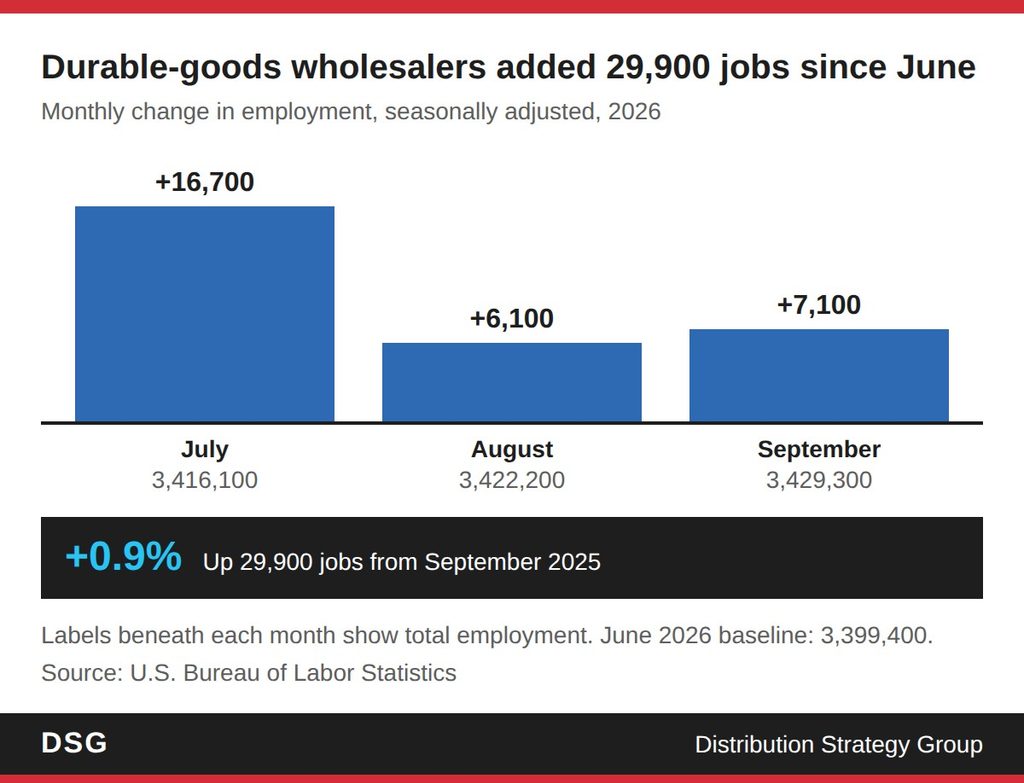
Durable-goods distributors added 7,100 jobs in September, extending a three-month hiring increase even as employment growth slowed across the broader U.S. economy.
Employment at durable-goods merchant wholesalers increased to a seasonally adjusted 3.429 million, according to the latest data from the U.S. Bureau of Labor Statistics.
The September increase followed gains of 6,100 jobs in August and 16,700 in July. Durable goods distributors employed about 36,000 more workers than a year earlier, an increase of approximately 1.1%.
The gains come as U.S. employers become more cautious about hiring. Total non-farm employment increased by 29,000 in September, compared with an average monthly gain of 45,000 over the previous 12 months. The unemployment rate was 4.2%.
Wholesale trade overall added 5,000 jobs in September, bringing industry employment to 6.078 million.
Durable goods distributors accounted for more than the industry’s net gain. Nondurable goods wholesalers cut 500 jobs during the month, while employment among wholesale trade agents and brokers declined by 1,600.
The durable-goods category includes distributors of machinery and industrial supplies, electrical products, plumbing and HVAC equipment, metals, building materials, motor vehicles and parts, and professional and commercial equipment.
Distributors are adding workers without the same broad wage acceleration that accompanied the tighter labor market of recent years.
Average hourly earnings across wholesale trade reached $40.06 in September, up 2.5% from $39.08 a year earlier.
Wholesale pay remains above the private-sector average of $37.81 an hour. However, private-sector hourly earnings have increased about 3% over the past year, meaning wholesale wage growth is running below the broader labor market.
Average weekly earnings in wholesale trade increased to $1,578.36 in September from $1,531.94 a year earlier.
The industrywide averages, however, mask substantial differences among distribution sectors.
The latest detailed BLS wage data, available through August for individual wholesale categories, show average hourly earnings among industrial supplies distributors increased 8.5% to $39.71 from $36.61 a year earlier.
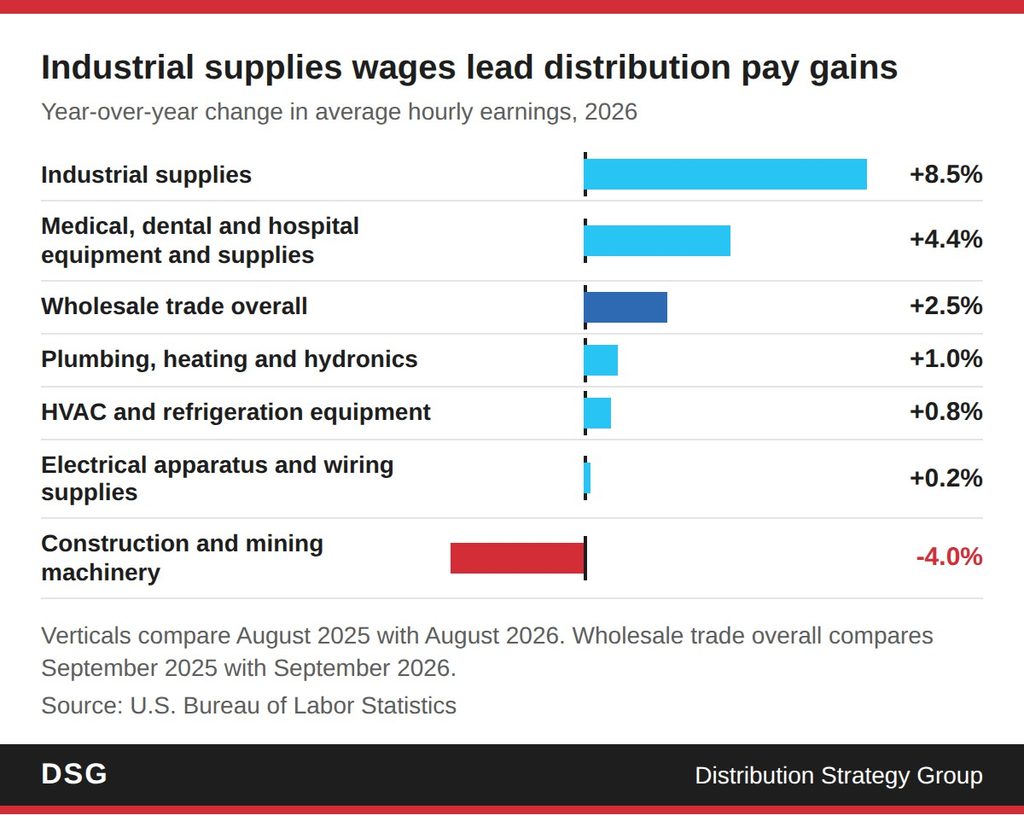
Medical, dental and hospital equipment and supplies distributors also recorded above-average wage growth, with hourly earnings increasing 4.4% to $44.38 from $42.52.
Other durable-goods sectors showed little wage growth.
Average hourly earnings among electrical apparatus and wiring-supply distributors were unchanged at $43.49 compared with $43.39 a year earlier. Plumbing, heating and hydronics distributors increased to $35.86 from $35.52, while HVAC and refrigeration equipment distributors increased to $38.89 from $38.58.
Average hourly earnings among construction and mining machinery distributors declined to $42.07 from $43.82.
The combination of continued hiring and slower overall wage growth could give distributors more flexibility in managing labor costs and staffing levels.
During the tighter labor market of recent years, distributors frequently competed for warehouse workers, drivers, salespeople, and other employees while absorbing rapidly rising compensation costs. The latest BLS data points to a different environment.
Durable-goods distributors are adding employees, but wholesale wage growth overall is restrained.
That does not mean labor pressures have disappeared. The sharp differences among individual distribution sectors suggest that hiring conditions increasingly depend on the type of workers a distributor needs and the markets it serves.
Industrial supplies distributors, for example, are experiencing faster wage growth than electrical, plumbing and HVAC distributors. That could reflect differences in labor demand, workforce composition, and competition for specialized skills.
For distributors, those differences make broad industry averages less useful when setting compensation or hiring plans. Companies competing for technical salespeople, product specialists, experienced warehouse employees, or other specialized workers may face labor conditions that look quite different from the overall wholesale market.
The hiring trend also comes as distributors increase investments in warehouse automation, artificial intelligence, ecommerce, and other technologies aimed at improving productivity.
That puts greater emphasis on what distributors get from each additional employee.
If revenue grows faster than headcount, distributors can increase sales per employee and potentially improve operating leverage. If payrolls expand while demand remains weak, labor costs can become a larger burden on operating performance.
The latest employment numbers do not show which of those scenarios is occurring. But they raise an important question for distributors as they build 2027 operating plans: whether additional employees are supporting growth and improved service or simply adding cost.
Technology investments make that calculation more complicated.
Automation can reduce the labor required for repetitive warehouse and administrative work while shifting hiring toward sales, technical, digital, and other higher-value positions. Artificial intelligence could produce a similar change in customer service, quoting, purchasing and back-office functions.
As those investments expand, headcount alone will become a less useful measure of distributor capacity. Productivity, revenue per employee and the mix of jobs across the organization will become increasingly important measures of workforce performance.
September’s numbers do not point to an industrywide hiring boom.
Instead, they show a widening divide within wholesale trade.
Durable goods distributors continued to expand employment while nondurable wholesalers and wholesale agents and brokers reduced payrolls. Wage trends are similarly uneven, ranging from an 8.5% increase among industrial supplies distributors to almost no growth in several other major durable-goods sectors.
For distributors, that creates both an opportunity and a management challenge.
A softer national labor market could make it easier to recruit in some positions and reduce pressure for across-the-board wage increases. Companies also may have more opportunities to selectively strengthen sales, operations, and technical teams than they did when labor markets were tighter.
But continued hiring will put greater pressure on distributors to demonstrate productivity gains if customer demand remains uneven.
The September data suggest the labor challenge is changing. For many distributors, the central question may no longer be simply whether they can find enough workers. It is increasingly where to add people, what skills command higher pay and which jobs can be redesigned or automated as companies balance growth, service, and labor costs.
Do not miss any content from Distribution Strategy Group. Join our list.
Share this article:
