



Why This Matters to Distributors: Demand for warehouse space is accelerating as companies add regional distribution capacity, outsource more logistics operations and seek larger facilities built for automation. For distributors, the shift is raising the importance of warehouse location, power capacity, inventory positioning, and automation-ready infrastructure.
U.S. industrial leasing jumped 50% in the second quarter as companies expanded distribution networks, increased their use of third-party logistics providers, and sought larger warehouses capable of supporting automation.
Industrial leasing activity increased 49.4% from a year earlier to 175.7 million square feet during the second quarter, according to JLL’s U.S. Industrial Market Dynamics report. Leasing totaled 320.9 million square feet in the first half of 2026.
The increase came as companies continued to rethink where they hold inventory and how they move products to customers.
Third-party logistics providers, or 3PLs, accounted for 22.4% of leasing activity, leading the market for the sixth consecutive quarter. JLL said 3PL space absorption increased 35.9% from a year earlier as companies used outsourced distribution networks to gain flexibility, technology capabilities, and additional capacity.
At the same time, companies are expanding warehouse networks beyond traditional coastal distribution hubs. JLL said occupiers are adding facilities in inland markets that offer more transportation options and less exposure to port congestion and international shipping volatility.
Companies also are building more multi-node distribution networks, including additional capacity and safety stock intended to protect operations from supply chain disruptions.
The trend has direct implications for distributors deciding where to place inventory and how much redundancy to build into their networks.
Demand Shifts to Bigger, Newer Warehouses
Demand is increasingly concentrated in larger and more modern distribution facilities.
Leasing for warehouses larger than 500,000 square feet increased 58.3% from a year earlier. Big-box leasing in the Inland Empire, Chicago, Dallas-Fort Worth, and eastern and central Pennsylvania accounted for 27.1% of all second-quarter leasing activity.
The largest buildings posted some of the strongest growth.
Leasing for facilities larger than 1 million square feet increased 71.1% from a year earlier, while leasing for buildings between 750,000 and 999,999 square feet increased 66.5%, according to the report’s second-quarter breakdown. By comparison, leasing for buildings smaller than 100,000 square feet declined 16.5%.
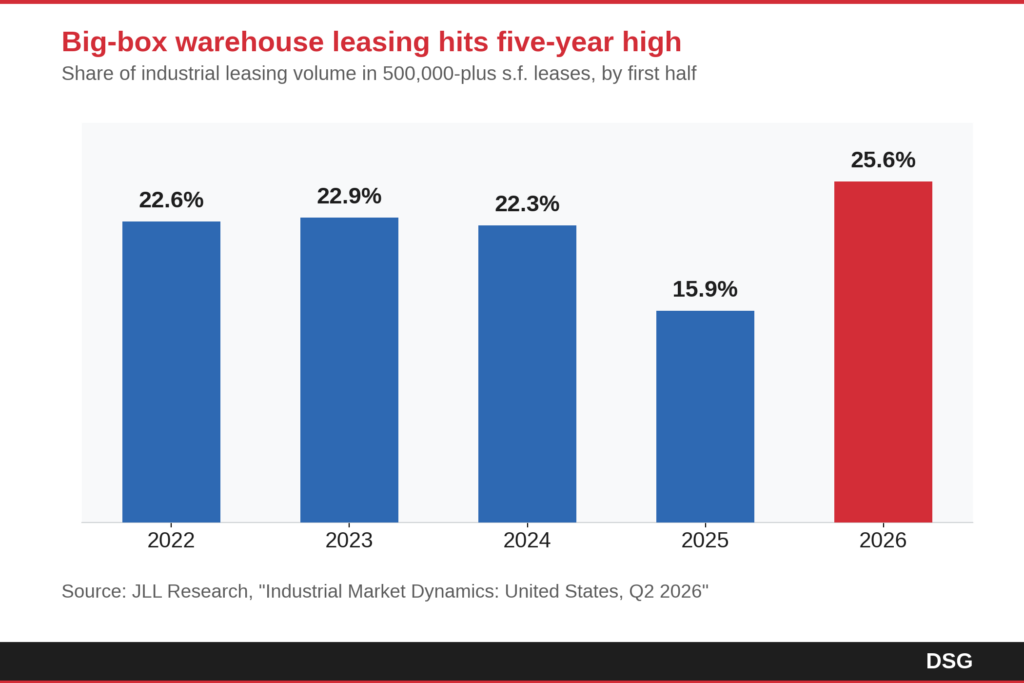
Big-box facilities accounted for 25.6% of leasing activity during the first half, exceeding the 22% to 23% share recorded during the peak pandemic years.
JLL attributed the shift to companies seeking facilities that can support automation, higher product throughput and larger regional or national distribution networks.
The divide also is widening between newer and older warehouses.
Class A leasing increased 7.1% from a year earlier, while Class B leasing declined 3.8%. JLL said tenants are favoring newer facilities with specifications suited to modern distribution operations, while older properties face longer leasing periods and greater pricing pressure.
Automation Becomes a Real Estate Requirement
Warehouse automation is helping drive that divide.
Persistent labor constraints and higher wages are accelerating investment in warehouse technology, according to JLL. Companies increasingly want buildings with the clear heights, power capacity and structural specifications required for robotics and other automated systems.
That makes warehouse selection increasingly an operational decision rather than simply a real estate decision for distributors.
JLL said demand is growing for facilities capable of supporting robotics, automated storage and retrieval systems and the electrical infrastructure needed to operate them. The firm also cited expanding warehouse requirements around data center construction and renewed ecommerce investment, including interest in facilities capable of supporting AI-powered inventory management.
Occupied Warehouse Space Surges
The increase in leasing is translating into higher warehouse occupancy.
Net absorption — newly occupied space minus space vacated — reached 99.1 million square feet in the second quarter, seven times the 14.4 million square feet recorded a year earlier.
Dallas-Fort Worth, Houston, Phoenix, Chicago, and the Inland Empire accounted for 34.2% of second-quarter absorption.
First-half absorption reached 167.4 million square feet, already exceeding the amount recorded during all of 2025. The national industrial vacancy rate declined 60 basis points from the first quarter to 6.8%.
New construction has not increased at the same pace.
Developers completed 62 million square feet during the quarter, up 3.3% from a year earlier but well below the quarterly totals exceeding 100 million square feet in 2023 and early 2024. About 276 million square feet was under construction.
Average asking rents increased 1.7% from a year earlier and 1% from the first quarter to $10.45 per square foot.
Supply Chains Move Inland
Trade uncertainty also is influencing where companies build distribution capacity.
JLL said shipping-rate volatility, tariffs and geopolitical uncertainty are encouraging companies to diversify supply chains and place more inventory domestically. Companies are increasingly considering nearshoring and onshoring while building regional distribution networks intended to reduce exposure to international transportation disruptions.
The result is a warehouse market increasingly shaped by the same issues distributors face in their broader supply chain strategies: where to hold inventory, how close to position it to customers, how much capacity to outsource and how aggressively to automate operations.
JLL said the industrial market entered the second half with stronger demand but continued uncertainty from trade policy, tariffs, and geopolitical conflicts. It expects a slower pace of new warehouse deliveries and improved tenant demand to support the market into 2027, particularly for modern, well-located facilities built to support automation.
Do not miss any content from Distribution Strategy Group. Join our list.
Share this article:
