

Why This Matters to Distributors: Major distributors are beginning to put capital directly into artificial intelligence companies, technology, and talent rather than relying exclusively on software vendors. Fastenal, Grainger, Builders FirstSource, Winsupply, The Home Depot and United Rentals have made acquisitions or strategic investments tied to AI and automation since 2025. The transactions differ, but they share a common theme: Distributors are seeking closer access to technology and technical expertise connected to inventory, supply chains, purchasing, sales, fulfillment, and other core operations.
Wholesale distributors spent much of the first phase of the artificial intelligence boom evaluating software, running pilots, and determining where AI could improve existing processes.
A smaller group is now taking a different approach. Instead of simply buying AI software, they are acquiring companies and technology, hiring the people who built it or investing directly in AI businesses developing applications for distribution and other operationally complex industries.
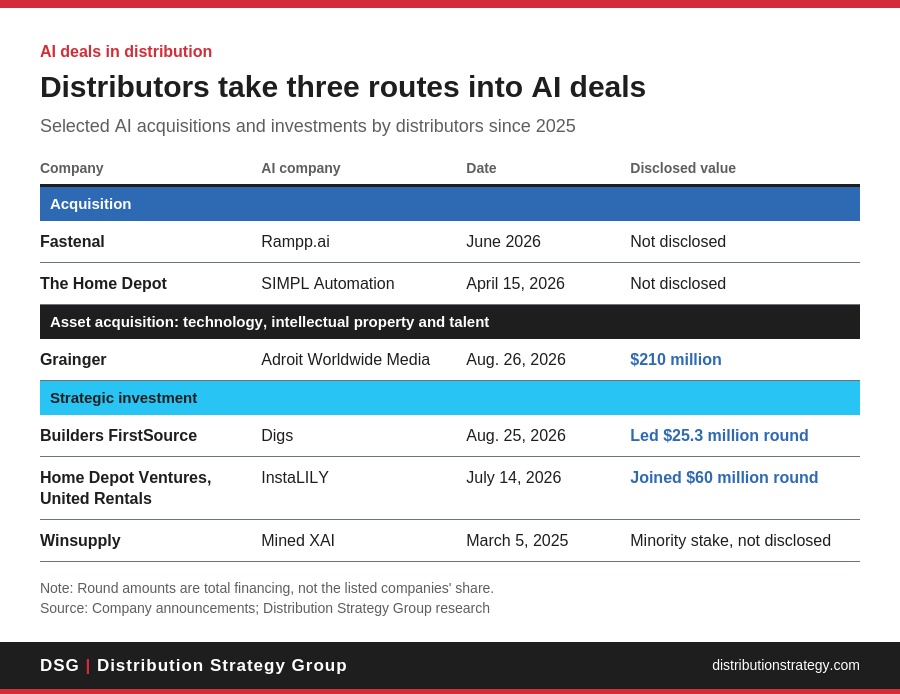
Fastenal acquired agentic AI company Rampp.ai in June. Grainger followed in August with a $210 million acquisition of technology, intellectual property, and talent from Adroit Worldwide Media. A day earlier, Builders FirstSource announced that it was the lead investor in AI platform Digs’ $25.3 million Series A financing and entered a five year commercial agreement with the company.
Winsupply had moved earlier. In March 2025, the distributor acquired a minority stake in Mined XAI after working with the AI company for three years on applications involving supply chain, purchasing, distribution, and fleet management.
The Home Depot also has pursued multiple approaches. It acquired SIMPL Automation in April after testing the company’s technology in one of its distribution centers, while Home Depot Ventures and United Rentals joined a $60 million Series B financing for InstaLILY in July.
The transactions should not be treated as identical. Fastenal bought a company, Grainger acquired selected technology, intellectual property and talent, Home Depot acquired an automation business, and Winsupply and Builders FirstSource made strategic investments in companies they are working with commercially.
Together, however, the deals show that some distributors are willing to commit capital to technology increasingly connected to how they buy, stock, sell and move products.
Fastenal Brings Agentic AI Inside the Company
Fastenal’s acquisition of Rampp.ai is one of the clearest examples of a distributor moving from buying AI technology to owning it.
Rampp.ai announced in June that Fastenal had acquired the company. Fastenal did not issue a separate investor relations announcement and later told Distribution Strategy Group that the original announcement represented the extent of what it planned to disclose publicly about the transaction.
Financial terms were not disclosed.
Rampp.ai, founded in 2023, developed an enterprise platform using agentic AI to coordinate workflows across business functions and systems. The technology is designed to move beyond generating or retrieving information and toward agents capable of taking actions and coordinating work.
The transaction also brought AI talent into Fastenal. Rampp.ai co founder and CEO Ajay Agrawal subsequently joined Fastenal as head of AI business transformation, while other Rampp personnel also moved into Fastenal following the acquisition.
The deal aligns with an AI roadmap Fastenal had outlined before the acquisition.
At its 2025 Investor Day, Fastenal described an evolution from generative AI toward task agents capable of taking actions and automating workflows and, eventually, more autonomous agents capable of planning work and coordinating other agents.
Fastenal has not said publicly where Rampp’s technology will be deployed, how it will be integrated into existing systems or how many Rampp employees joined the distributor. The company also has not said that its previously disclosed agentic AI strategy directly led to the acquisition.
What can be established is that Fastenal had identified agentic AI as part of its technology roadmap before acquiring a company specializing in that area. The transaction gave Fastenal both technology and employees with experience developing agentic AI applications.
Grainger Pays $210 Million for Technology, IP, and Talent
Grainger took a more targeted approach.
On Aug. 26, the distributor announced it had paid $210 million in cash for technology, intellectual property and talent from Adroit Worldwide Media, or AWM.
Grainger did not acquire the entire company. It purchased specific assets it intends to use to strengthen inventory management within its High Touch Solutions North America business.
Grainger said the acquired technology is expected to help customers reduce the cost of managing maintenance, repair, and operations inventory, improve product availability and free skilled employees for other work. The company said it would begin integrating the technology immediately and expected to launch a commercial pilot within several months.
The structure of the transaction is notable because Grainger specifically identified technology, intellectual property, and talent as the assets it was buying.
For distributors evaluating AI investments, that distinction matters. The software itself represents only one part of the capability required to develop and deploy AI applications. Companies also need employees who understand how the technology works and how to integrate it into existing operations.
Grainger bought both.
The application also sits close to Grainger’s core business. Inventory management is central to the company’s maintenance, repair and operations offering, particularly when Grainger manages products located at customer facilities.
Rather than buying a general purpose AI tool, Grainger is investing in technology it expects to use in a specific inventory management application.
Builders FirstSource Combines Investment With a Commercial Agreement
Builders FirstSource is pursuing a different model.
On Aug. 25, the building materials distributor announced that it was the lead investor in Digs’ $25.3 million Series A financing. Builders FirstSource simultaneously entered a five year commercial agreement with Digs.
The companies plan to integrate Digs’ AI technology into the Builders FirstSource digital ecosystem and develop applications spanning estimating, procurement, construction, and the homeowner experience.
They also plan to use the technology to connect information contained in construction documents, including plans, specifications, product selections, approvals, warranties, conversations, and project histories.
The combination of an equity investment and a long term commercial agreement makes the transaction more than a financial investment.
Builders FirstSource brings product data, digital systems, customer relationships, and access to more than 140,000 customers. Digs brings an AI platform developed specifically around homebuilding information and workflows.
Builders FirstSource CEO Peter Jackson said the companies intend to combine those capabilities to simplify workflows, reduce manual work and create a more connected experience throughout the homebuilding process.
The investment gives Builders FirstSource exposure to the AI company’s growth while the commercial agreement gives the distributor a direct role in applying the technology to its own customers and systems.
For distributors, that represents a middle ground between purchasing software and acquiring an entire technology company.
Winsupply Invests After Working With Mined XAI for Three Years
Winsupply followed a similar path, but only after establishing a longer operating relationship with its AI partner.
The distributor acquired a minority stake in Mined XAI on March 5, 2025, after the companies had worked together for three years.
Winsupply said the companies were developing explainable AI applications for supply chain, purchasing, distribution, and fleet management. Robert DiTommaso, president of Winsupply’s Support Services Group, said at the time that the company already had seen an impact from AI in its operating processes and expected the investment to accelerate that work.
The transaction deepened an existing relationship rather than beginning a new one.
That distinction reduces some of the uncertainty associated with investing in emerging technology. Winsupply had worked with Mined XAI before becoming an investor and had experience applying its technology to Winsupply operations.
The relationship also has continued beyond the financial investment. Winsupply President Jeff Dice currently serves on Mined XAI’s board of directors.
Winsupply has not disclosed the size of its ownership stake or the amount invested. It also has not provided detailed financial results from the AI applications developed with Mined XAI.
The areas identified for development, however, are fundamental distribution processes. Supply chain management, purchasing, distribution, and fleet operations directly affect inventory availability, transportation, operating costs, and customer service.
Home Depot Acquires Technology After Testing It
The Home Depot’s acquisition of SIMPL Automation provides another model for investing in emerging technology.
Home Depot announced the acquisition in April after testing SIMPL’s automation technology at its Locust Grove, Georgia, distribution center.
SIMPL uses advanced engineering, automation, and AI technology in distribution facilities. Home Depot said the pilot increased picking speed, shortened cycle times and reduced product touches.
SIMPL also developed a patented storage and retrieval system designed to increase storage density. Home Depot said the technology allows it to position a broader assortment of products closer to customers and support faster delivery.
The company did not disclose the purchase price.
The sequence is significant. Home Depot tested the technology inside its own distribution network before acquiring the company.
That allowed the retailer and distributor to evaluate the technology in an operating environment before deciding to own it. Home Depot has said the acquisition supports its broader work in supply chain automation, inventory management, and faster fulfillment.
Home Depot’s investment in AI also extends beyond acquisitions.
Home Depot and United Rentals Invest in InstaLILY
Home Depot Ventures and United Rentals joined a $60 million Series B financing for InstaLILY in July.
Energize Capital led the financing, while existing investor Insight Partners increased its investment. Home Depot Ventures and United Rentals joined as new strategic investors.
InstaLILY develops AI technology for operationally intensive industries including industrial distribution, construction, and logistics. The company says its technology is designed to deploy AI inside existing business processes rather than operate solely as a standalone assistant.
Neither Home Depot nor United Rentals acquired control of InstaLILY. Their participation instead gives the companies strategic exposure to a business developing AI for industries closely related to their own operations.
That is an important distinction in the emerging distributor investment model.
Companies do not necessarily need to acquire an AI provider to develop a closer relationship with it. Strategic investments can give distributors access to emerging technology and closer relationships with developers while allowing the AI company to remain independent and serve other customers.
Why Distributors Are Putting Capital Behind AI
The transactions raise a basic question: Why invest in or acquire an AI company when distributors can buy increasingly capable AI software from established technology providers?
There is no single answer, and the companies have cited different strategic objectives.
Grainger wants technology that can improve inventory management. Builders FirstSource wants to connect AI with estimating, procurement, construction, and homeowner workflows. Winsupply is working with Mined XAI on supply chain, purchasing, distribution, and fleet applications. Home Depot acquired SIMPL after testing its automation technology inside a distribution center.
Fastenal has disclosed less about the specific operating rationale for Rampp.ai, but the acquisition closely follows the agentic AI direction Fastenal had previously described to investors.
What connects the transactions is where the technology is being applied.
These companies are not primarily investing in AI to write emails or summarize documents. They are targeting processes connected to inventory, purchasing, quoting, fulfillment, construction workflows, and other operating functions.
As AI moves deeper into those processes, some distributors appear willing to establish closer relationships with the companies developing the technology.
Buying Technology Can Also Mean Buying Time
Acquisitions also can shorten the time required to build specialized capabilities internally.
Developing advanced AI applications requires engineers, data specialists, and product developers, along with employees who understand the business processes where the technology will operate.
Those capabilities can take time to assemble.
Fastenal’s acquisition brought Rampp’s technology and employees into the company. Grainger explicitly acquired talent along with AWM’s technology and intellectual property.
That does not establish that acquisition is less expensive than internal development. Neither company has disclosed enough information to make that comparison.
It does show that both distributors chose to acquire existing capabilities rather than rely entirely on building them internally.
The distinction becomes more important as distributors move beyond AI experiments. A company testing a general purpose AI assistant may need little specialized internal development, while a distributor attempting to automate inventory, purchasing or other operating workflows requires deeper integration with its existing data and systems.
Proprietary Data Changes the Value of AI
Data is another reason these investments matter.
General purpose AI models increasingly are available to every distributor. Access to the underlying model therefore may offer little competitive differentiation by itself.
Distributors possess information that is not universally available, including customer histories, product information, purchasing patterns, inventory movement, quotes, orders, supplier data, and fulfillment records.
Combining AI with that proprietary information can make the technology more specific to the distributor’s business.
The recent investments are concentrated in areas where proprietary operating data matters.
Grainger is targeting inventory management. Winsupply has identified supply chain, purchasing, distribution and fleet management. Builders FirstSource is connecting AI with its product data and customer workflows. Home Depot is applying AI and automation to distribution center operations.
Fastenal’s agentic AI strategy potentially goes further by using agents to take actions and coordinate workflows across business systems, although the company has not disclosed where Rampp technology will be deployed.
That distinction is important. The potential value does not necessarily come from owning an AI model. It can come from combining AI technology with proprietary data and embedding it in operating processes that competitors cannot easily duplicate.
Talent Is Part of the Investment
The transactions also highlight another challenge facing distributors: specialized AI talent.
Most wholesale distributors were not built as software companies and historically have not employed large teams of AI engineers and machine learning specialists.
Acquiring a technology company or selected assets can bring those capabilities into the organization more quickly.
Fastenal’s transaction provides the clearest example. Rampp co founder Agrawal moved into Fastenal as head of AI business transformation after the acquisition.
Grainger’s announcement was explicit that talent was included in its $210 million transaction.
The significance is not simply the number of employees acquired. Bringing people who developed a technology into the distributor can preserve technical knowledge that otherwise would remain with an outside vendor.
Whether that produces better results will depend on how effectively those teams are integrated into the larger organization.
Three Investment Models Are Emerging
The transactions so far fall broadly into three categories.
Fastenal and Home Depot represent outright acquisitions. Grainger used a targeted asset acquisition to obtain technology, intellectual property, and talent without buying the entire company.
Winsupply and Builders FirstSource represent strategic equity investments tied to commercial relationships. Home Depot and United Rentals also have taken the venture investment route through InstaLILY.
None of the transactions establishes that distributors broadly are abandoning conventional software purchasing. Most AI applications are still likely to come from outside technology providers, just as distributors continue to buy enterprise resource planning, warehouse management, customer relationship management, and ecommerce software.
The recent deals instead suggest that some distributors are making a distinction between technology they are comfortable licensing and capabilities they want to own, influence, or develop through a closer strategic relationship.
That line appears most likely to emerge around processes that directly affect the economics of distribution.
Inventory, purchasing, sales, quoting and fulfillment influence revenue, margins, working capital, and customer service. Technology embedded deeply enough in those functions can become more strategically important than a standalone productivity application.
From AI Customer to AI Investor
The shift remains small. Six companies making acquisitions or strategic investments do not establish that direct AI ownership has become the dominant technology strategy in wholesale distribution.
But the transactions are significant because of who is making them and where the technology is being applied.
Fastenal is bringing agentic AI technology and talent inside the company. Grainger is spending $210 million on technology, intellectual property and people tied to inventory management. Builders FirstSource has combined an equity investment with a five year agreement to develop AI enabled homebuilding workflows. Winsupply invested after three years of working with Mined XAI. Home Depot bought automation technology after testing it in its distribution network and separately invested in InstaLILY alongside United Rentals.
These companies are taking different paths, and it is too early to know which investments will produce meaningful returns.
What is clear is that the relationship between distributors and AI providers is beginning to change. For some applications, major distributors are no longer limiting themselves to being customers of AI technology.
They are becoming owners and investors as wel
The Data and AI strategy takes that concept further by creating common infrastructure that can operate beneath individual brands and businesses. For an acquisitive distributor, that could make data integration increasingly important to capturing value from future deals.
The Goal Is Bigger Than Ecommerce
Sonepar already has substantial digital scale. With €12.3 billion ($14 billion) in online sales in 2025, more than one third of its global revenue is generated through digital channels, making the next stage of its digital strategy less about simply convincing more customers to order online.
The larger opportunity is using information generated by digital and physical operations to make more of the business predictive. Demand forecasting can become more precise, inventory can be positioned based on expected demand, product recommendations can become more personalized, salespeople can receive more relevant customer information and supply chain decisions can draw on patterns identified across a much larger pool of transactions.
That makes the Onepoint project part of a broader transformation rather than a standalone AI initiative. Sonepar has spent more than €2.5 billion ($2.8 billion) on supply chain automation and is investing another €1 billion ($1.1 billion) in its global digital platform, while simultaneously building the data and AI infrastructure intended to connect those investments and extract more value from them.
For other distributors, that may be the more important takeaway from Sonepar’s announcement. The competitive question is shifting from which distributor has the newest AI application to which companies have the data, architecture and operating processes required to deploy AI repeatedly across sales, inventory, purchasing, logistics and customer service.
Sonepar is attempting to build that capability across one of the largest electrical distribution networks in the world. Its new Data and AI platform is intended to provide the common infrastructure needed to connect its digital, physical, and increasingly automated operations.
Do not miss any content from Distribution Strategy Group. Join our list.
Share this article:
