



Why This Matters to Distributors: Commerce is rolling out new artificial intelligence tools designed to improve product data used by ecommerce sites, marketplaces, search engines, and AI shopping agents. The launch comes less than three weeks after the BigCommerce parent announced plans to cut $60 million to $80 million in annual operating costs while continuing to invest in B2B commerce, Feedonomics, product intelligence and agentic commerce.
Commerce has launched new AI product data tools for BigCommerce and Feedonomics as the ecommerce technology company concentrates investment on B2B, product intelligence and agentic commerce while cutting costs elsewhere.
The Austin, Texas based company has introduced Feedonomics Enrichment and BigCommerce Catalog Enrichment, two products that use AI to expand and structure existing product information for use across ecommerce sites, marketplaces, search engines, and emerging AI shopping applications.
The launch follows a Sept. 10 restructuring plan that Commerce said will reduce its annual operating costs by $60 million to $80 million. The company plans to cut spending on staffing, professional services, facilities, software, and infrastructure while continuing to invest in B2B commerce, payments, Feedonomics, product intelligence and agentic commerce.
Taken together, the moves provide a clearer picture of where Commerce is concentrating resources as AI begins to change how business buyers search for, compare and potentially purchase products.
Commerce is the parent company of BigCommerce, Feedonomics and Makeswift. BigCommerce provides ecommerce technology for B2B and B2C companies, while Feedonomics manages and distributes product information across digital channels.
The new products address a growing challenge for manufacturers and distributors with large catalogs. Product information originally created for customers browsing websites may lack the detail and structure AI systems need to accurately identify, compare, and recommend products.
“AI agents can only answer questions about your products as well as your data allows,” said Sharon Gee, senior vice president of product for AI at Commerce. “Whether you’re a marketer driving AEO or a product leader building shopping agents, better data is the foundation for better agentic experiences.”
Feedonomics Enrichment and BigCommerce Catalog Enrichment use existing catalog information to generate additional product titles, descriptions, feature bullets, frequently asked questions, and search metadata.
The products also can create structured product facts and question and answer fields intended to give AI systems more context about what a product is, how it is used and which applications it may fit.
That could be particularly relevant for distributors and manufacturers managing large catalogs of technical products.
Traditional ecommerce search relies on keywords, categories, filters, and product attributes. AI search increasingly allows buyers to describe a problem, application, or product requirement conversationally and receive product recommendations in response.
The quality of those results depends in part on the underlying product information available to the AI system.
Feedonomics Enrichment is aimed at companies managing complex catalogs across multiple sales and marketing channels. Commerce said the system can create and structure product information for ecommerce sites, search and answer engines and channels including Google, Meta, Amazon, and eBay, as well as AI platforms including Gemini, ChatGPT and Microsoft Copilot.
The product is available through self-managed and managed service options. It includes a quality scorecard designed to evaluate accuracy, consistency and compliance with a company’s brand requirements and flag information for additional review.
Commerce also is adding analytics intended to show how enriched product information performs across website traffic and paid media. The company said a planned conversational reporting agent will allow users to analyze those results through natural language queries.
BigCommerce Catalog Enrichment brings similar capabilities directly into the BigCommerce platform.
Merchants can select products, provide brand information, and use AI to generate titles, descriptions, feature bullets, frequently asked questions, search metadata and structured product fields. Users can review the generated information before adding it to their catalogs.
For distributors with thousands or millions of stock keeping units, automating portions of that process could reduce the amount of manual work required to improve product information.
The potential significance extends beyond a distributor’s own ecommerce site. Product information increasingly is distributed across marketplaces, advertising platforms, search engines, social commerce channels and AI applications.
As those channels multiply, the underlying product catalog becomes more important to whether products can be discovered and accurately matched to a buyer’s requirements.
Commerce Cuts Costs, Protects B2B and AI Investment
The launch follows a broader restructuring Commerce announced Sept. 10.
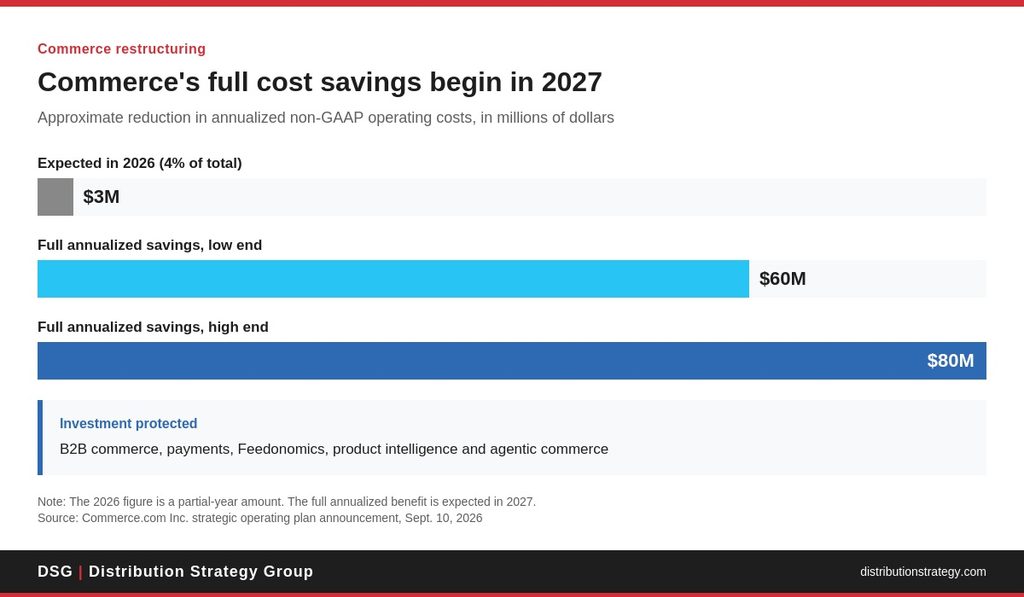
The company expects the plan to reduce its annual operating cost base by about $60 million to $80 million. Commerce expects approximately $3 million of those savings in 2026, with the full annualized benefit beginning in 2027.
Most of the restructuring is expected to be implemented by the end of the fourth quarter and completed during the second quarter of 2027.
Commerce also said it plans to increase its internal use of AI to improve operating efficiency.
At the same time, the company identified several areas where it intends to maintain investment. Those include B2B commerce, payments, Feedonomics, product intelligence and agentic commerce.
“Over the past several quarters, we have focused Commerce on the parts of the business where we see the strongest opportunities to grow,” CEO Travis Hess said. “We also need to be more disciplined about what we spend and the returns we generate from those investments.”
Commerce said it will reduce spending on businesses and activities it considers less central to its strategy or where it expects lower returns.
The company is targeting adjusted operating margins of at least 20% beginning in 2027 and has authorized up to $50 million in stock repurchases through September 2028.
Commerce reported second quarter revenue of $84.5 million, up 3% from $81.8 million a year earlier. Net income was $1.1 million compared with a net loss of $6.9 million in the year earlier quarter.
Gross merchandise value processed through Commerce platforms increased 14% to $8.8 billion during the quarter. The company expects 2026 revenue of $336.5 million to $344.5 million.
The new enrichment products are part of a broader Commerce effort to position product data for AI based product discovery and purchasing.
Commerce previously announced capabilities allowing Feedonomics customers to distribute catalog information to AI discovery channels. The company also has been developing conversational search, AI assisted shopping and AI enabled checkout capabilities.
The Sept. 29 launch focuses further upstream by improving the product information those systems use.
That issue could have implications in B2B distribution, where buyers frequently search using detailed specifications, dimensions, compatibility requirements, applications, and other technical attributes.
AI may make it easier for buyers to search those catalogs using conversational queries, but technology still requires accurate and sufficiently detailed underlying product information to identify appropriate products.
For Commerce, the strategy increasingly connects product data enrichment, distribution of that information across digital channels and the use of AI in product discovery and purchasing.
The restructuring shows that Commerce intends to continue funding those areas even as it makes substantial cuts elsewhere.
For distributors, the broader shift raises the stakes around product data. Catalog information historically determined how easily customers could find products on a distributor’s website. As AI becomes another product discovery channel, that same data increasingly could determine whether an AI system can find, understand and recommend those products in the first place.
Do not miss any content from Distribution Strategy Group. Join our list.
Share this article:
