

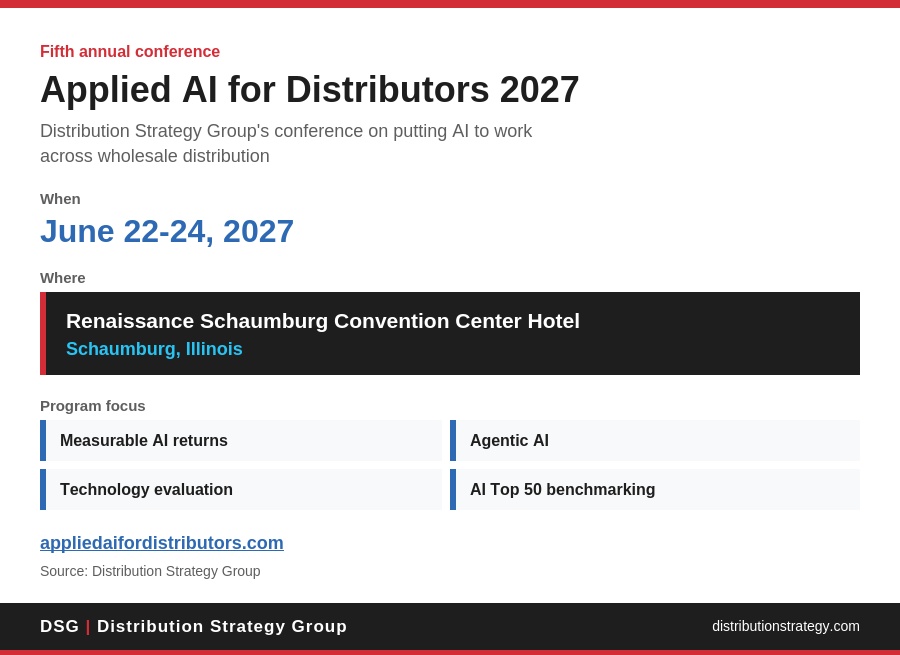
Why This Matters to Distributors: Distribution Strategy Group is expanding Applied AI for Distributors in 2027 as artificial intelligence moves deeper into sales, pricing, inventory, customer service, purchasing, and other core functions. The fifth annual conference will take place June 22 to 24, 2027, at the Renaissance Schaumburg Convention Center Hotel in Schaumburg, Illinois, with a greater focus on measurable returns, agentic AI, technology evaluation and how distributors compare with industry leaders in AI deployment.
Distribution Strategy Group is expanding its Applied AI for Distributors conference in 2027 as wholesale distributors move beyond experimentation and begin deploying artificial intelligence across more of their operations.
The fifth annual conference will take place June 22 to 24, 2027, at the Renaissance Schaumburg Convention Center Hotel in Schaumburg, Illinois. The event expected to attract more than 350 attendees as DSG expands the program and its technology presence.
The larger event reflects a changing AI market for distributors. The industry’s early focus on generative AI, individual use cases and pilot programs is giving way to questions about implementation, return on investment and how AI can be incorporated into everyday business processes.
“We created Applied AI for Distributors because we saw a widening gap between AI’s potential and what distributors knew about applying it,” said Ian Heller, co-founder and chief strategy officer of Distribution Strategy Group. “When we launched in late 2023, most distributors were curious but had no practical roadmap. The urgency is far greater now.”
That shift will shape the 2027 program, which will focus on AI technologies distributors can deploy, the business problems those systems can address and how companies can determine whether their investments are producing measurable financial and operational results.
Attendees will be able to evaluate AI technologies developed for distribution, compare their progress with companies in DSG’s AI Top 50 and develop roadmaps for further investment. The program also will include mainstage presentations, concurrent technology sessions, workshops and structured meetings between distributors and AI technology providers.
The emphasis will remain on distribution specific applications rather than broader discussions about AI. Heller said that distinction was one of the reasons DSG created the conference.
“One of the things I see at conferences is a lot of general speakers on AI,” Heller said. “Some of the topics are fantastic, what are the greater implications on society, but what they don’t speak to is how do I run a distribution company and apply AI to it so that I get better business outcomes? That’s what this conference is about.”
From Pilots to Production
The 2027 conference comes as distributors face increasing pressure to turn AI experimentation into operating capabilities. DSG research presented in connection with the 2026 event found that 97% of distributors considered AI important to the future of their companies, but 63% remained in the exploration or pilot stage. At the same time, 65% expected to increase AI investment during the following two years.
That creates a challenge for distributors deciding which applications are ready to move beyond pilots, how those technologies should connect with existing systems and whether they can generate sufficient returns to justify broader deployment.
Applications are emerging through sales, customer service, pricing, product information, accounts receivable, digital commerce, forecasting, purchasing, inventory management, and supply chain operations. For more advanced distributors, the question increasingly is not whether they can find an AI use case, but which applications produce enough value to scale across the business.
DSG co-founder and managing partner Jonathan Bein told attendees at the 2026 conference that AI’s impact on distribution could exceed the changes produced by ecommerce. AI “is going to be way bigger,” Bein said, adding that the technology will not require the 25 years it took ecommerce to mature.
Distributors that develop those capabilities early could create what Bein called “a big upward spiral” as productivity and operational improvements accumulate.
Agentic AI Takes a Larger Role
Agentic AI is expected to take on a more prominent role in the 2027 discussion. Unlike generative AI tools that primarily answer questions or create content, AI agents can perform multiple steps in a business process and take actions on behalf of users.
“It’s not just answering your questions anymore,” Heller said. “It’s taking action on your behalf.”
For distributors, those capabilities are beginning to emerge in order management, quoting, customer service, purchasing, billing, credit, product inquiries, and delivery coordination. Bein told attendees at the 2026 conference that the transition could happen quickly.
“By 2028, maybe 2027, agentic AI will be able to handle order management, quote management, product and service inquiries, issue resolution, account support, billing and credit support and delivery coordination,” Bein said.
That would move AI closer to the operating core of a distribution business. Instead of employees using AI primarily as a separate productivity tool, agents could interact with business systems, monitor activity, identify required actions, and execute portions of workflows with varying levels of human oversight.
Broader deployment also raises questions about data quality, cybersecurity, governance, accountability and how work should be divided between employees and AI systems. Those issues are expected to become more important as distributors move from isolated deployments to AI systems operating across multiple functions.
AI Top 50 Adds a Benchmark
DSG also plans to make its AI Top 50 initiative a bigger part of the 2027 conference. The program evaluates how distributors are deploying AI and gives executives a benchmark for comparing their companies with others in the industry.
DSG evaluates companies based on factors including deployed AI applications, technology capabilities, executive commitment, governance, partnerships, customer-facing applications and demonstrated business results.
The benchmarking reflects another change in the market. As enterprise software providers add AI capabilities and distributors announce more internal initiatives, simply having an AI strategy provides less insight into how extensively a company has deployed the technology.
A distributor may have sophisticated AI applications in sales, for example, while continuing to rely on traditional processes in inventory management or purchasing. Another may have automated back office processes but have few customer facing applications. The 2027 program will examine those differences and how distributors are extending AI across multiple functions.
Technology Choices Multiply
The number of AI technology choices available to distributors also is increasing. About 40 technology sponsors participated in the 2026 conference, according to Heller, giving distributors an opportunity to compare different applications and approaches.
Distributors now can choose among AI capabilities embedded in existing enterprise software, specialized platforms developed for distribution, general purpose AI models, agentic systems, and internally developed applications. That makes technology selection more complicated, particularly for companies trying to determine how new AI applications fit with existing enterprise resource planning, customer relationship management, ecommerce, and product information management systems.
Applied AI 2027 will again include structured meetings and technology sessions intended to give distributors direct access to providers. Heller said DSG reviews vendor presentations to keep the sessions focused on education rather than sales pitches.
“We vet the content, presenter and presentation,” he said. “These must be educational. They can’t be sales pitches.”
A Bigger Event for 2027
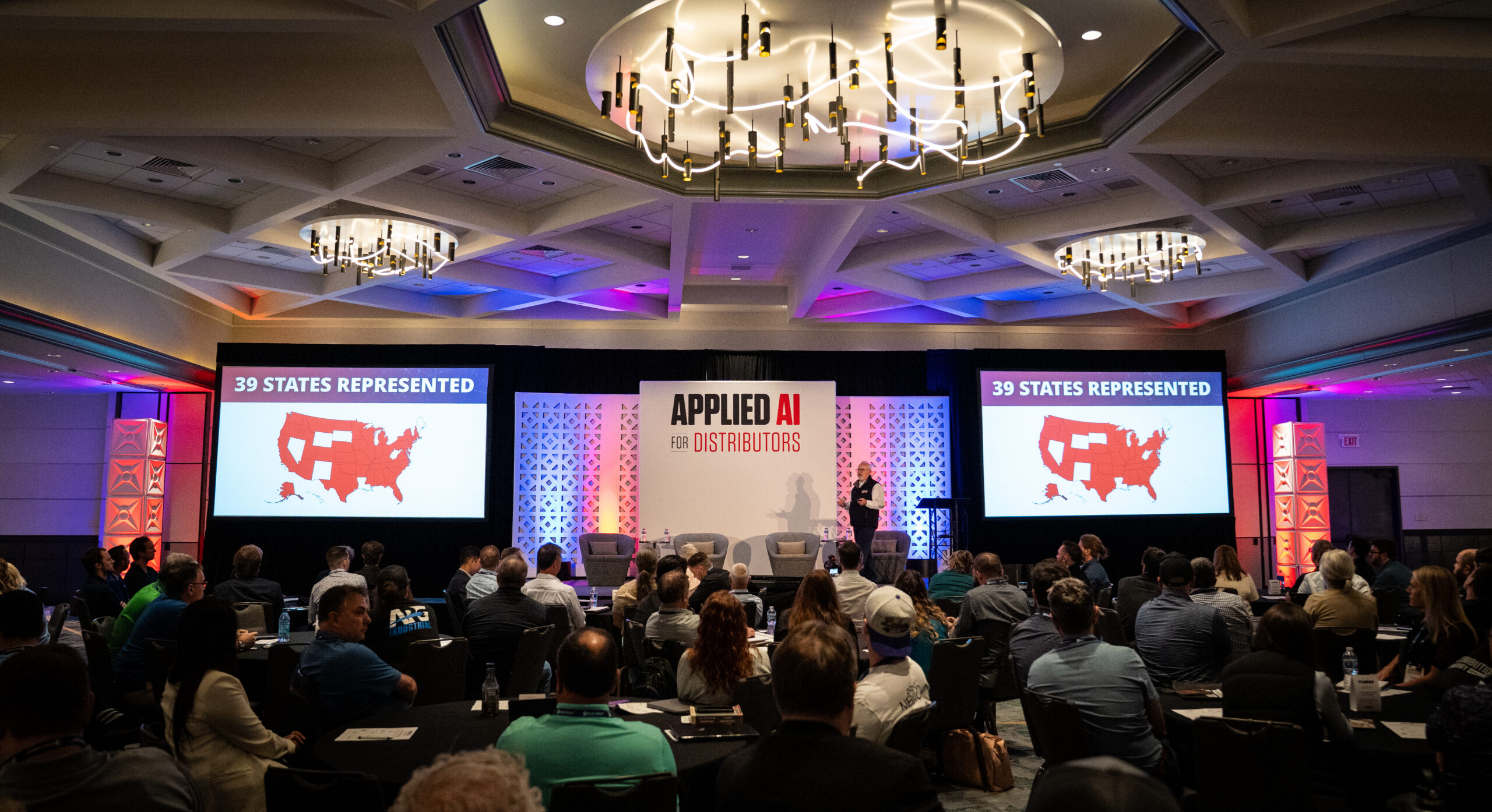
The move to the Renaissance Schaumburg Convention Center Hotel gives DSG more room for the conference, technology providers, and an expected audience of about 350. The 2026 event was held June 23 to 25 at the Chicago Marriott O’Hare in Rosemont and brought together distribution executives, technology companies, researchers, and AI practitioners.
Speakers included executives from Graybar and W.W. Grainger, while sessions examined applications ranging from sales and intelligent search to pricing, forecasting, purchasing, inventory management, and agentic AI. DSG also expanded Applied AI beyond Chicago in 2026, adding a regional event in Atlanta and a U.K. and Europe forum in Birmingham, England.
The expansion comes as distributors face decisions about how quickly to invest in AI and which applications can produce meaningful returns. Heller said distributors historically have been deliberate in adopting technology rather than pursuing new products simply because they are available.
“You’ll hear a lot of knocks against distributors, like how they are technologically behind the times,” Heller said. “But you know what? They make choices that work for their business, and I think they’re more interested in mature technologies that really work than trying to impress everybody with being bleeding edge adopters.”
AI, however, may compress that decision making cycle. “This is coming, and I mean, whether you like it or not, that’s the thing; it doesn’t matter,” Heller said. “It’s coming, and if you don’t do it, your competitors are going to be doing it.”
Focus Shifts to Results
The 2027 conference also will put greater emphasis on what AI investments produce. At the 2026 conference, Bein outlined potential gains in areas including accounts receivable, inventory management, sales, and construction takeoff.
He projected that AI eventually could help distributors reduce required inventory by more than 10% while improving inventory turns and fill rates. AI powered construction takeoff applications also can convert customer drawings into bills of materials faster than traditional manual processes.
“For distributors that can do this, it’s a big value to their customers,” Bein said.
The larger issue for 2027 is whether distributors can repeat those gains across their businesses. As spending on AI rises, executives will increasingly need to measure improvements in productivity, labor efficiency, customer service, inventory performance, revenue, and operating costs rather than simply count the number of AI projects underway.
That marks a change from the first phase of AI adoption in distribution, when the focus was on understanding the technology and identifying potential use cases. The next phase is about execution, including determining which applications work, integrating them into existing operations, scaling successful deployments and measuring the results.
Applied AI for Distributors 2027 is being expanded around that transition. Registration is open for the June 22 to 24 conference, with individual registration currently priced at $1,895 and a $500 discount for additional attendees from the same organization after the first attendee registers at the full rate.
Additional speakers, technology companies, and sessions are expected to be announced as DSG builds out the 2027 program.
For more information click here
Do not miss any content from Distribution Strategy Group. Join our list.
Share this article:
