


Why This Matters to Distributors: Sonepar’s new global Data and AI platform is about more than adding artificial intelligence applications. The €33.6 billion ($38.1 billion) electrical distributor is building common data and AI infrastructure across a business spanning 40 countries, 90 brands, 180 distribution centers and about 2,400 branches. The strategy is designed to let Sonepar develop AI applications centrally, deploy them across multiple businesses and use its enormous volume of sales, customer, and logistics data to improve forecasting, inventory, sales productivity, and customer experience.
Sonepar’s new global Data and AI platform addresses a challenge created in part by the electrical distributor’s own size: how to use data generated across dozens of countries, operating companies, distribution centers, branches, and digital channels as a common corporate asset.
The €33.6 billion ($38.1 billion) distributor is working with French consulting and technology company Onepoint to create a common platform that analyzes sales, customer histories, and logistics data across much of Sonepar’s global operation. Sonepar said predictive models running on the platform already cover businesses representing 95% of group revenue.
The company plans to use the infrastructure to improve demand forecasting, adjust inventory, increase product availability, personalize product recommendations, and automate portions of sales and administrative work. Those individual applications are not necessarily new to distribution, but what makes Sonepar’s strategy notable is the scale at which the company intends to deploy them and the common technology and data infrastructure it is building underneath them.
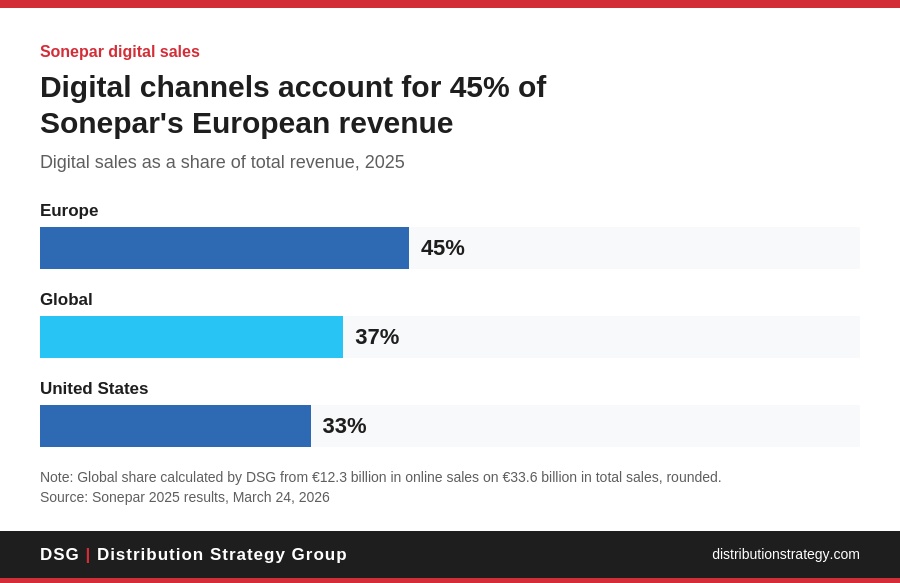
Sonepar operates in 40 countries with 90 brands, 180 distribution centers, about 2,400 branches and 46,000 employees. The company generated €33.6 billion ($38.1 billion) in 2025 sales, including €12.3 billion ($14 billion) through digital channels.
That scale gives Sonepar access to an enormous volume of transaction, customer, product, and supply chain data, but it also creates significant complexity. Different countries and operating companies have different customers, product assortments, purchasing patterns, and operating requirements, while acquisitions bring additional businesses, systems, and pools of data into the company.
Sonepar completed 10 acquisitions in 2025, adding €245 million ($278 million) in annual sales, while continuing to integrate larger acquisitions completed in previous years. The Data and AI platform is designed to create a common foundation beneath those increasingly complex operations.
Build Once, Deploy Across the Business
One of the most important elements of Sonepar’s strategy is its plan to make the platform a technological foundation for its subsidiaries. Instead of individual countries, brands or operating companies building separate data infrastructure and AI applications, Sonepar can develop common capabilities and extend them across multiple businesses.
Onepoint helped Sonepar modernize its existing data infrastructure, establish a common architecture, and migrate operations to a unified platform using Microsoft Fabric and Azure AI Foundry. The project also includes common data governance and production environments for deploying AI applications internationally.
The distinction is important because developing an AI model is only one part of putting AI into production. A distributor can build a forecasting model quickly, but running models continuously across businesses representing tens of billions of dollars in sales requires standardized data, governance, security, computing infrastructure, and connections to operating systems.
Sonepar is attempting to establish that foundation globally. Once the infrastructure is in place, additional AI applications can use an existing data environment rather than require separate technology stacks for individual projects, potentially making it easier to move successful applications from development into production across multiple businesses.
Inventory May Be the Bigger Opportunity
Personalized product recommendations are among the more visible uses of AI, but inventory and demand forecasting could have much larger operational implications for Sonepar. Electrical distribution is an inventory intensive business, with customers expecting products to be available when construction, maintenance and industrial projects require them.
That forces distributors to balance product availability against the cost of carrying inventory, a challenge that becomes more complicated across 180 distribution centers and roughly 2,400 branches. Sonepar said the new platform continuously analyzes sales, customer histories, and logistics flows, allowing predictive models to be used to improve forecasts, adjust inventory levels and increase product availability.
The platform also is being built alongside one of the industry’s largest physical supply chain modernization programs. Sonepar is investing more than €2.5 billion ($2.8 billion) in supply chain automation and another €1 billion ($1.1 billion) in its global digital platform. The company had 37 automated distribution centers operating worldwide at the end of 2025.
Those investments increasingly intersect. Warehouse automation can improve how efficiently products move through the network, while data and AI can help determine which products should be positioned in those facilities, how much inventory should be carried and where demand is likely to emerge.
Taken together, the investments suggest Sonepar is building more than a collection of AI applications. The new platform can serve as an intelligence layer over an increasingly automated physical distribution network.
Digital Growth Gives Sonepar More Data to Use
The timing also reflects how much Sonepar’s digital business has grown. The company generated €12.3 billion ($14 billion) in online sales in 2025, with digital sales representing 33% of U.S. revenue and 45% of European revenue.
That activity generates information about what customers search for, what they purchase, which products they buy together and how buying patterns change. Sonepar has spent several years building the infrastructure to collect and use that information.
When the company announced a broader digital transformation initiative in 2022, it said transactions through its Spark omnichannel platform would feed information into a common data lake. That data could then be used to identify customer behavior patterns and help automate inventory and logistics processes.
The new Data and AI platform extends that strategy. Sonepar first built the digital channels, those channels generated larger amounts of standardized customer and transaction data, and the company is now building infrastructure to apply AI to that information across its operations.
That progression helps explain why Sonepar is making the investment now. AI becomes more useful when a distributor already has large volumes of digital activity, standardized data, and modernized systems capable of feeding information into AI models and acting on the results.
Connecting the Digital and Physical Networks
Sonepar’s broader strategy is to create an omnichannel business in which ecommerce, mobile applications, sales teams, branches, and logistics operations function as parts of the same customer relationship. That requires more than a common ecommerce platform because pricing, product availability, orders, delivery information, and customer histories must remain accessible as customers move among digital and physical channels.
AI gives Sonepar another way to use the information generated by those interactions. Product recommendation systems can use purchasing histories to identify additional products, forecasting models can analyze sales patterns to anticipate inventory requirements, and automated email classification can route and prioritize customer requests.
AI also can help salespeople find and use information contained across large product and customer databases. Sonepar has identified personalized product recommendations, automated email categorization, and carbon data calculations as early examples of applications supported by the platform, with additional work planned in inventory optimization and sales support.
Those applications address different business problems, but they rely on the same underlying data infrastructure. That common foundation is what could allow Sonepar to move beyond isolated AI projects and deploy the technology across multiple functions and businesses.
Turning Scale Into a Data Advantage
Sonepar’s size has long provided advantages in purchasing, geographic coverage, product availability, and logistics. AI creates the possibility of another scale advantage based on the volume of data generated across customers, products, transactions, and supply chain operations.
A distributor processing more transactions across more customers and products can generate a larger pool of information for forecasting, recommendations, and other predictive applications, but size alone does not create that advantage. Large distributors also tend to have more systems, acquired businesses and inconsistent data, and having more information does not necessarily produce better AI if that information cannot be standardized and governed.
Sonepar’s platform is intended to address that problem by establishing common architecture and data governance across its businesses. If the company can do that effectively, its scale becomes more useful because data generated in one part of the organization can contribute to models and applications deployed elsewhere.
More transactions can produce more data, while better data can improve forecasting and recommendations. Better forecasting can improve product availability and inventory productivity, while more relevant recommendations can increase digital sales and customer engagement, generating additional information that can be fed back into the system.
The potential competitive advantage, therefore, is not simply access to an AI application. Similar applications increasingly are available to distributors of all sizes, but the harder capability to replicate is infrastructure that can apply AI consistently across billions of euros in transactions and hundreds of operating locations.
Acquisitions Add Another Reason
Sonepar’s acquisition strategy makes a common data infrastructure increasingly important. The company completed 10 acquisitions in 2025 that added €245 million ($278 million) in annual sales while continuing to integrate larger transactions completed in prior years.
Every acquisition brings additional customers, transaction histories, product information, and operating systems. A common global platform potentially gives Sonepar a framework for bringing those businesses into a larger data environment and extending existing AI capabilities to acquired operations.
Sonepar also has been consolidating some operations at the market level. In the U.S., for example, it combined five operating companies under the Echo Electric brand as part of an effort to create a more unified business.
Do not miss any content from Distribution Strategy Group. Join our list.
Share this article:
