


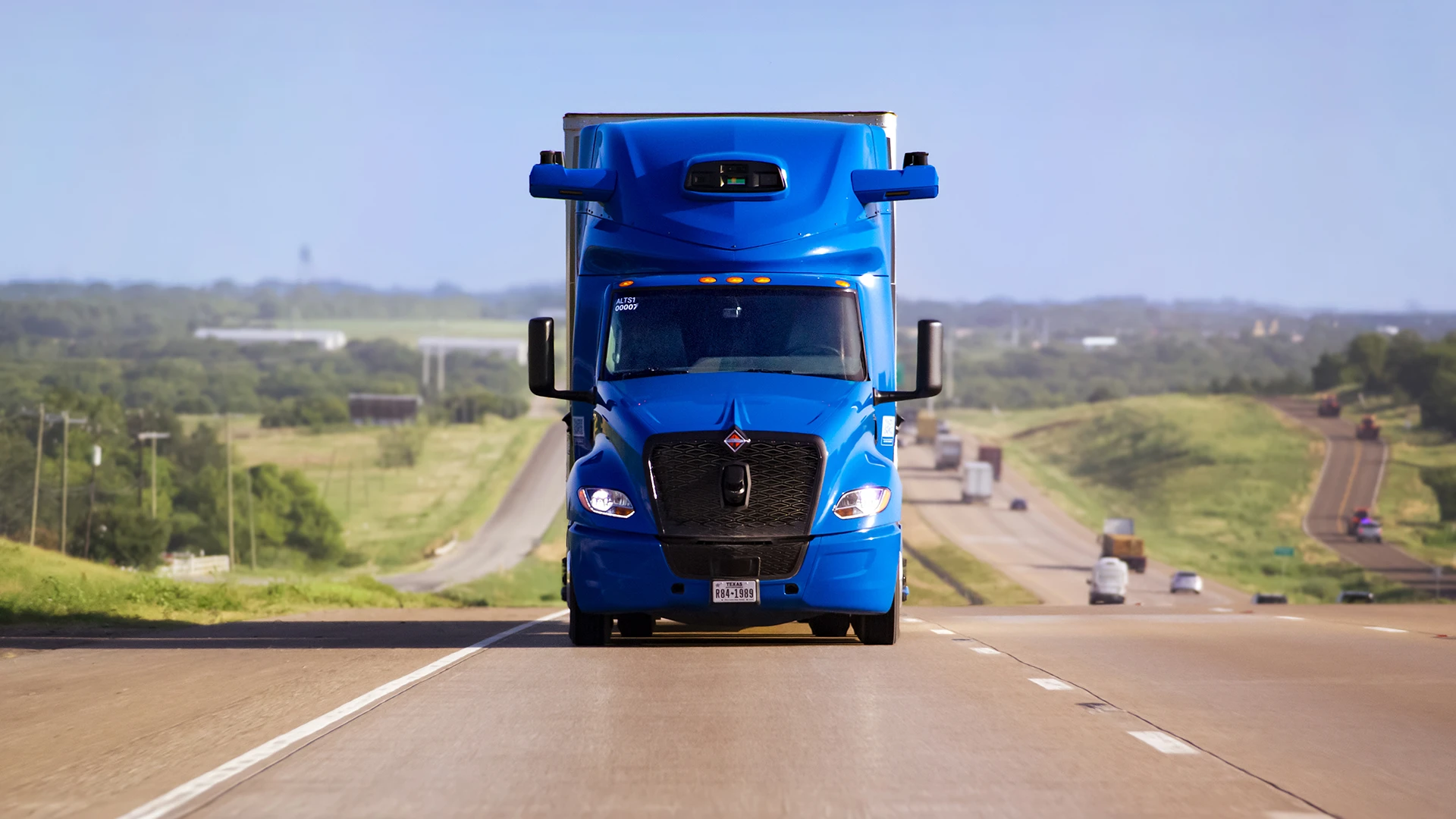
Why This Matters to Distributors: McLane’s rollout offers a model for using autonomous trucks on recurring routes between facilities while retaining drivers for customer deliveries. The potential benefit is additional hauling capacity and more consistent schedules. Other distributors will need to measure those gains against transportation costs, freight handoffs, and service disruptions.
McLane Co. is using AI-powered driverless trucks to haul restaurant supplies and perishable food between Dallas and Houston, pairing autonomous highway transportation with human drivers who make deliveries to customers.
The distributor and Aurora Innovation announced the transition to driverless commercial hauls May 6, following a supervised pilot that began in 2023. By the announcement, the companies reported more than 280,000 autonomous miles, 1,400 loads and 100% on-time performance during the pilot. Those figures cover the supervised program, rather than exclusively driverless service.
McLane, a Berkshire Hathaway subsidiary founded in 1894, distributes products to convenience stores, mass merchants, and chain restaurants nationwide. The autonomous trucking agreement supports its restaurant supply business.
The companies’ operating model assigns long-haul freight movement to Aurora’s self-driving system and customer deliveries to McLane drivers. During the pilot, service expanded to two round trips daily between Dallas and Houston, seven days a week.
AI Handles the Driving
McLane’s deployment uses the Aurora Driver, a Level 4 autonomous driving system. Within its defined operating conditions, the system performs the driving task without a human driver.
Cameras, radar and lidar — laser-based sensing equipment — collect information about the truck’s surroundings. Machine learning helps the system identify and track vehicles, pedestrians, and other objects, then estimate their position, speed, and movement.
Aurora’s January 2026 technical explanation describes a neural network that processes information from all three sensor types and continually updates its estimates. Those calculations help the system interpret traffic and obstacles before determining how the truck should respond.
Aurora combines artificial intelligence and machine learning with engineered rules in its perception and motion-planning systems, according to its annual filing. Together, those systems support decisions about steering, speed, and braking.
The announced McLane application centers on driving. The companies have not established in the rollout announcement that AI also manages McLane’s dispatching, inventory, or refrigeration controls.
Highway Hauls and Customer Deliveries
McLane is introducing autonomous trucks into one part of its transportation network while keeping employees responsible for deliveries to restaurants.
“Autonomous technology helps us drive greater efficiency across the supply chain, while our drivers remain focused on the critical last mile,” said Susan Adzick, president of McLane Restaurant.
The companies said they would retain that division of work as the partnership expanded. They described autonomous refrigerated hauling to provide reliable capacity, accommodate demand, and address labor constraints, but did not disclose McLane-specific cost savings.
Aurora provided a broader utilization measure in September. The company said trucks serving McLane, Werner and other customers were averaging an annualized rate of more than 225,000 miles, which it described as more than twice the utilization of a traditional truck.
The figure covers multiple customers and is not a McLane-specific average. Higher utilization also does not, by itself, establish lower transportation costs or a financial return for the distributor.
The May announcement included plans to add routes between McLane distribution centers across the Sun Belt by year-end. It did not confirm that those additional routes were already operating.
What the Model Means for Other Distributors
McLane’s approach suggests that recurring freight moves between facilities offer a starting point for distributors evaluating autonomous transportation. Its deployment has a defined highway route, regular freight demand and human drivers handling the customer delivery portion of the trip.
For another distributor, the first question is whether its network has comparable lanes. Scheduled transfers between distribution centers present different requirements from routes with numerous customer stops, changing delivery instructions and unloading responsibilities.
The financial case depends on the entire freight movement. Transportation charges, loading and unloading, transfers between vehicles, equipment availability and procedures for interrupted trips all affect the cost of serving customers. Additional truck capacity is useful only when freight volume and receiving operations can support it.
Reliability also requires careful measurement. McLane’s reported pilot performance provides evidence about the supervised service, but it does not establish the same result for every subsequent driverless trip. Distributors would need to compare on-time arrivals, downtime, and service recovery with their existing transportation options.
The staffing implications remain similarly limited. McLane has said its drivers will continue making customer deliveries, but the rollout announcement does not quantify changes in total driver employment or transportation labor costs.
Operational responsibility is another consideration. Shipping and receiving facilities and the autonomous carrier need clear procedures for inspections, freight handoffs, delays, and trips that cannot proceed as scheduled.
McLane’s rollout illustrates how autonomous trucks can be integrated into an existing distribution network. Whether the model works elsewhere will depend on the volume, costs, and service requirements of each distributor’s routes.
Do not miss any content from Distribution Strategy Group. Join our list.
Share this article:
