

Why This Matters to Distributors: Distributors are using artificial intelligence to prepare quotes, process orders, manage inventory and support purchasing. Earnings disclosures offer examples of faster work and early savings, although most companies have not separately quantified AI’s contribution to earnings.
Distributors reporting quarterly results this earnings season described expanding internal uses of artificial intelligence, with Fastenal reporting faster sourcing and quoting, MSC Industrial Supply revising its technology investment strategy and Sysco outlining purchasing and routing projects supporting a multiyear savings program.
Wesco International said AI applications were improving analytics and productivity, while Ingram Micro reported increased use of automated email-to-order processing. The disclosures show how distributors are applying the technology to daily operations, although companies have not isolated its effect on earnings.
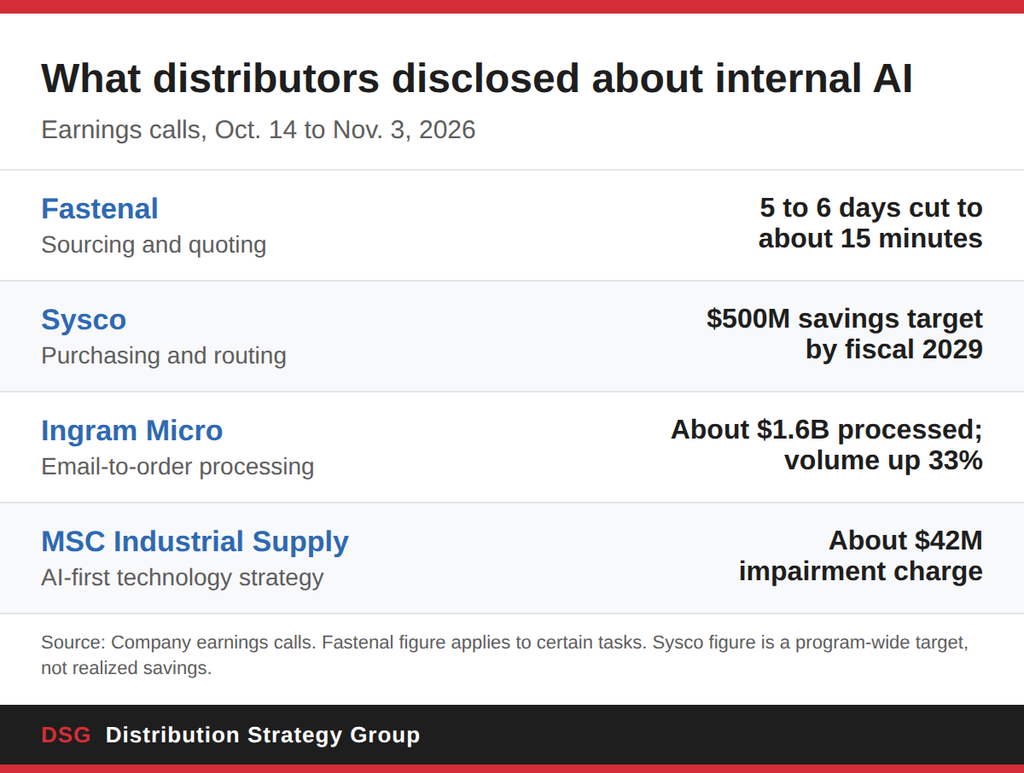
Fastenal provided one of the most specific examples during its Oct. 14 third-quarter earnings call. President and CEO Jeff Watts said tools combining AI with internal technology could reduce certain sourcing and quoting work from five or six days to approximately 15 minutes.
Watts said Fastenal began developing the tools by examining branch efficiency. Managers increasingly were requesting technology to handle additional business rather than automatically seeking more employees. He emphasized that the company would continue adding workers where needed.
Fastenal also discussed a small technology acquisition that brought capabilities to coordinate its AI and technology systems. Management did not disclose a separate estimate of AI savings or indicate that the quoting example represented an average across the company.
At MSC, AI is influencing both operating processes and technology spending. During its Oct. 22 fiscal fourth-quarter call, President, and CEO Martina McIsaac said the company discontinued Digital Core, a program intended to modernize purchasing, payment, order processing, and collections, following a review of its technology infrastructure.
MSC adopted an “AI-first modular approach,” a change that resulted in an approximately $42 million asset impairment charge. McIsaac said smaller implementations would offer greater flexibility, reduce fixed costs, and produce returns sooner.
Management identified AI applications in guided selling, inventory placement, safety assessments, product matching, product information management, and order automation. MSC also appointed Andrei Dumitriu vice president of business systems and AI strategy.
The company linked those projects to its broader productivity and operating margin objectives but did not disclose the financial contribution of individual applications.
Sysco outlined financial targets during its Nov. 3 fiscal first-quarter call. Its AI- and technology-supported business improvement program targets $100 million in net cost savings in fiscal 2027 and $500 million by the close of fiscal 2029.
Those figures represent expected benefits from the overall program, which includes technology and operating changes beyond AI. They do not represent savings already realized.
Management described an early purchasing application: an AI-supported request for proposals that completed work autonomously under human supervision. Sysco said the resulting procurement savings exceeded its target by approximately 30%. That figure compares actual savings with the company’s target; it does not mean the purchase price fell 30%.
The foodservice distributor also described routing optimization operating in pilot regions. Management expects fiscal 2027 program savings to increase in the second half.
Wesco Chairman, President and CEO John Engel said during the company’s Oct. 29 third-quarter call that its internal AI applications had progressed beyond conventional analytics.
The company has “generative and true agentic AI applications running inside our environment,” Engel said, referring to systems that generate content or analysis and applications capable of carrying out tasks. They draw on transaction, customer and supplier information, supplemented with outside data, collected in a central data system.
Engel said AI was improving analytics and productivity and began to help control operating costs as sales increased. Wesco did not separately quantify that contribution.
He also said the company was obtaining benefits before completing deployment of its new technology platform at every location, allowing AI implementation to proceed alongside the broader systems rollout.
Ingram Micro’s Oct. 29 third-quarter call included an update on email-to-order processing through its Xvantage platform. Management said email-to-order volume increased 33%, processing approximately $1.6 billion in revenue.
That figure measures revenue managed through the process, rather than additional sales generated by AI or labor savings. Management linked broader operating improvements to platform automation and other actions but did not isolate the earnings contribution from email-to-order processing.
Henry Schein also identified AI among internal efficiency initiatives during its Nov. 3 third-quarter call. Management said it was prioritizing projects based on their expected impact and return, alongside shared services, outsourcing and supply chain tools intended to improve efficiency, reduce inventory, and simplify processes.
The company did not provide a separate savings estimate for internal AI applications or detail their individual financial contributions.
Do not miss any content from Distribution Strategy Group. Join our list.
Share this article:
