
Why This Matters to Distributors: TD SYNNEX’s strategy shows how technology distribution is shifting as vendors reduce the number of channel partners they work with, and customers require more help deploying increasingly complex AI, data center, and networking systems. TD SYNNEX is responding by adding vendors and customers, expanding existing relationships into new markets, and moving deeper into engineering, integration, financing, and supply chain services. For distributors, the broader takeaway is that growth increasingly may depend not just on carrying more products, but on becoming more valuable to both suppliers and customers through specialized expertise, digital capabilities and services that make complex technologies easier to buy and deploy.
TD SYNNEX is winning new customers, expanding relationships with major technology suppliers, and moving deeper into artificial intelligence infrastructure as the company positions itself to capture more business from vendors consolidating their distribution networks.
The global technology distributor said it has added multiple billions of dollars in gross billings over the past year through new customer wins and an expanded vendor lineup. At the same time, its Hyve Solutions business is ramping three new hyperscale customers and multiple programs with those customers.
CEO Patrick Zammit said TD SYNNEX also sees technology manufacturers reducing the number of companies they work with as technology becomes more complex, potentially shifting more business toward distributors that can provide global reach and technical expertise.
“We see, at the same time, in the vendor community, a trend accelerating in terms of rationalizing the go-to market, reducing the number of direct customers, direct resellers, and number of distributors,” Zammit told analysts during the company’s fiscal third-quarter earnings call. “Because of our value prop, because of the relationships we’ve built over the years, I think we are going to continue to benefit from that trend.”
The comments provide a closer look at the strategy behind TD SYNNEX’s growth as it adds vendors, expands existing supplier relationships into new countries, gains new customers, and takes on larger AI and data center infrastructure projects.
The strategy is unfolding as TD SYNNEX posts sharply higher sales and earnings. Revenue for the fiscal third quarter ended Aug. 31 increased 37.7% to $21.558 billion from $15.651 billion a year earlier. Net income increased 83.5% to $416.240 million from $226.795 million.
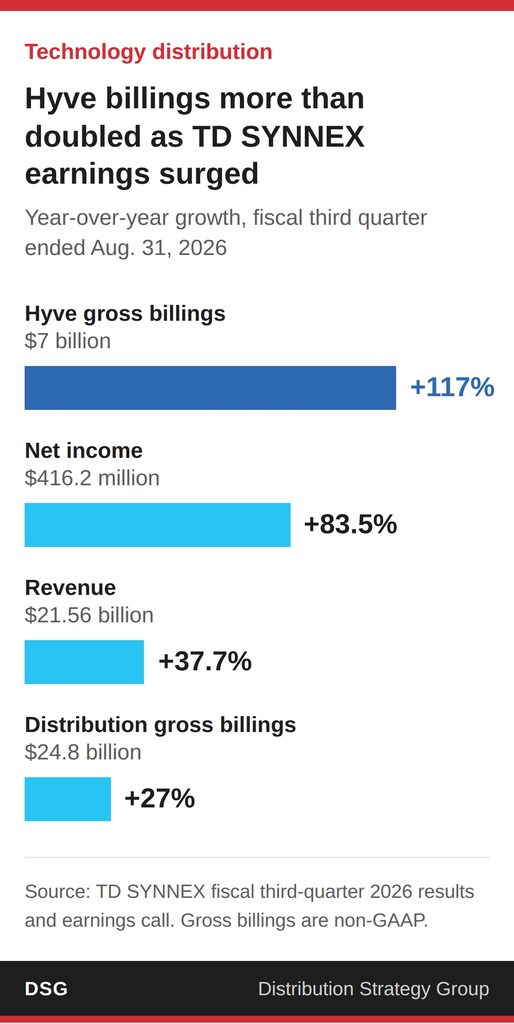
For the first nine months of fiscal 2026, revenue increased 29.2% to $58.294 billion from $45.129 billion during the same period a year earlier. Net income increased 86.0% to $1.077 billion from $579.253 million.
The company’s distribution business generated $24.8 billion in non-GAAP gross billings during the third quarter, up 27% from a year earlier, with double-digit growth across each region and most major technology categories.
TD SYNNEX believes growing complexity across corporate technology systems is increasing the role of distributors that can combine products from multiple suppliers with technical, financing, deployment, and other services.
“Vendors are looking for partners that can not only efficiently reach customers but enable customer capabilities, activate demand, and execute consistently around the world,” Zammit said. “This is increasing the strategic importance of Distribution.”
One example is TD SYNNEX’s expanded relationship with IBM.
TD SYNNEX announced in August that it had expanded its IBM distribution footprint into 20 additional countries across Europe, Asia-Pacific and Latin America. The expansion extends the distributor’s access to IBM products and services and gives more channel partners access to TD SYNNEX programs supporting IBM sales.
“We believe this expansion reflects the strength of our go-to-market model and the confidence our vendors place in our ability to activate demand, execute consistently across end markets around the world, and accelerate growth,” Zammit said.
The IBM expansion is part of a broader business-development push. Zammit said new customer wins and additions to TD SYNNEX’s vendor lineup have collectively added multiple billions of dollars in gross billings during the past year.
“More importantly, we believe these relationships deepen our role in the technology ecosystem and create additional opportunities for long-term profitable growth and potential earnings expansion,” he said.
AI infrastructure is becoming another major piece of that strategy.
TD SYNNEX and Mach3 Systems have signed an agreement to support an NVIDIA AI factory powered by Vera Rubin NVL72 systems. TD SYNNEX described it as one of the largest enterprise AI factory infrastructure deployments expected to be delivered through the channel.
The project combines design, integration, deployment, financing, supply chain support, and ongoing administration for an NVIDIA-based AI infrastructure platform for a large enterprise customer.
“One area we are particularly encouraged by is the growing number of enterprises moving from AI experimentation towards production-scale centralized AI factory deployments,” Zammit said.
That shift could expand the distributor’s role beyond supplying computing equipment. Companies deploying AI on a scale also must determine which models to use, where workloads should run and how to manage cost, security, and governance across private, public, hybrid, and edge computing environments.
TD SYNNEX expects distributors with technical capabilities across those areas to have an opportunity to participate in more of the technology deployment.
“What we see is some very large deals coming from large enterprises, but we are starting to see also mid-size companies investing in that space,” Zammit said.
TD SYNNEX is simultaneously expanding Hyve Solutions, its hyperscale infrastructure design, manufacturing, and supply chain business.
Hyve generated $7 billion in non-GAAP gross billings during the third quarter, up 117% from a year earlier. Manufacturing grew more than 130% and accounted for approximately two-thirds of Hyve’s gross billings. Supply chain services grew more than 90%.
Chief Financial Officer David Jordan said Hyve is ramping three new hyperscale customers along with multiple programs within those accounts.
“Hyve is ramping three new hyperscalers and multiple programs within each of those customers,” Jordan said. “The new programs that we have won, which are predominantly manufacturing, are neutral to accretive to Hyve.”
Networking is emerging as a significant part of that new business.
“If you look at the new programs we have won, they are primarily networking programs,” Zammit said. “Again, at a good margin. We started seeing some of the ramp this quarter, and we are going to see an acceleration in Q4 and Q1.”
Hyve also is working with multiple customers on advanced liquid-cooled networking racks that TD SYNNEX expects to enter production during the first half of fiscal 2027.
The company said increasingly sophisticated infrastructure requirements are causing customers to bring Hyve into projects earlier, creating opportunities in engineering, validation, manufacturing, and supply chain management.
That growth, however, requires TD SYNNEX to invest before many of the new programs begin generating their full returns. The company has been spending on working capital, manufacturing expansion, engineering talent, and other technical capabilities to support the new business.
Jordan said hyperscale programs can require a lengthy startup period but can continue for several years once they are established.
“When you go into one of these programs, it can take you a year to get up to speed,” Jordan said. “What we’re working on is we’ve won a category within a hyperscaler where we support a multiyear piece of technology.”
“In many cases, these programs can last a few years, but there is always the potential that volumes can move around,” he added.
Digital commerce is another part of TD SYNNEX’s strategy to increase business with existing customers.
Zammit said customers that use TD SYNNEX’s digital offerings have increased their spending with the company at twice the pace of similar customers. TD SYNNEX has been expanding PartnerFirst and Digital Bridge while adding AI agents to parts of the customer experience.
In August, TD SYNNEX separately announced additional data-driven commerce capabilities for PartnerFirst in North America, including greater automation, visibility, and customer insights.
“Whether customers engage through digital platforms, technical specialists, enablement programs, or a combination of all three, our objective remains the same: helping our customers build capabilities, grow their business, and better serve their end users,” Zammit said.
The combination of new customers, expanded vendor relationships, digital tools and larger infrastructure programs reflects an effort by TD SYNNEX to take a larger role in how technology reaches corporate customers.
Zammit said that strategy is helping the distributor gain business as customers deal with increasingly complicated technology requirements.
“As you have noticed, we grew faster than market, and we’ve done that now consistently for many quarters,” he said. “I think it’s due to two things. One, from a customer side, indeed, we have this collection of specialist approach, which means that we have a very appealing value-added proposition by technology.”
TD SYNNEX also said it has not seen evidence of a slowdown in the data center business in the customer forecasts and backlog it currently has.
“When you look at the forecast we’ve received or the backlog we have, we don’t see any sign of concern today,” Zammit said.
For TD SYNNEX, the business-development strategy increasingly depends on the premise that AI and data center expansion will require more than simply supplying hardware. The company is positioning Distribution and Hyve to participate in designing, financing, manufacturing, integrating, and supporting the infrastructure required to put those systems into production.
“Enterprise AI adoption is progressing toward broader production deployments,” Zammit said. “Data center modernization remains a priority as organizations prepare for next-generation infrastructure requirements, while AI is driving new security, governance, and compliance requirements across technology environments.”
Do not miss any content from Distribution Strategy Group. Join our list.
Share this article:
