



Why This Matters to Distributors: Artificial intelligence tools increasingly can access negotiated prices, supplier rebates and customer purchasing histories. A survey from Instalily found that some businesses have experienced improper handling of that information, while questions from customers and suppliers are influencing technology purchases.
Artificial intelligence tools are gaining access to the confidential pricing and account records that distributors use to run their businesses, raising questions about how companies protect information entrusted to them by customers and suppliers.
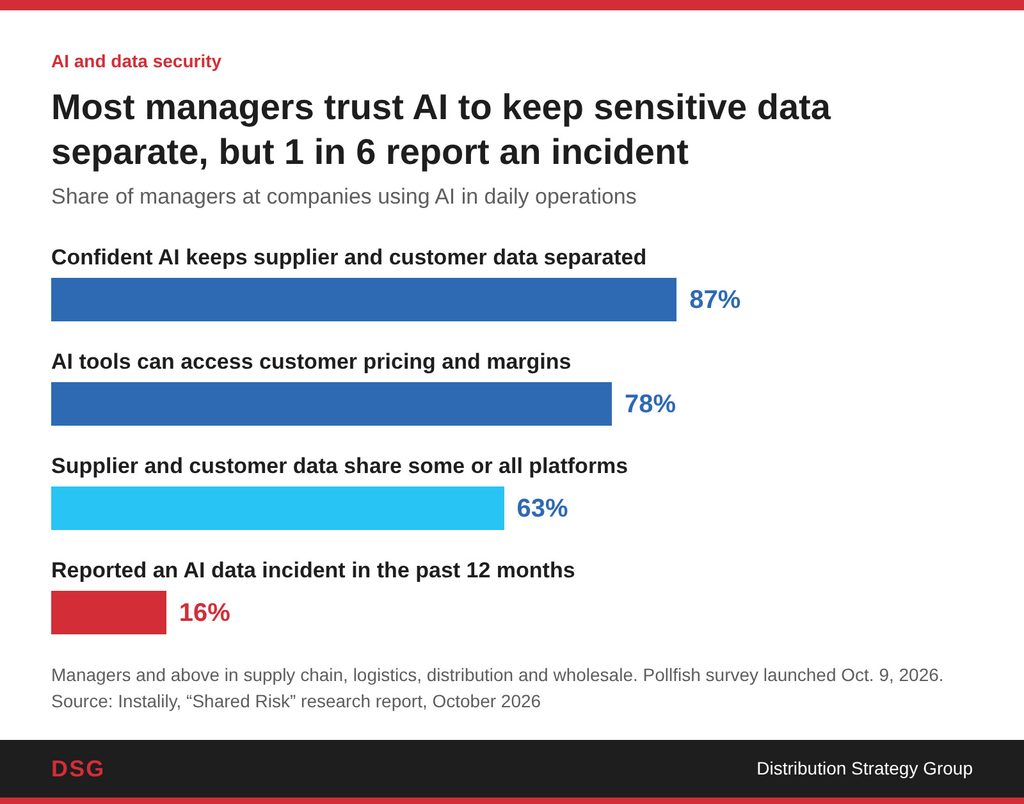
A survey by AI provider Instalily found that 16% of 250 managers and executives in supply chain, logistics, distribution and wholesale said their employer experienced an incident in the previous 12 months involving supplier or customer data being exposed, shared or accessed incorrectly through an AI tool.
The research highlights a challenge for distributors expanding AI into quoting, purchasing, and account management. Those applications depend on access to commercial information, but they must also preserve restrictions on who can see negotiated prices, supplier rebates, and account histories.
The reported incidents involved 40 respondents. The survey did not establish their severity or whether information reached anyone outside the business, and the report did not provide a separate incident rate for distributors. Overall, 81% reported no incident, while 3% were unsure.
“Speed means very little if a faster answer costs you a relationship that took years to build,” Adam Isenberg, head of distribution at Instalily, said.
Access to sensitive records was widespread among the companies represented in the survey. Across the full sample, 78% of respondents said their employers’ AI tools could access customer pricing and margins, and the same share reported access to customer purchasing histories. Another 67% reported access to supplier pricing and rebate data, while an equal share said the tools could access internal financial information.
Among respondents who identified their industry as distribution, 77% said AI tools could access customer pricing and margins. Approximately 70% reported access to supplier pricing and rebates.
For distributors, those records help determine what to recommend, how to price an order and when to follow up with an account. The risk arises when information needed to complete an internal task appears in a response or document intended for someone who is not authorized to receive it.
An AI tool preparing a customer quote, for example, may need access to product costs and account terms. That access should not allow it to disclose a confidential supplier rebate or another customer’s negotiated price. These are potential failures described in the report, rather than documented outcomes of the reported incidents.
AI already plays a substantial role in the participating companies’ operations. About 76% of respondents said more than a quarter of their employers’ daily operations involved an AI tool, including AI features embedded in existing software. About 34% said AI touched more than half of daily operations.
Those figures describe companies already using AI. They do not measure adoption across distribution or establish that AI performs those tasks independently.
Confidence in data protection remained high. About 45% of respondents were confident their AI tools kept supplier and customer information appropriately separated, and 42% were confident.
Meanwhile, 51% reported some overlap between supplier and customer data across company platforms, including AI tools, and 12% reported full overlap. Only 32% said the information was held in separate systems.
Shared platforms do not inherently compromise confidentiality, the report notes. Permissions can restrict access within a common system. The question for distributors is whether those restrictions remain effective when AI retrieves records, combines information and generates a response.
The report recommends testing realistic tasks before expanding AI access. Those tests could examine whether an employee can retrieve account terms beyond that employee’s permissions or whether a customer quote could disclose confidential supplier information.
Customers and suppliers are already asking businesses to explain their protections. About 63% of respondents said their employer had received an inquiry about how supplier or customer information was protected.
Among those respondents, 47% said the inquiry affected a decision involving a vendor, software, or an AI tool. That represents 74 respondents, or approximately 30% of the full sample.
The findings suggest that distributors’ technology evaluations increasingly involve questions from trading partners as well as internal operational needs. The report recommends establishing which records an AI tool can access, how permissions apply and what records are available to investigate its use.
Respondents most often expected their own employer to bear the greatest responsibility for an exposure. About 51% identified their company, compared with 23% who identified the software or AI vendor and 20% who expected shared responsibility. Those responses reflect perceptions of accountability, rather than findings about legal liability.
Decisions about AI access rested with technology teams. About 66% identified information technology or security as the primary decisionmaker, followed by individual department heads at 17% and operations leadership at 14%.
The reported barriers to keeping supplier and customer data separate were closely divided. About 22% said their biggest obstacle was that AI tools were not designed with that requirement in mind. Cost followed at 21%, and a lack of technical expertise at 20%. Another 15% said the issue was not viewed as a risk, while 20% reported no barrier.
Stronger controls also influenced respondents’ preferences for AI products. Overall, 90% said their employer would be more likely to choose AI built for distribution and supply chain operations over a general-purpose tool if it offered better control over supplier and customer information. Among distribution respondents, the figure was 89%.
That preference depended on better protection. The survey did not test competing products or establish that industry-specific tools provide stronger safeguards. The report recommends applying the same scrutiny to specialized and general-purpose AI.
Protecting supplier and customer information ranked high among respondents’ priorities for the next 12 months. About 56% rated separating that information within AI systems as a high priority, and another 36% called it a moderate priority.
Companies also were considering changes to their mix of AI tools. About 78% rated consolidating to fewer AI vendors or a single platform as a high or moderate priority. About 26% reported using several individual AI applications from different vendors, while 48% used a combination of individual applications and a platform serving multiple functions.
The survey did not link the use of multiple vendors to reported incidents. The report recommends using consolidation to review access permissions and verify that protections remain effective as work moves between systems.
The survey launched Oct. 9 and collected 250 responses from professionals at manager level or above whose companies used AI in daily operations. Its findings reflect respondents’ knowledge, perceptions, and reported experiences, rather than independent examinations of company systems or incidents.
Comparisons among industry segments were descriptive and were not tested for statistical significance. The report cautions that the results should not be presented as estimates for all businesses in the industries surveyed.
Do not miss any content from Distribution Strategy Group. Join our list.
Share this article:
