


Why This Matters to Distributors: Distributors are adding AI leaders to oversee projects, spending, and implementation. Recruiting firms estimate annual cash pay for chief AI officers can exceed $500,000 before stock awards and benefits.
Distributors are acquiring artificial intelligence companies and appointing dedicated leaders as businesses across industries expand executive oversight of the technology.
Fastenal has brought an AI company and its founder into its organization, while Meritus Gas Partners has appointed a director to oversee AI projects. The moves put responsibility for implementation inside the distributor, where decisions about data, staffing and investment must connect with sales and operations.
The appointments come amid a broader increase in corporate AI leadership. IBM’s 2026 survey of 2,000 chief executives worldwide found that 76% of surveyed organizations had a chief AI officer, up from 26% in 2025 — a 50-percentage-point increase. The figures describe the surveyed organizations, rather than all companies worldwide.
The survey does not establish how many executives work exclusively on AI. Companies use standalone positions and combined technology, data and AI titles, and a comprehensive count of dedicated AI leaders in wholesale distribution is not available from the sources reviewed.
An AI executive’s assignment begins with deciding where the technology can produce a measurable business result. Executive search firm MSH identifies strategy, implementation oversight, governance, staffing, budgeting, and employee adoption as core responsibilities.
The executive determines which projects receive funding and in what order, coordinates teams from development through deployment and monitors performance after implementation. The role also includes establishing policies and approval procedures, selecting outside providers and building the internal team needed to carry out the work.
In distribution, those responsibilities can connect AI with demand forecasting, inventory management, pricing, sales, and customer service. The leadership task is to set objectives for each application and establish who is accountable for the outcome.
Data preparation is another part of implementation. Grainger’s current recruiting materials, for example, describe work on reliable data systems, search capabilities and integration tools that support AI agents and operating decisions. An executive overseeing such work must coordinate technical teams with the employees who understand the underlying business processes.
The authority attached to the position varies. A chief AI officer may oversee strategy and investment across the company, while a director may manage projects within a broader technology or operating organization. Some companies centralize strategy and standards while assigning implementation to individual business units.
Fastenal acquired Rampp.ai, an enterprise AI company, bringing its platform and co-founder into the industrial distributor. Rampp announced the transaction on its company LinkedIn account, and co-founder Ajay Agrawal lists his position as Fastenal’s head of AI transformation, beginning in June 2026. The sources did not disclose his compensation.
Meritus Gas Partners announced Sept. 16, 2026, that it had named Rob D’Alessandro Jr. director of AI operations. His responsibilities include identifying, prioritizing, developing, and implementing AI projects across the distributor’s businesses.
QXO previously had a chief artificial intelligence officer. The building products distributor announced the appointment in November 2024, but that executive subsequently left the company.
The examples illustrate different ways to establish AI leadership. An acquisition can bring technology and personnel into the business together, while a dedicated operating position assigns responsibility for selecting and carrying out projects. Counting chief AI officers alone would miss distributors that place those responsibilities in other positions.
Finding someone to lead the work requires assessing both technical knowledge and business judgment. Available public evidence does not establish chief AI officer, or any other AI position, as the hardest job to fill across distribution.
MSH recommends asking candidates to explain an actual AI implementation, including data constraints, deployment decisions, and oversight. A separate assessment uses a prospective employer’s business needs to test whether the candidate can develop a plan executives will fund.
The firm identifies technology companies, consultancies, startups, and internal data science teams as potential sources of candidates. It estimates a well-run chief AI officer search takes four to six months, although that estimate covers the broader executive market rather than distributors specifically.
For a distributor, defining the assignment shapes the candidate pool. Coordinating vendors and individual projects requires a different background from building an AI organization, managing investment, and overseeing implementation across multiple business units.
Annual Cash Pay Can Exceed $500,000
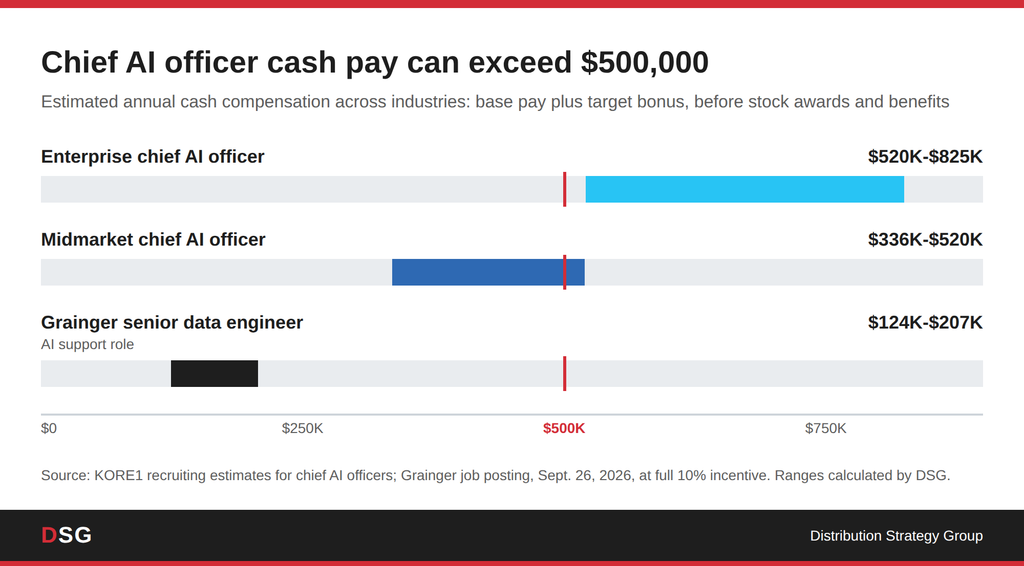
Recruiting firm KORE1 estimates midmarket chief AI officers earn annual base salaries of $280,000 to $400,000, with target bonuses of 20% to 30%. Applying the bonus targets to the endpoints yields $336,000 to $520,000 in annual cash compensation before stock awards and benefits.
For enterprise positions, KORE1 estimates base salaries of $400,000 to $550,000 and target bonuses of 30% to 50%. Those figures yield $520,000 to $825,000 in annual cash compensation before stock awards and benefits.
The figures are calculations based on recruiting estimates across industries, rather than disclosed distributor compensation. Signing payments and awards replacing stock forfeited at a previous employer can increase first-year compensation without becoming recurring annual pay.
Distributor job postings provide more specific information about technical positions supporting AI. Grainger’s Sept. 26 posting for a senior data engineer lists annual base pay of $112,900 to $188,100, with an incentive target of up to 10%.
At a 10% incentive payout, annual cash compensation would range from $124,190 to $206,910. The posting also lists a 6% company contribution to a retirement savings plan, health coverage, and other benefits.
The position supports data systems for AI agents, analytics, and operating decisions. Its compensation provides an example of technical staffing costs, rather than a benchmark for chief AI officer pay.
Broader research indicates employers pay a premium for AI skills. PwC’s 2026 Global AI Jobs Barometer, which analyzed more than 1 billion job advertisements, reported an average wage premium of 62% for workers with those skills. The findings span industries and countries and do not establish a distributor-specific premium.
Corporate survey results show a sharp increase in formal AI leadership. Distributor announcements show how companies are assigning responsibility for the work, but disclose little about executive compensation, recruiting time or which searches have proved most difficult.
Do not miss any content from Distribution Strategy Group. Join our list.
Share this article:
