

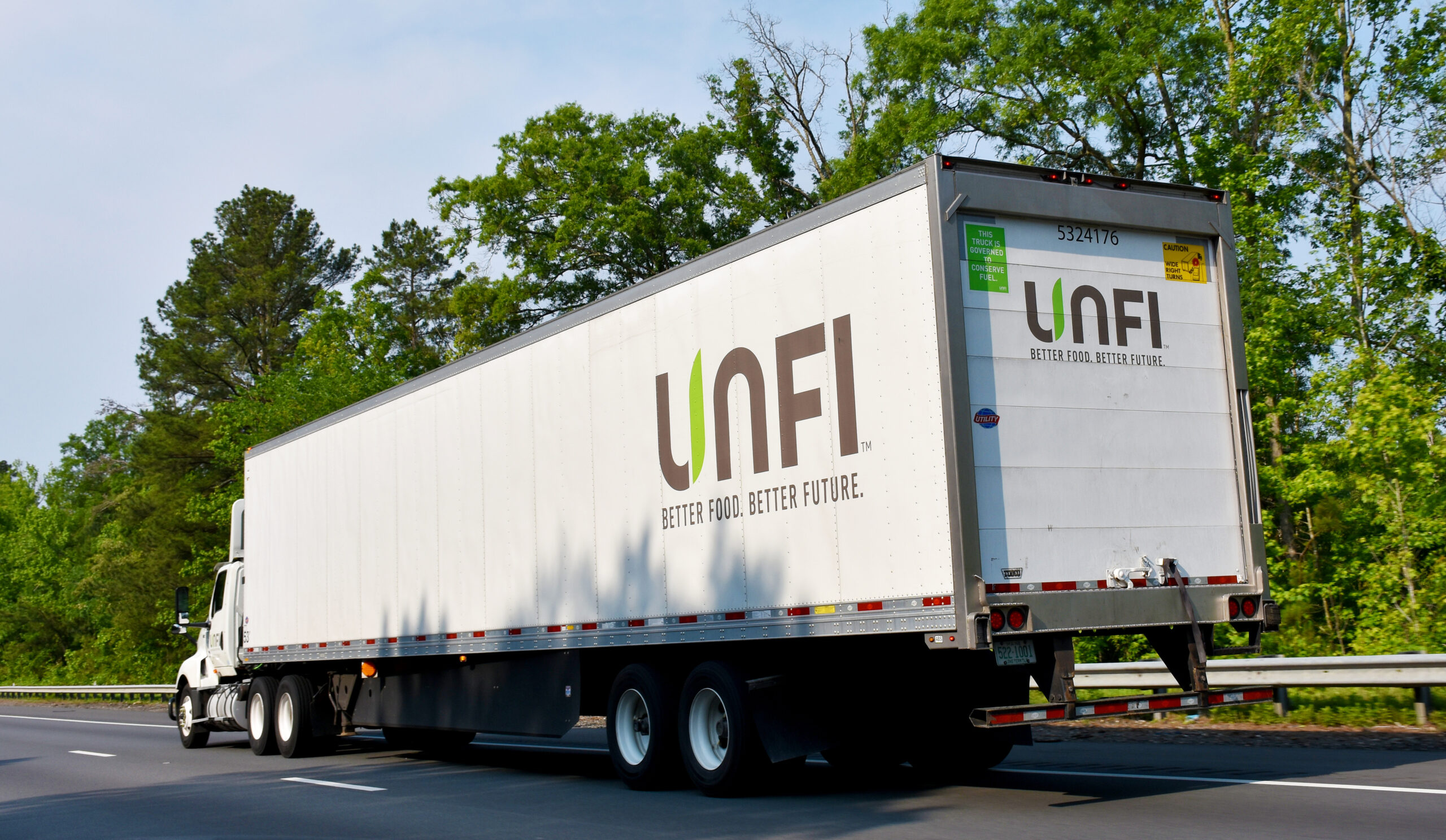
United Natural Foods Inc. returned to profit in its fiscal second quarter, as cost reductions, supply chain changes, and expanded use of AI tools improved operations even as sales declined.
For the 13 weeks ending Jan. 31, UNFI reported net sales of $7.947 billion, down $211 million, or 2.6%, from $8.158 billion a year earlier. Net income was $20 million, compared with a net loss of $3 million in the prior-year quarter.
For the first half of fiscal 2026, sales totaled $15.787 billion, down $242 million, or 1.5%, from $16.029 billion a year earlier. Net income was $16 million, compared with a net loss of $24 million in the prior-year period. Because results improved from a loss to a profit, percentage comparisons for net income are not meaningful.
The sales decline was tied to internal restructuring. The company said optimization actions reduced revenue by 500 basis points in the quarter, driven primarily by the exit of its Allentown, Pennsylvania, distribution center.
President and chief financial officer Giorgio Tarditi said underlying demand was also uneven.
“These results also reflect inflation, favorable mix and sequentially weaker underlying food retail trends, partially driven by SNAP uncertainty, weather-related volatility and a dynamic operating backdrop,” Tarditi said.
By segment, natural product sales rose to $4.290 billion from $4.021 billion, up $269 million, or 6.7%. Conventional sales fell to $3.392 billion from $3.861 billion, down $469 million, or 12.1%, while retail sales declined to $560 million from $610 million, down $50 million, or 8.2%.
Despite the top-line decline, executives said the underlying business showed modest growth when excluding optimization actions. Tarditi said, “if you normalize the 2.5% sales decline with the 500 basis points of network optimization, we actually saw low single-digit growth in the broader business.”
The company used the earnings call to outline operational changes aimed at improving performance.
CEO Sandy Douglas said UNFI is expanding RELEX, an AI-based supply chain planning system, across its network.
“Roughly another dozen distribution centers are expected to go live next week, and we expect we will complete our implementation by fiscal year-end,” Douglas said.
He said the system is helping improve “customer service, fill rates and inventory management,” contributing to stronger cash flow.
UNFI is also expanding its private-label offerings. Douglas said the company has launched “nearly 50 new private label SKUs” so far, this fiscal year, focused on areas including health and wellness, value, and convenience.
At the same time, the company is pushing operational changes across its distribution network. Tarditi said lean daily management has been implemented in 36 distribution centers.
He said distribution center productivity increased “over 6%,” while “shrink” declined by more than 11% from a year earlier. Throughput and on-time deliveries each increased by 7%.
Douglas said those improvements are part of a broader operational shift.
“Fill rates are higher than they were last year as us on time continues to improve. Our shrink is down,” he said.
UNFI also pointed to stabilization in parts of its retail business. Tarditi said same-store sales trends improved sequentially, with declines narrowing to 2% in the quarter from 3% in the prior quarter.
Looking ahead, the company lowered its full-year sales forecast to a range of $31.0 billion to $31.4 billion, down from a previous range of $31.6 billion to $32.0 billion. It raised its net income outlook to $50 million to $75 million, from $0 to $50 million.
Tarditi said the revised sales outlook reflects faster-than-expected optimization actions and softer retail conditions, while new business is expected to contribute more to the next fiscal year.
Douglas said those dynamics should reverse.
“We expect that the cycling of larger optimization actions in Q1 2027 will allow our business to return to growth in fiscal 2027,” he said.
He added that most future growth is expected to come from existing customer relationships. “The majority is incremental categories with existing customers,” Douglas said.
Do not miss any content from Distribution Strategy Group. Join our list.
Share this article:
