



Why This Matters to Distributors: AI is becoming a key factor in selecting logistics providers, but a new study finds a readiness gap. While 93% of shippers consider AI capabilities important, only 12% of logistics providers say they are highly prepared. Data quality, systems integration, and uncertain financial returns remain major obstacles.
Artificial intelligence is moving into daily supply chain operations, but most logistics providers remain only moderately prepared to deliver the technology at scale, according to a new industry study.
The 2027 Third-Party Logistics Study found that 93% of shippers consider AI capabilities important, particularly important or critical when selecting or retaining logistics providers. However, only 12% of third-party logistics providers, or 3PLs, described themselves as highly prepared to deliver AI-enabled operations, while 82% rated themselves moderately prepared.
The findings point to a widening challenge for logistics providers as customers increasingly expect AI to improve transportation planning, inventory management, order fulfillment, and supply chain visibility.
The research is part of the 31st annual Third-Party Logistics Study, developed with NTT DATA, Penske Logistics, the University of Tennessee’s Global Supply Chain Institute, and the Council of Supply Chain Management Professionals.
The report examines AI adoption, operational applications, financial returns, and the barriers preventing companies from deploying the technology more broadly.
The study found substantial differences in how shippers and logistics providers are deploying AI.
Among shippers, 66% reported implementing predictive analytics and risk-sensing capabilities, making them the most widely adopted applications. Machine learning followed at 48%, while 41% reported implementing generative AI.
Logistics providers reported significantly higher adoption of generative AI, with 74% saying they had implemented the technology. Another 62% reported using machine learning, while 55% had adopted optimization and mathematical modeling tools.
The differences reflect the distinct responsibilities of shippers and logistics providers. Shippers are concentrating on forecasting demand, identifying potential disruptions, and improving planning decisions. Logistics providers are applying AI to transportation routing, shipment documentation, customer communications, and other operational processes.
The study also found that 53% of logistics providers had implemented autonomous or agent-based decision support, compared with 18% of shippers.
Those findings indicate that logistics providers are increasingly using AI to support operational execution and automate repetitive work, while shippers remain more focused on planning and risk management.
Transportation planning and routing generated the highest reported return on investment among the AI applications examined.
On a four-point scale, with four representing the highest return, logistics providers assigned transportation planning and routing a score of 3.15. Shippers gave the same application a score of 2.71.
Other applications produced more moderate results.
Among logistics providers, demand sensing and forecasting received a score of 2.86, followed by AI-enabled warehouse robotics at 2.74 and inventory optimization at 2.61.
Shippers reported comparatively strong returns from customer service and order visibility, which scored 2.60, and document processing and compliance, at 2.58. Demand sensing and forecasting and workforce optimization each scored 2.54.
Overall, both groups rated their AI investments at approximately 2.5 on the four-point scale.
The findings suggest that transportation planning offers one of the clearest opportunities for logistics companies to generate operational value from AI. However, the ratings represent respondents’ assessments rather than independently verified financial results, and the study does not translate them into specific cost savings or productivity improvements.
Despite growing adoption, the study found that data and technology challenges continue to constrain broader AI implementation.
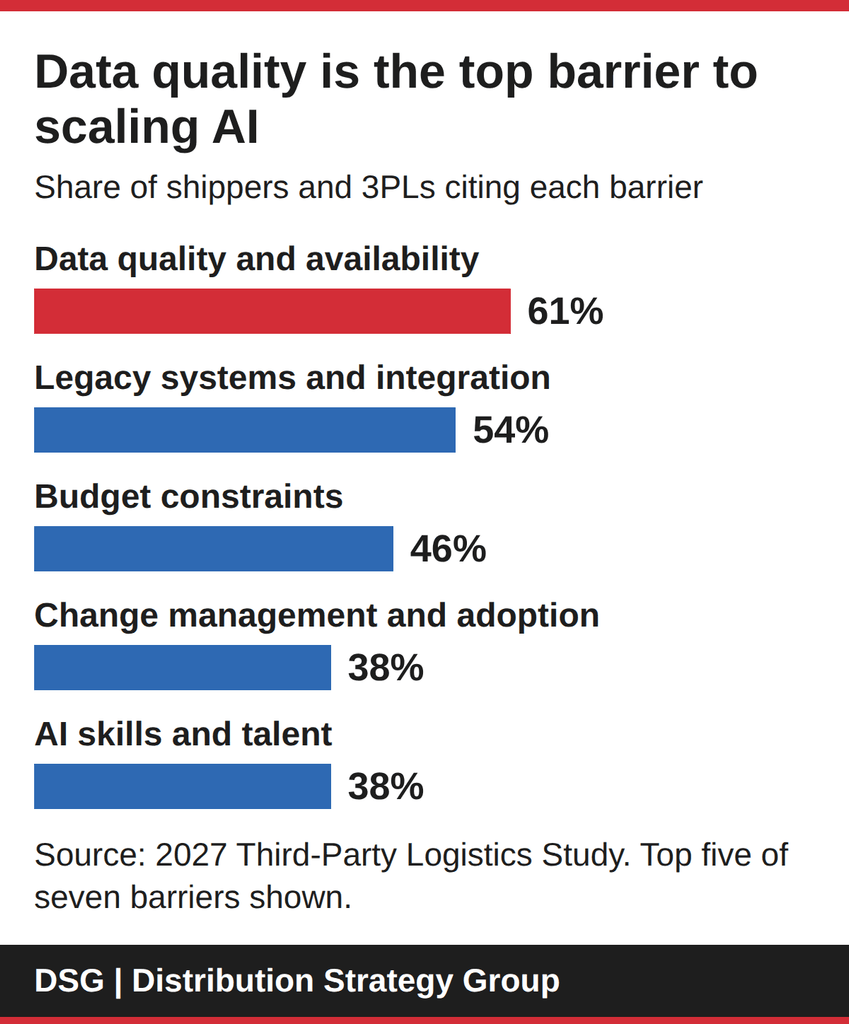
Data quality and availability ranked as the leading obstacle, cited by 61% of respondents. Legacy systems and integration complexity followed at 54%, while 46% identified budget or investment constraints.
The findings underscore the difficulties companies face when attempting to apply AI across transportation management systems, warehouse platforms and other supply chain applications that were not necessarily designed to exchange information.
Incomplete or inconsistent data can undermine forecasting accuracy, inventory visibility, and the reliability of automated recommendations. Those problems become more difficult when supply chain decisions depend on information shared among distributors, suppliers, carriers, and logistics providers.
The study also identified shortages of employees with expertise in supply chain planning, analytics, and AI-related disciplines, creating additional obstacles for companies seeking to expand their use of the technology.
For distributors operating multiple warehouses or managing complex transportation networks, the findings reinforce the importance of data quality and systems integration before expanding AI investments.
The research found that AI capabilities are becoming an increasingly important consideration in logistics partnerships, even as providers struggle to meet customer expectations.
While 93% of shippers consider AI capabilities important when evaluating logistics partners, only a small minority of providers describe themselves as highly prepared to deliver AI-enabled operations.
The study also identified a substantial difference between how logistics providers assess their technology capabilities and how customers evaluate them.
Although 94% of logistics providers believed their customers were satisfied with their information technology capabilities, only 70% of shippers reported satisfaction.
The 24-percentage-point gap suggests providers may be overestimating customer satisfaction with their technology.
That difference is particularly significant as shippers increasingly expect logistics partners to deliver measurable improvements in service, visibility, and operational performance.
The research also found that 74% of shippers are consolidating the number of logistics providers they use, up from 50% in the previous study. The trend could increase pressure on providers to demonstrate that their technology investments deliver operational benefits.
For distributors, the findings point to a more demanding process for evaluating logistics partners. AI capabilities are becoming part of the selection process, but adoption alone offers limited evidence of whether a provider can improve delivery performance, reduce transportation costs or strengthen inventory management.
The study indicates that AI is gaining ground across logistics operations, with transportation planning and routing producing the strongest reported returns. However, data quality, aging technology systems and workforce limitations remain significant barriers to broader implementation.
The results suggest that the next competitive distinction among logistics providers will depend less on whether they offer AI technology and more on whether they can demonstrate measurable improvements in supply chain performance.
Do not miss any content from Distribution Strategy Group. Join our list.
Share this article:
