


Why This Matters to Distributors: New state AI laws are tightening rules on hiring, employee management, and workplace surveillance. Distributors must review AI systems, assess vendor risks, and comply with different state requirements.
Wholesale distributors face a growing patchwork of state artificial intelligence laws governing employment decisions, workplace surveillance, and personal information, creating new compliance challenges as companies expand their use of AI.
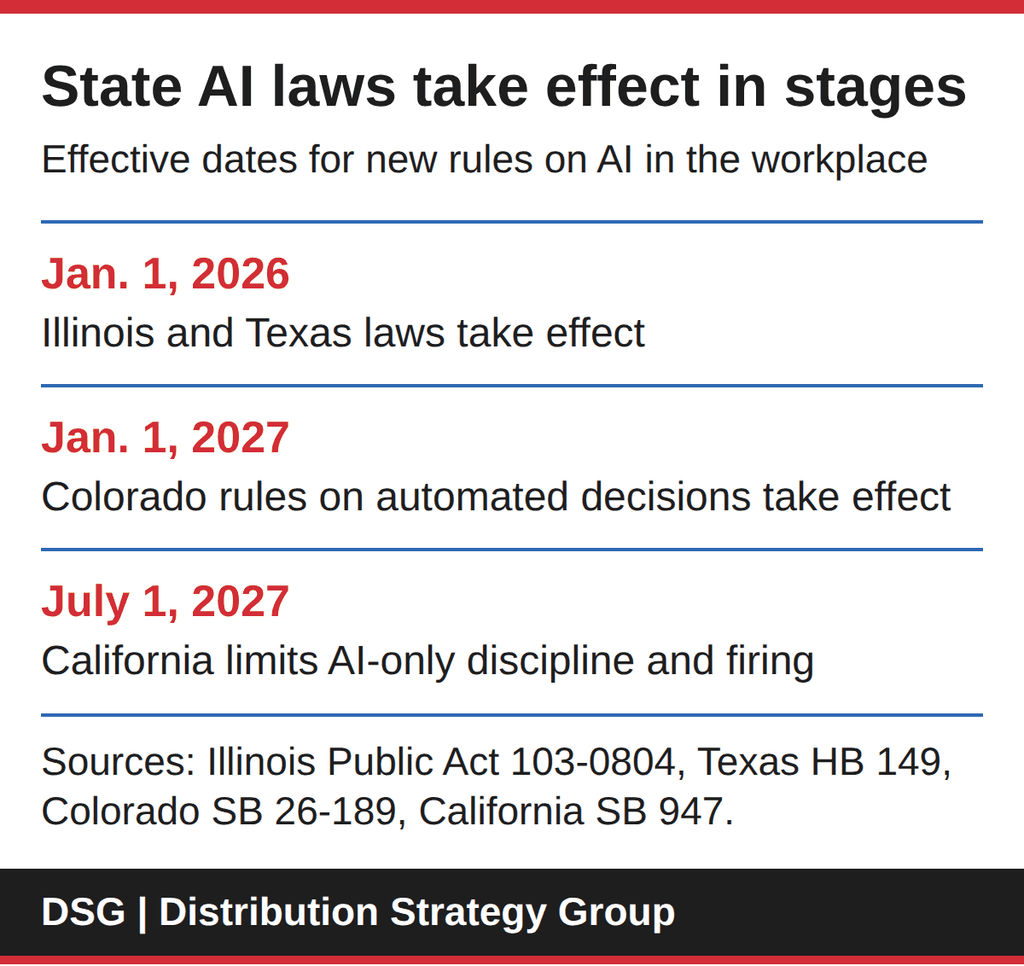
Illinois and Texas implemented new requirements Jan. 1, 2026, while California enacted additional workplace protections Sept. 30. Colorado is preparing to implement a revised regulatory framework for automated decision-making in January 2027.
The changes are occurring as distributors increasingly deploy AI to recruit employees, evaluate worker performance, manage warehouse operations, process customer information, and automate administrative tasks. Some of those applications now face greater scrutiny under state laws addressing discrimination, privacy, and automated employment decisions.
At the federal level, the Trump administration is seeking to limit state AI restrictions and establish a less burdensome national framework. The competing approaches are creating uncertainty for distributors operating in multiple states, where the same technology may be subject to different requirements.
For distributors, the immediate challenge is identifying which AI applications could trigger legal obligations and determining whether existing policies, vendor agreements and management procedures provide adequate oversight.
What Distributors Should Do Now
The expanding regulatory landscape calls for a review of how distributors use AI, particularly in applications that influence decisions about employees or process personal information.
Inventory forecasting, transportation routing and automated replenishment present different regulatory concerns from AI systems used to evaluate workers, recommend disciplinary action, or process biometric information.
Distributors should prioritize eight steps:
1. Inventory AI applications across the business. Identify systems used in recruiting, hiring, employee evaluations, workforce scheduling, productivity monitoring, customer management, and security. The review should include AI capabilities embedded in software already in use, not just newly purchased AI products.
2. Identify applications that influence employment decisions. Give particular attention to systems that screen applicants, rank employees, recommend promotions, evaluate performance, or support disciplinary and termination decisions. These applications are among the principal targets of new state regulations.
3. Review vendor contracts and system documentation. Determine what information AI applications collect, how recommendations are generated, what safeguards vendors provide and which compliance responsibilities remain with the distributor. Purchasing software from a third party does not necessarily transfer an employer’s legal obligations.
4. Establish human oversight of consequential decisions. Review how managers use automated recommendations in hiring, promotion, discipline, and termination. Human involvement should be meaningful, with procedures for questioning or overriding AI-generated recommendations where appropriate.
5. Check requirements in every state of operation. Distributors using standardized technology across multiple branches or warehouses should determine whether different state laws require additional notices, safeguards, or operating procedures.
6. Document AI use and oversight. Maintain records identifying which systems are deployed, the decisions they influence, the information they process and the procedures used to monitor their performance. Documentation can help companies demonstrate compliance with applicable requirements.
7. Review employee notices and workplace policies. Determine whether AI use triggers notification obligations or requires changes to policies governing employee monitoring, performance evaluations, and employment decisions.
8. Include AI compliance in acquisitions and technology consolidation. Distributors acquiring businesses should evaluate inherited recruiting, workforce management, and employee monitoring systems before deploying them across a larger organization.
These steps are not universal statutory requirements. They are practical measures distributors can use to identify potential exposure under applicable laws and prepare for additional regulations.
Illinois Targets AI in Hiring and Employee Management
Illinois is among the states with AI employment protections already in effect.
An amendment to the Illinois Human Rights Act, enacted through Public Act 103-0804, took effect Jan. 1. The law prohibits employers from using AI in employment decisions that discriminate against applicants or employees based on protected characteristics.
It also requires employers to provide notice when AI is used for covered employment purposes, including recruitment, hiring, promotion, training, discipline, and termination. The legislation addresses the use of ZIP codes as substitutes for protected characteristics in employment decisions.
The requirements are particularly relevant to distributors using AI-powered recruiting platforms, automated applicant screening, and employee performance management systems.
A distributor using AI to rank warehouse applicants, for example, must consider whether the system produces discriminatory results. Similar concerns apply to software that evaluates employees, recommends promotions, or supports disciplinary decisions.
The law does not prohibit AI in employment decisions. Instead, it applies anti-discrimination protections to covered uses of the technology and establishes notification requirements.
For Illinois distributors, reviewing AI-enabled recruiting and workforce management systems should be an immediate priority because the law is already in effect.
California Expands Workplace AI Restrictions
California added workplace protections Sept. 30 when Gov. Gavin Newsom signed legislation addressing automated employment decisions, technological displacement, and employee surveillance.
Senate Bill 947 restricts reliance on automated systems in certain disciplinary and termination decisions. Senate Bill 951 establishes requirements involving notice of technological displacement and covered layoffs, while Assembly Bill 1883 addresses certain workplace surveillance practices.
The measures could affect distributors using AI to monitor warehouse productivity, evaluate employees, recommend staffing changes or support disciplinary decisions.
California’s legislation is particularly relevant to large distribution operations that rely on labor management systems and automated performance monitoring. Depending on how those systems are used, employers may face restrictions on decisions made without appropriate human involvement.
The state also has adopted regulations under the California Consumer Privacy Act addressing automated decision-making technology, privacy risk assessments, and personal information.
Those requirements may apply to covered distributors using AI to make certain decisions about employees or customers. Applicability depends on the information processed, the type of decision and the specific regulatory provisions.
The workplace legislation and privacy regulations have separate implementation schedules. Senate Bill 947 is scheduled to take effect in July 2027.
Distributors with California operations should review employee monitoring and automated decision-making systems ahead of the new requirements, with particular attention to disciplinary and termination procedures.
Texas Establishes AI Governance Requirements
Texas implemented its Responsible Artificial Intelligence Governance Act on Jan. 1, establishing restrictions on certain uses of AI.
Enacted through House Bill 149, the law addresses intentionally unlawful discrimination involving AI, specified forms of behavioral manipulation and certain biometric data practices.
The legislation also includes provisions directed specifically at government agencies and health care applications, meaning not all requirements apply to private distributors.
For distribution companies, potentially relevant applications include automated employment screening, biometric security systems and AI tools that make decisions involving individuals.
Unlike some broader regulatory approaches, the Texas law does not impose a universal requirement for businesses to audit every AI application. Its obligations depend on how the technology is used and which statutory provisions apply.
Texas distributors should focus their reviews on AI applications involving potentially discriminatory decisions, biometric information and other practices specifically addressed by the legislation.
Colorado Prepares New Rules for Automated Decisions
Colorado is preparing to implement a revised AI regulatory framework Jan. 1, 2027, following changes to legislation originally enacted in 2024.
Senate Bill 26-189, signed in May, revised the state’s approach to automated decision-making systems involved in consequential decisions, including certain employment matters.
The legislation establishes requirements affecting developers and businesses deploying covered technology. It also addresses the use and correction of inaccurate personal information in automated decisions.
The Colorado attorney general’s office is developing implementing regulations ahead of the January effective date.
For distributors with Colorado operations, the requirements could affect AI systems used in hiring, employee evaluations, and other covered decisions.
Distributors should determine whether their systems meet the law’s definitions and review the implementing regulations as they are finalized. Earlier versions of Colorado’s AI legislation should not be used as the sole basis for compliance planning.
Federal Government Challenges State AI Regulation
The expansion of state AI oversight is occurring as the Trump administration seeks to reduce regulatory barriers to AI development and deployment.
On Dec. 11, 2025, President Donald Trump signed Executive Order 14365, directing the Justice Department to establish an AI Litigation Task Force to challenge certain state laws that conflict with the administration’s national AI policy.
The order also directed the Commerce Department to review state AI laws and identify provisions that could conflict with federal policy. It called for recommendations on federal legislation that could supersede conflicting state requirements.
The administration argues that differing state regulations increase compliance costs, complicate national deployment and discourage AI investment.
Supporters of stronger state oversight argue that additional safeguards are necessary to protect employees and consumers from discrimination, intrusive surveillance and automated decisions made without adequate accountability.
The executive order does not automatically invalidate state laws. Existing requirements remain applicable unless they are amended, superseded by federal legislation, or struck down by courts.
For distributors, the conflict creates uncertainty over the longer-term regulatory environment without eliminating current compliance responsibilities.
Workplace AI Presents the Greatest Immediate Exposure
The most direct implications for distributors involve AI applications used to recruit, monitor, and manage employees.
Warehouse and distribution operations use software to schedule workers, measure productivity, evaluate performance and determine staffing needs. Some applications also generate recommendations involving hiring, promotions, and disciplinary actions.
Whether those systems fall under new AI requirements depends on how they function and how their recommendations influence employment decisions.
An AI application that forecasts warehouse staffing needs, for example, raises different regulatory questions from one that evaluates individual employees or recommends termination.
The distinction becomes more important as workforce management platforms incorporate AI into existing software. A system originally designed to track productivity may also be used to evaluate employees, potentially triggering additional employment protections.
Distributors also need to consider the role of technology vendors. Software providers may supply documentation, safeguards, and technical support, but employers remain responsible for determining whether their own use of the technology complies with applicable laws.
Multistate Operations Complicate Compliance
The differences among state laws create challenges for distributors operating national branch and warehouse networks.
A company using the same AI recruiting platform in Illinois, California, Texas, and Colorado may face different requirements depending on where employees work, what information the system processes and how automated recommendations are used.
Those differences can affect software procurement, technology deployment, and employee management policies.
Distributors may need to review vendor agreements, document how AI systems operate and establish procedures for evaluating automated recommendations in employment decisions.
The issues also extend to acquisitions and technology consolidation. A distributor acquiring another business may need to review the acquired company’s AI applications before deploying them across a larger network.
Smaller distributors face similar concerns, particularly when they rely on outside technology providers for recruiting, payroll, workforce management, and other administrative systems.
The practical challenge is establishing enough visibility into those systems to understand what they do and whether they trigger legal requirements.
More Regulatory Changes Ahead in 2027
The next major developments include Colorado’s revised automated decision-making requirements, scheduled for January 2027, and additional California workplace protections taking effect later in the year.
Federal challenges to state AI laws could also affect the regulatory landscape, although the outcome and timing of litigation or congressional action remain uncertain.
The emerging framework reflects a shift toward regulating specific AI applications rather than imposing uniform restrictions on the technology itself.
Employment decisions, workplace monitoring, and the use of personal information are receiving greater attention than routine applications such as inventory forecasting or transportation optimization.
For distributors, the priority is to understand where AI is being used, which decisions it influences and what obligations apply before expanding deployment.
Companies that inventory their systems, evaluate vendors, document oversight procedures and review state requirements will be better positioned to manage compliance risks as AI becomes more deeply integrated into distribution operations.
Do not miss any content from Distribution Strategy Group. Join our list.
Share this article:
