



Why This Matters to Distributors: Distributors are adopting artificial intelligence while leaving basic sales results unmeasured. Gaps in tracking quote conversions, customer retention and forecast accuracy can make it harder to identify vulnerable accounts, direct sales resources, and assess whether technology investments improve performance.
Half of respondents to a Phocas Software survey said their distribution businesses use artificial intelligence in sales, yet about a third do not track how often customer quotes become orders.
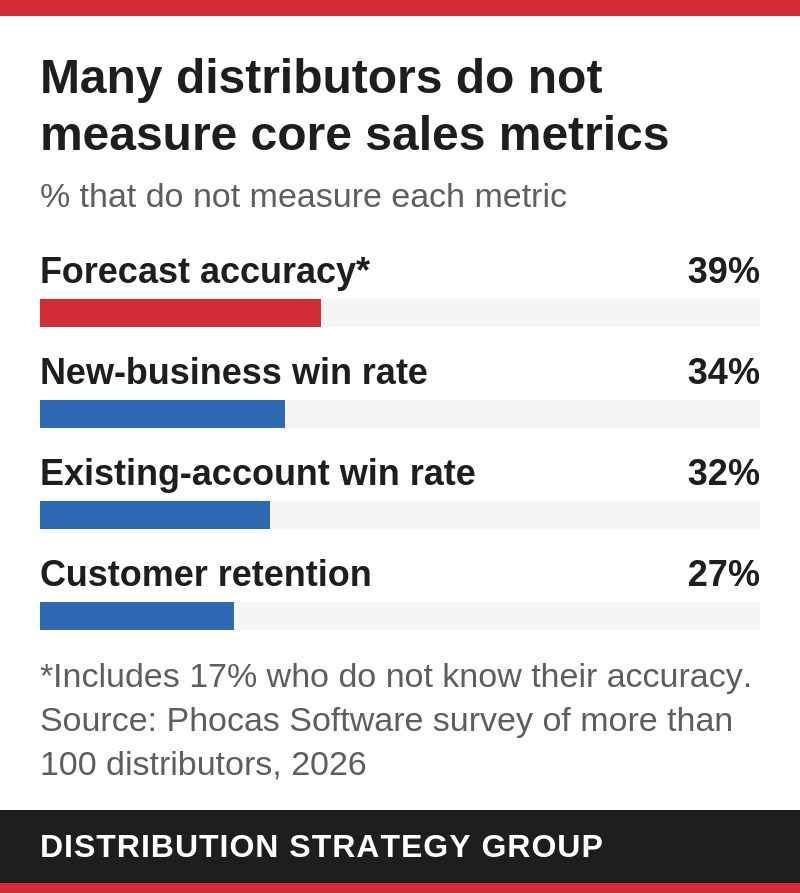
The company’s “The State of Sales in Distribution 2026” report found that 49% use AI for sales, while 34% do not measure quote win rates for new business and 32% do not measure them for existing customers. Another 27% do not measure customer retention.
The findings show uneven use of sales data alongside technology adoption. Respondents reported using digital tools to identify opportunities and automate work, but many lacked measures needed to evaluate sales results and customer relationships.
Forecasting showed similar gaps. Twenty-two percent said their businesses do not track forecast accuracy, and 17% did not know how accurate their forecasts were. Another 20% reported that forecasts were off by more than 10%.
One respondent, identified in the report as a sales manager at an industrial equipment wholesaler, attributed shortcomings in retention analysis to difficulty obtaining data.
“So, at the moment, we don’t know what we don’t know,” the respondent said.
The survey also found differences in measurement practices depending on sales priorities. Among respondents focused primarily on new-customer growth, 87% tracked their new-business win rate, compared with 46% of those focused on expanding existing accounts. The report did not establish whether those measurement practices produced better sales results.
Phocas surveyed more than 100 distribution sales professionals globally. Seventy-six percent of respondents run sales teams with fewer than 20 representatives, and 52% work for family-owned businesses. Consumer goods, heating, cooling, plumbing, and industrial machinery and equipment accounted for the largest portions of the sample.
The report did not disclose the exact sample size, survey dates, geographic breakdown, or margin of error, limiting broader conclusions about the distribution industry.
In addition to the 49% already using AI for sales, 29% planned to adopt it within six months. Twenty-two percent had no adoption plans, all of whom worked on sales teams with fewer than 20 representatives.
Identifying opportunities and prioritizing accounts was the most frequently selected opportunity for AI, cited by 22% of respondents. Data analysis and reporting followed at 20%, while 17% selected automating customer relationship management logging and administrative work.
Consistent use of customer relationship management software, or CRM, remained a challenge. Fifty-six percent of respondents reported using CRM software, but among those users, only 34% logged at least three-quarters of customer interactions in the system.
Better CRM adoption was the most frequently selected capability that respondents said would improve their sales teams, at 27%. Greater collaboration across the business followed at 24%, and better account prioritization at 20%.
Field sales remained the most frequently cited effective sales channel despite the adoption of digital tools. Fifty-five percent selected field or outside sales as their most effective channel, compared with 5% who selected ecommerce.
Those responses reflect assessments of channel effectiveness, rather than the share of revenue generated through each channel. Product expertise and relationships also ranked prominently: Asked to select three attributes of an effective salesperson, 75% chose product and usage knowledge, and 57% selected long-term relationship management.
Order values were stable or rising. Forty-six percent said average order values had increased over the previous 12 months, 37% reported no change and 10% reported a decline. The report did not distinguish whether increases resulted from pricing, product mix, or purchasing volume.
Phocas concluded that distributors could improve sales practices by making more consistent use of data and existing technology. Across the sample, the gaps extended from recording customer interactions to measuring quote conversions and checking forecasts.
Do not miss any content from Distribution Strategy Group. Join our list.
Share this article:
