


The majority of respondents were distributors – 75%, with most having 1-10 branches:
| # of branches | % of distributors |
|---|---|
| None | 10% |
| 1-10 | 57% |
| 11-25 | 16% |
| 26-50 | 6% |
| 51-100 | 4% |
| More than 100 | 7% |
Number of inside sales people:
| # of inside sales people | % of distributors |
|---|---|
| None | 10% |
| 1-10 | 47% |
| 11-25 | 23% |
| 26-50 | 11% |
| 51-100 | 7% |
| More than 100 | 12% |
80% described their inside sales teams as mostly reactive. 42% had their inside sales teams centralized at headquarters, while 40% were de-centralized and 16% centralized at a branch.
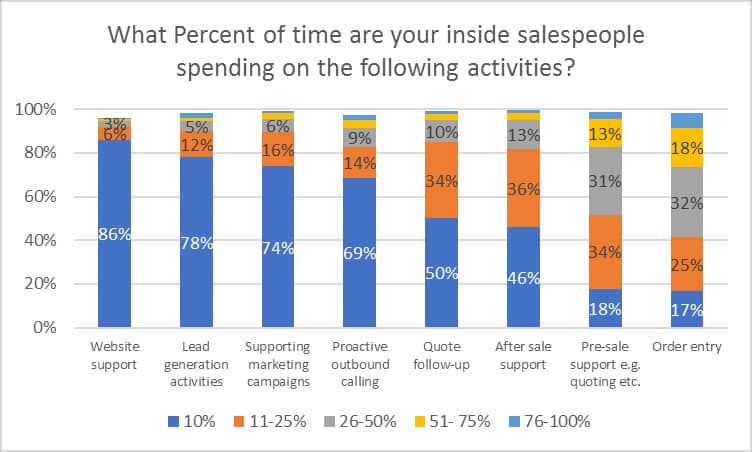
69% of inside sales people are spending less than 10% of their time making proactive outbound calls. They are spending the majority of their time doing after sale support, order entry and pre-sale support.
These activities were ranked as the top five most important in this order:
- Provide an excellent level of service
- Grow sales and profit
- Increase customer loyalty
- Lead generation
- Increase order entry efficiency
The biggest challenges facing the group today were:
- Lack of pro-activity, having enough time to make pro-active calls and training/product knowledge issues.
- 71% of respondents said that their teams were cross-selling and identifying new business opportunities less than 25% of the time.
- 30% of respondents were extremely satisfied or very satisfied with their inside sales teams, while 50% were moderately satisfied and 20% were dis-satisfied.
73% of respondents wanted their teams to have more selling skills training, 91% wanted their teams to have more customer service training and 55% felt they needed more technical training.
The top three most effective ways to train were:
- Informal coaching sessions
- Team members train each other on the job
- Formal training sessions with manager
The most cited methods of measurement of the effectiveness of the inside sales teams were gross profit dollars (50%), followed by overall sales growth (35%) and order entry quantity and quality (31%). 68% of respondents were executive or general managers, with 19% in sales and/or marketing. The majority of respondents’ company revenues fell into the less than $100M range (61%), 25% in the $101M – $500M range and 14% over $500M.
When asked what changes respondents would like to see to their overall sales channel:
- 80% wanted inside sales to be more pro-active.
- 48% wanted to shift field sales accounts that weren’t being effectively managed to inside sales.
- 47% wanted field sales to be more pro-active.
When asked about the selling styles of field sales reps, the respondents fell largely into the following industries:
- Industrial
- Electrical
- Building materials/construction
- Power transmission/bearings
- Hardware
- HVACR
- JanSan
Conclusions
The results of this survey are similar to the survey completed in 2014:
- Companies are still challenged with finding time to be more pro-active rather than 100% reactive.
- Time management is still a challenge – the reactive activities such as quoting and order entry still take the largest amount of time and it is difficult to find spare time for selling.
- Many respondents still think that individuals who can provide a high level of reactive customer service should be selling. Customer service and selling skillsets are opposite; the mindset of a CSR is the polar opposite of that of a pro-active seller.
- Most respondents understood the value of pro-active selling, but were challenged with how to actually do it.
Share this article:
