
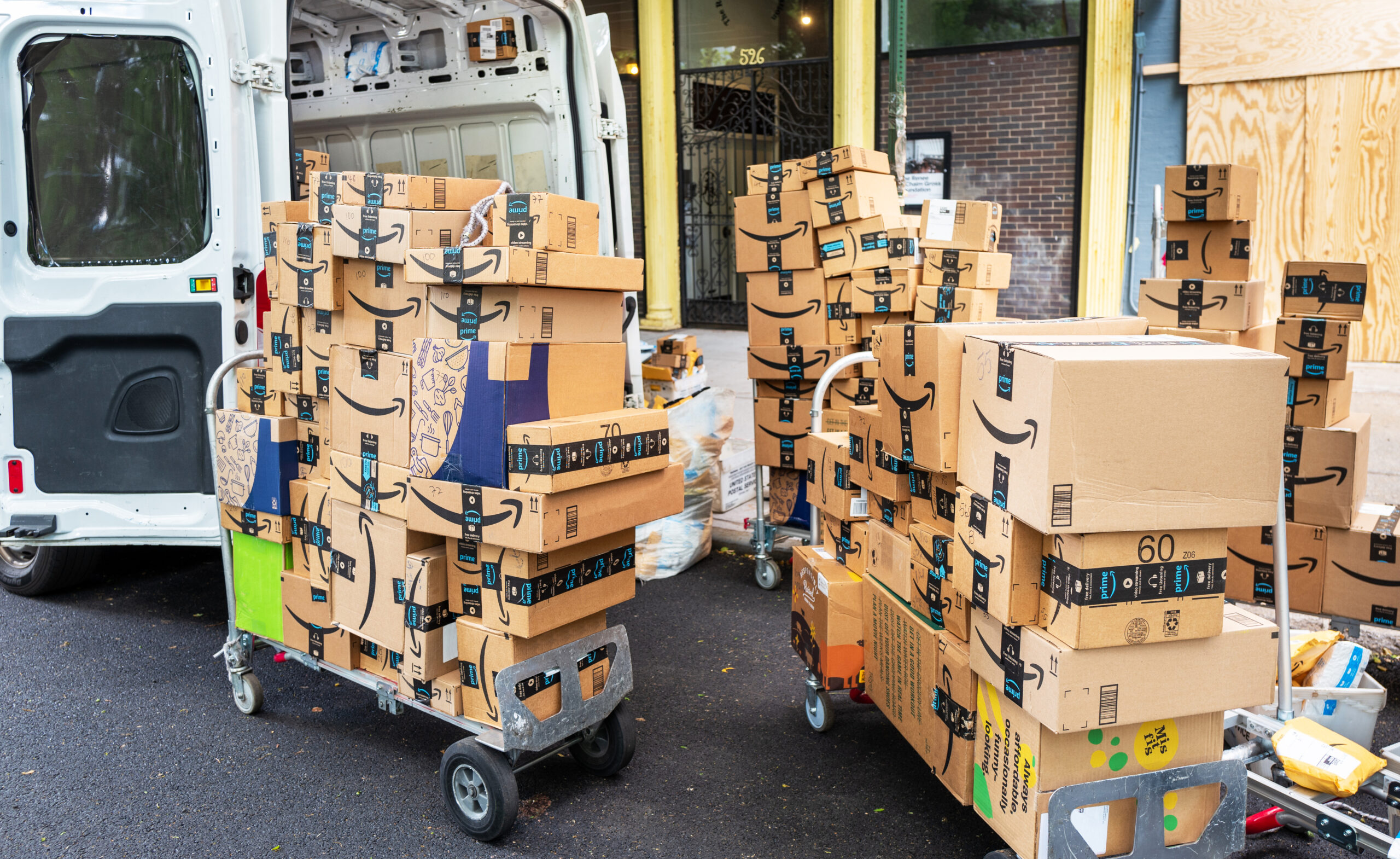
Why This Matters to Distributors: As Amazon, UPS and FedEx push fuel surcharges and expand into B2B delivery, distributors face a dual challenge of managing more volatile freight costs while competing with logistics providers moving into their core markets.
Amazon’s decision to impose a 3.5% fulfillment surcharge marks a turning point in logistics pricing, with implications that extend across wholesale distribution.
The company notified sellers in late March that it would implement the surcharge beginning in mid-April for Fulfillment by Amazon services in the U.S. and Canada. Amazon said the fee reflects “elevated costs in fulfillment and logistics” and a shift from absorbing those costs to passing through a portion to sellers.
For distributors, the move lands at a moment when fuel-driven cost pressure is intensifying across transportation.
U.S. diesel prices have climbed sharply, rising about 30% year over year and remaining above $5 per gallon in early 2026, according to federal energy data. Prices have also been volatile on a weekly basis, with swings of 10 to 20 cents per gallon driven by geopolitical tensions, refinery constraints, and global oil market uncertainty. Compared with pre-pandemic levels near $3 per gallon, diesel costs remain structurally elevated, increasing baseline transportation expenses across linehaul, last-mile delivery and air freight.
Because diesel is the primary fuel for trucking—the backbone of domestic distribution, even incremental increases translate quickly into higher freight costs. Sustained pricing at current levels is amplifying cost pressure across the supply chain.
Against that backdrop, Amazon’s surcharge aligns it with a broader industry shift already underway at United Parcel Service and FedEx, both of which are expanding the role of fuel surcharges in pricing.
UPS has made fuel surcharges a central lever. The carrier updates its surcharge weekly based on U.S. Department of Energy diesel benchmarks, but recent changes extend beyond fuel tracking. UPS has repeatedly adjusted its surcharge tables—lowering the thresholds at which higher percentages apply—effectively increasing charges even when diesel prices stabilize. Ground fuel surcharges now frequently exceed 20% of base transportation rates and are applied across a broader set of charges, including certain accessorial fees.
FedEx has adopted a similar approach. The company maintains weekly index-based adjustments across its air and ground networks while recalibrating surcharge tables to widen the spread between fuel tiers. That increases the effective surcharge percentage at comparable fuel levels. As with UPS, fuel surcharges are applied broadly, compounding across base rates, residential delivery charges, and other fees.
The United States Postal Service, long an outlier, is now moving in the same direction. The agency plans to introduce a temporary package surcharge of about 8% beginning in late April, citing higher transportation and energy costs. The move represents a significant shift and brings USPS closer to private-carrier pricing practices.
Across the industry, fuel surcharges are no longer a narrow cost-recovery mechanism. They have become a flexible pricing tool—adjusted through both fuel indexes and table changes—to protect margins and respond quickly to volatility.
That same model extends beyond parcel carriers. DHL applies fuel surcharges across express, e-commerce and freight services, often in the 20% to 30% range, with frequent updates tied to diesel and jet fuel indexes. Freight forwarders and trucking carriers use similar approaches, including bunker adjustment factors for ocean freight and diesel-index-based surcharges for linehaul.
For distributors, the shift is occurring alongside a second, equally important change: logistics providers are moving deeper into B2B delivery.
Amazon continues to expand its capabilities through Fulfillment by Amazon, Buy with Prime and multi-channel fulfillment, positioning its network to manage more business-to-business volume. At the same time, UPS and FedEx are targeting higher-margin B2B shipments, including healthcare, industrial and small-business deliveries, as residential e-commerce growth slows.
The result is a convergence of cost pressure and competitive pressure. The same companies raising delivery costs through surcharges are also expanding into the markets distributors serve.
For distributors, that combination is reshaping the economics of fulfillment.
Delivered costs are rising and becoming less predictable. Weekly and monthly adjustments across carriers mean the cost to ship an order can shift materially over short periods, complicating pricing, and margin management.
Margin pressure is also moving downstream. As Amazon and carriers pass through costs, distributors must decide more frequently whether to absorb increases or pass them on to customers.
Many are already adjusting. Fuel surcharges and delivery fees tied to carrier indexes are becoming more common, along with tighter free-shipping thresholds and higher minimum order sizes. Distributors are also breaking out freight as a separate line item more consistently, increasing transparency while making pricing more complex.
Operational strategies are shifting as well. Companies are investing in regional fulfillment networks and local delivery capabilities to reduce shipping distances and exposure to fuel volatility. Others are diversifying carrier relationships, adding regional providers or third-party logistics partners to offset rising costs from national carriers.
At the same time, distributors are investing in better cost visibility, integrating real-time freight data into pricing, and quoting systems to align charges more closely with actual cost to serve.
Amazon’s surcharge also carries competitive implications. While modest, the 3.5% fee slightly narrows the pricing gap on commoditized goods. More broadly, it signals that Amazon is no longer fully insulating customers from logistics inflation.
For manufacturers and brands, that shift underscores the risks of channel dependency. As logistics providers expand into B2B while raising fees, suppliers face both margin pressure and increased competition for customer relationships.
The broader takeaway for distributors is that freight pricing and competition are changing at the same time. With Amazon, UPS, FedEx, and USPS all embracing cost pass-through—and with carriers pushing deeper into B2B delivery—distributors operate in a market where delivered cost is volatile, pricing is dynamic and the line between partner and competitor is increasingly blurred.
Do not miss any content from Distribution Strategy Group. Join our list.
Share this article:
