



Why This Matters to Distributors: Census Bureau data show larger distributors are scaling AI adoption faster while many small and midsize distributors remain in early-stage deployment, widening the competitive gap across the industry.
Wholesale distributors continue to adopt artificial intelligence at a slower pace than the broader U.S. economy even as AI usage increased steadily across American businesses during the first half of 2026, according to new data from the U.S. Census Bureau.
The Census Bureau’s Business Trends and Outlook Survey found overall AI adoption among U.S. businesses ranged from 17% to 20% between December 2025 and May 2026. Another 20% to 23% of businesses said they expect to adopt AI within the next six months.
Adoption rates were higher when measured by employment size rather than by number of companies. On an employment-weighted basis, AI adoption reached 32%, indicating larger companies are deploying AI much faster than smaller firms.
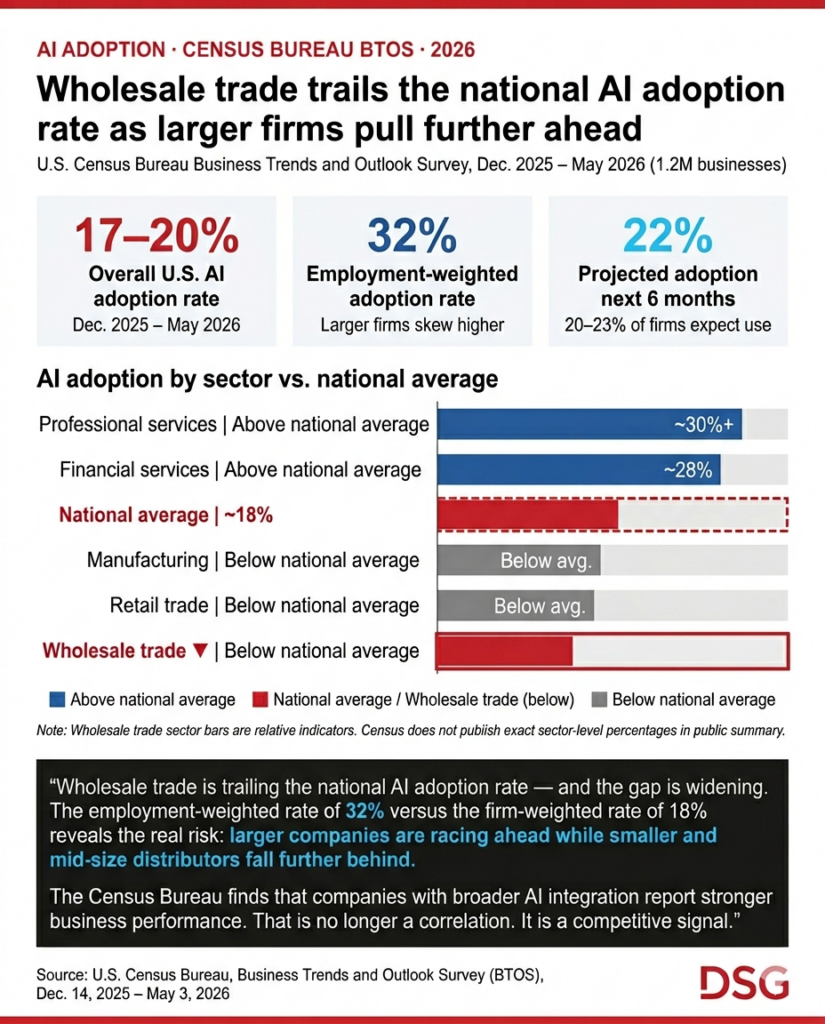
The disparity is especially significant for wholesale distribution because the Census Bureau broadened its AI definition in November 2025 to include the use of AI in any business function rather than limiting the measure to producing goods or services. The revised methodology captures a wider range of applications, including customer service, finance, administration, and other back-office operations.
Even under the broader definition, wholesale trade, manufacturing, and retail all reported AI adoption rates below the national average. Wholesale trade includes distributors under the federal North American Industry Classification System.
The survey, which covers about 1.2 million businesses and collects responses every two weeks, tracks how companies are adopting AI across industries, geographic regions, and company sizes. It also examines how businesses are using AI, the types of work it supports and how adoption is affecting operations and labor.
The Census Bureau found most businesses are deploying AI in targeted operational areas rather than across entire enterprises. Researchers also reported limited evidence of broad AI-related job reductions, with most companies using AI to support workers rather than replace them.
The Bureau additionally found companies with broader AI integration often reported stronger business performance and higher investment activity, suggesting advanced AI adoption may increasingly correlate with operational and financial advantages.
AI adoption rates were highest in professional services and financial industries. Separately, work-related generative AI usage among individuals reached about 41% as of November 2025, with adoption accelerating in recent months. A separate November survey of senior executives estimated that 78% of the U.S. labor force works at companies that have adopted AI, while about 54% works at firms using large language models.
Why This Matters to Distributors: Census Bureau data show larger distributors are scaling AI adoption faster while many small and midsize distributors remain in early-stage deployment, widening the competitive gap across the industry.
Do not miss any content from Distribution Strategy Group. Join our list.
Share this article:
