



Why This Matters to Distributors: McKesson’s fiscal 2026 results show what AI looks like when it moves from pilot to production — orchestrating supply chain planning, powering robotics in new distribution facilities and driving per-employee productivity gains at scale. For wholesale distributors, the operational benchmarks McKesson is setting signal where the competitive bar on AI-driven distribution infrastructure is heading.
McKesson Corp. is embedding artificial intelligence across its distribution network, oncology platform, and biopharma services operations — deploying the technology not as a pilot initiative but as core infrastructure driving measurable productivity gains and supply chain transformation.
The health care distributor’s fiscal fourth quarter and full-year 2026 earnings call, held May 7, offered the most detailed account yet of how McKesson is operationalizing AI at scale across a network that distributes approximately one-third of all pharmaceuticals in North America.
Full-year consolidated revenues reached $403 billion, a 12% increase over fiscal 2025. In the fourth quarter, consolidated revenues increased 6% to $96.3 billion.
“We achieved this through strong execution, disciplined planning and continued productivity investments, including the application of technology and automation,” said Brian Tyler, chief executive officer, describing the company’s record biopharma services season in which 3.4 million patients were supported, with each full-time employee handling 120 more patients than in the prior year.
The clearest example of McKesson’s infrastructure build-out is its new Montreal distribution center, launched during the quarter as part of what the company calls its “supply chain of the future” initiative. The facility features an advanced storage and retrieval system powered by AI and robotics. “Once fully ramped, this facility will enhance resiliency, improve service reliability across Eastern Canada and reinforce our ability to serve customers and patients with greater speed, consistency and efficiency,” Tyler said.
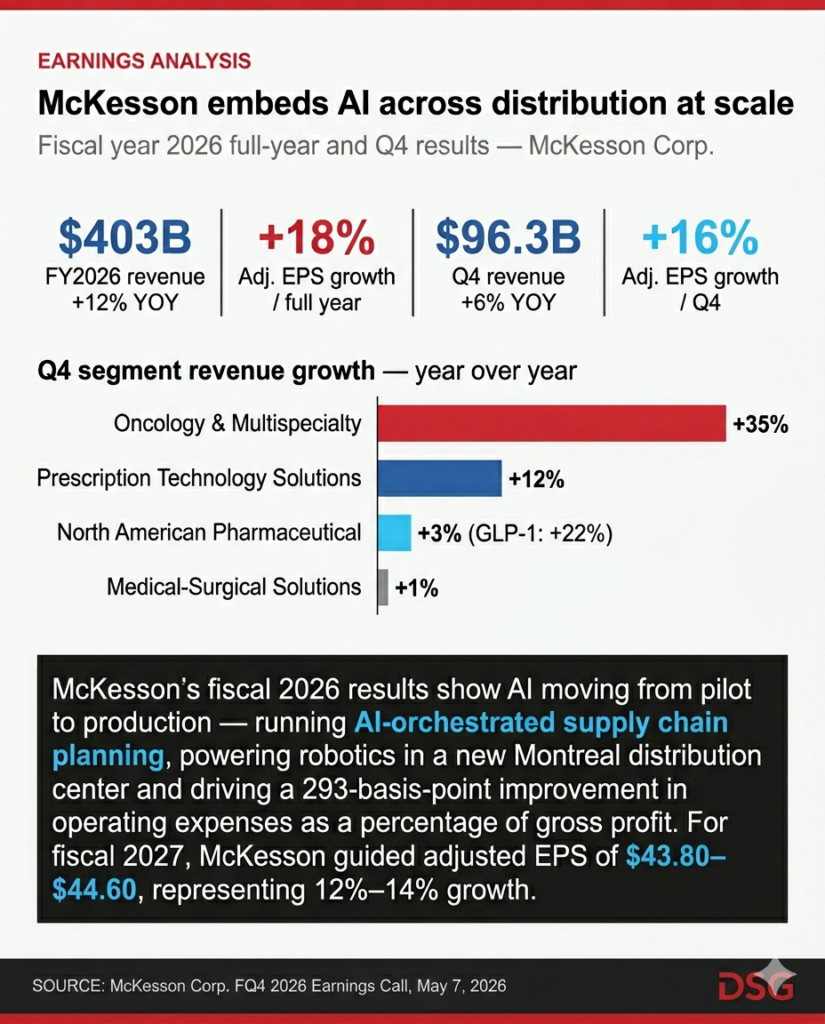
Across the broader North American network, McKesson deployed an AI-driven planning system that orchestrates demand, supply, inventory, and operations inside a single integrated environment. The company said the system enabled a shift “from reactive to more technology-enabled real-time decision-making” and contributed directly to the $6.2 billion in operating cash flow McKesson generated in fiscal 2026, a figure that exceeded the company’s own plans.
In the U.S. Oncology Network, ambient scribe technology is now used by more than 1,900 providers. Tyler framed the deployment in operational terms: physicians spend less time on documentation and more time with patients. The company also uses technology to drive deeper clinical data insights through Ontada, its data and insights business, which now incorporates in-office dispensing data from Florida Cancer Specialists and Research Institute to help biopharma customers assess adoption trends across the community oncology landscape.
Efficiency gains from those investments showed up across the financials. Chief financial officer Britt Vitalone said McKesson achieved improvement in operating expenses as a percentage of gross profit compared to the prior year. “We achieved this operating efficiency while simultaneously making targeted investments to modernize our operations through automation and AI-driven capabilities, which we anticipate will accelerate growth, creating enterprise-wide efficiencies,” Vitalone said.
The oncology and multispecialty segment delivered the sharpest growth in the portfolio. Fourth quarter revenues increased 35% to $12.7 billion, fueled by provider expansion and specialty distribution growth. Segment operating profit jumped 53% to $385 million. Excluding acquisition contributions, organic operating profit grew 13%. In North American Pharmaceutical, fourth quarter revenues increased 3% to $79.1 billion, with segment operating profit up 11% to $980 million. GLP-1 distribution revenues reached $14 billion in the quarter, a 22% year-over-year increase.
McKesson also launched what it described as an industry-first integrated specialty access and affordability solution, connecting benefits verification, prior authorization, and affordability support into a single coordinated workflow. The company said the solution is designed to accelerate time to therapy for high-cost, high-touch medications by addressing the fragmentation that typically delays treatment starts.
On the portfolio front, McKesson is advancing the separation of its Medical-Surgical Solutions segment into an independent company. In April, the company completed a $1 billion senior secured Term Loan A and a $1 billion revolving credit facility, establishing a standalone capital structure for the business. It also announced a $1.25 billion minority investment from Apollo Funds, representing approximately 13% of the business and implying a total enterprise value of $13 billion. McKesson said it will retain operating control and majority ownership while targeting a planned IPO. Tyler said the separation “will unlock shareholder value and create strategic clarity for both organizations.”
The oncology platform continued its provider expansion. McKesson added more than 570 providers to the U.S. Oncology Network in fiscal 2026 (the largest net increase since 2010) and in April added Cancer Care Northwest, extending its footprint into Washington and Idaho. PRISM Vision, its retina and ophthalmology platform, grew providers by approximately 20% over the past year.
Do not miss any content from Distribution Strategy Group. Join our list.
Share this article:
