

Why This Matters to Distributors: The conference signaled a turning point for the industry. The discussion has shifted from whether distributors should adopt AI to how quickly they can deploy it to improve operations, customer service, and decision-making. The companies that execute first, not those that wait for perfect conditions, are likely to gain the biggest competitive advantage.
The conversation around artificial intelligence in wholesale distribution has changed.
Just a year ago, many distributors were asking where AI might fit into their businesses. At Distribution Strategy Group’s Applied AI for Distributors conference held June 23-25 in Rosemont, Ill., that question was absent.
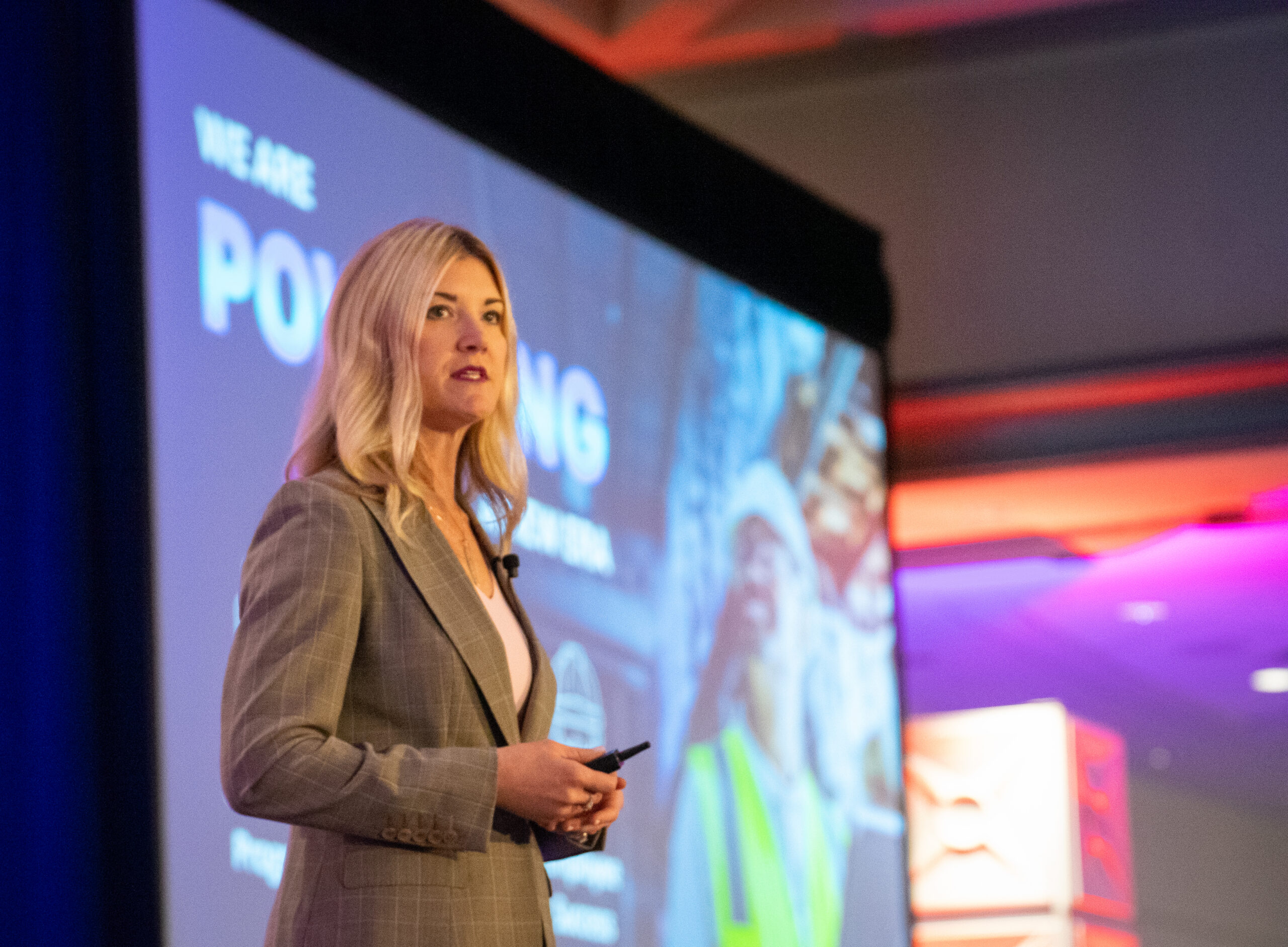
Instead, keynote speakers from Graybar, W.W. Grainger, Distribution Strategy Group, and other industry leaders focused on execution. Their message was consistent throughout the three-day conference: AI is no longer a technology experiment. It is becoming an operating capability that will influence how distributors buy inventory, serve customers, develop employees, protect data, and compete in the marketplace.
While each keynote approached AI from a unique perspective, together they outlined a roadmap for distributors entering the next phase of adoption.
Graybar: Stop Waiting for Perfect Conditions
The conference opened with its clearest call to action.
Danna Stone, Graybar’s senior vice president of marketing, and Ed Fenton, vice president of AI and digital transformation officer, urged distributors to stop waiting for perfect data, perfect systems, or perfect timing before putting artificial intelligence to work.
Instead of chasing headlines about the latest AI model, Graybar has concentrated on practical applications that improve business performance.
The company deploys AI across inventory optimization, demand forecasting, transportation management, workforce productivity, and customer experience, targeting operational improvements that produce measurable returns.
“We are seeing a lot of return on investment” from inventory-related applications, Stone said, citing forecasting and inventory optimization among the company’s strongest early successes.
The emphasis throughout the presentation was not on technology for its own sake. It was on solving operational problems.
Graybar demonstrated how AI can help analyze inventory, automate portions of the request-for-quote process, and improve employee productivity while keeping people at the center of customer relationships.
Fenton challenged one of the most common reasons distributors delay AI projects.
“You don’t need your data to be perfect,” he said. “You just need some of what’s in there to be meaningful enough.”
He argued that companies often spend too much time worrying about technology while overlooking the organizational work required to deploy it successfully.
“The technology is not the problem,” Fenton said. “It’s going to be your data, your processes and your people.”
Stone also pushed back against fears that AI will replace distributors’ greatest asset—their people.
“It’s still a people-to-people business,” she said. “Those relationships still absolutely matter.”
That balance between technology and human expertise became one of the conference’s recurring themes.
Grainger: Build AI One Problem at a Time
If Graybar emphasized speed, W.W. Grainger focused on discipline.
Chief Technology Officer Jonny LeRoy described an AI strategy built around solving specific business problems instead of attempting enterprise-wide transformation all at once.
“We’ve learned you’ve got to break down your problem into smaller chunks,” LeRoy said.
That philosophy has guided Grainger’s AI investments.
Rather than replacing customer service representatives, the company has built AI assistants that help employees retrieve product information more quickly, interpret complex customer requests and provide better answers.
The technology augments employees rather than replacing them.
LeRoy described today’s AI systems as “enthusiastic, energetic and fallible,” comparing them to interns who require guidance, coaching and continuous improvement before consistently delivering reliable results.
Grainger has applied that incremental philosophy across customer onboarding, product search, software development, and catalog management.
For example, AI now helps interpret complex spreadsheets submitted by prospective customers and improves search functionality on Grainger’s ecommerce platform by better understanding conversational, multiword search queries.
Throughout the keynote, LeRoy emphasized balancing innovation against cost, governance, and cybersecurity.
He cautioned distributors against assuming every AI startup represents a replacement for existing enterprise software and advised attendees to carefully evaluate how new technologies fit into existing technology ecosystems.
His closing advice summarized Grainger’s approach.
“Rethink your processes before sprinkling them with AI pixie dust.”
AI Is Reshaping Distribution’s Markets
Several keynote speakers shifted the conversation from internal operations to external opportunity.
Economist Alex Chausovsky argued that artificial intelligence is creating one of the largest industrial investment cycles in decades.
Massive investments in data centers, electrical infrastructure, power generation, automation and advanced manufacturing are generating new demand across sectors served by wholesale distributors.
Electrical distributors are supplying data center construction.
Industrial distributors are supporting factory automation.
HVAC distributors are seeing opportunities tied to cooling increasingly sophisticated computing facilities.
Building products distributors are benefiting from infrastructure expansion.
The message broadened AI’s significance beyond productivity.
Artificial intelligence is changing not only how distributors operate but also what their customers buy.
Your Institutional Knowledge Is Your Competitive Advantage
Distribution Strategy Group co-founder Jonathan Bein and Chief Operating Officer Brian Hopkins challenged attendees to think differently about competitive advantage.
Their argument was straightforward.
Most distributors can license the same large language models.
Most can purchase similar software.
Few possess the same decades of customer relationships, pricing expertise, inventory management practices, sales workflows, and operational knowledge.
Those assets increasingly represent the information AI systems need to become truly valuable.
Rather than buying additional AI applications, Bein argued that distributors should focus on teaching existing systems how their businesses operate.
Hopkins expanded on that idea by encouraging distributors to embed institutional knowledge directly into AI workflows, so expertise remains inside the organization even as experienced employees retire.
The implication was clear.
Competitive advantage is shifting from technology ownership to knowledge management.
Governance Must Keep Pace
Rapid AI adoption also introduces new risks.
Cybersecurity expert Jeff Crume argued that AI strategies must include governance, security, and employee education from the outset.
As AI becomes integrated into sales, procurement, finance and customer service, organizations must understand how sensitive information is protected, how employees use AI responsibly and how cybersecurity defenses evolve alongside increasingly sophisticated attacks.
LeRoy echoed those concerns during Grainger’s keynote.
Artificial intelligence is making cybercriminals more effective while also giving defenders more sophisticated tools.
That dynamic dramatically compresses response times.
Security teams that once measured response windows in days may soon need to respond within hours—or even minutes.
For distributors expanding AI throughout their organizations, governance emerged as a business discipline rather than simply an information technology responsibility.
AI Changes Work More Than It Eliminates Jobs
Another recurring theme centered on people.
Rather than presenting AI as a workforce replacement strategy, keynote speakers consistently described it as a productivity tool.
Graybar wants employees spending less time searching for information and more time serving customers.
Grainger wants representatives answering increasingly complex questions with greater confidence.
Matt Sigelman argued that AI will automate repetitive work while increasing demand for analytical thinking, technical expertise, and customer relationship skills.
For distributors confronting persistent labor shortages and an aging workforce, AI offers an opportunity to increase productivity while helping experienced employees share their knowledge with the next generation.
A New Standard for AI Adoption
The conference’s most important conclusion emerged not from any single keynote but from the consistency across all of them.
Graybar urged distributors to move AI projects into production.
Grainger demonstrated how disciplined implementation creates measurable business value.
Alex Chausovsky explained how AI is reshaping markets.
Jonathan Bein and Brian Hopkins argued that proprietary business knowledge will become the industry’s next competitive advantage.
Jeff Crume warned that governance and cybersecurity must evolve alongside technology.
Matt Sigelman described a workforce transformed by AI rather than displaced by it.
Together, those perspectives described an industry moving into a new phase.
The conversation has shifted beyond chatbots, proofs of concept and pilot projects.
Distributors are increasingly evaluating AI the same way they evaluate any other strategic investment: by asking whether it improves customer service, strengthens operations, increases productivity, and generates measurable financial returns.
That shift may prove to be the defining legacy of the 2026 Applied AI for Distributors conference.
The companies that lead the next generation of wholesale distribution will not necessarily be those with access to the newest AI models.
They will be the distributors that execute with discipline, invest in their people, protect their data, and integrate artificial intelligence into the everyday work of serving customers.
Do not miss any content from Distribution Strategy Group. Join our list.
Share this article:
