


Why This Matters to Distributors: Demand remains healthy, but rising costs, slower supplier deliveries and growing inventories suggest distributors may face increasing pressure to protect margins as customers grapple with inflation.
The U.S. services sector expanded for the 23rd consecutive month in May, but businesses faced the strongest pricing pressure in four years as inflation continued to work its way through supply chains, according to data released June 3 by the Institute for Supply Management.
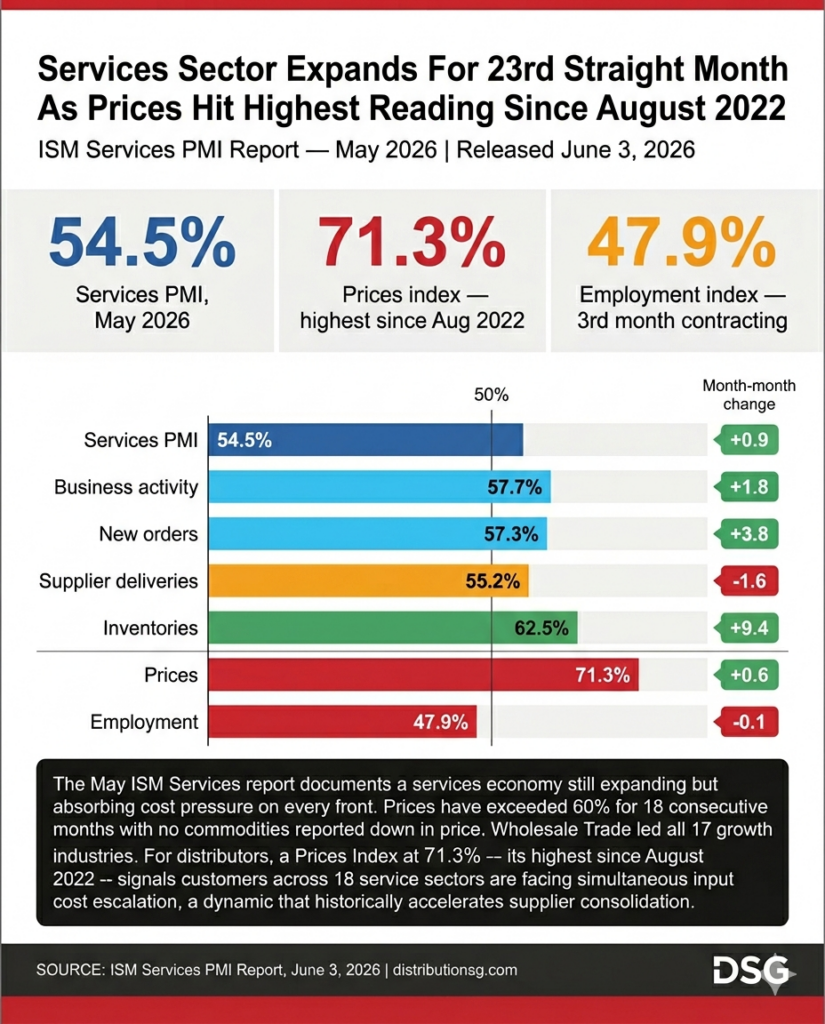
The ISM Services Purchasing Managers Index registered 54.5% in May, up from 53.6% in April. A reading above 50 indicates expansion. Wholesale trade was the highest-ranked industry among the 17 services sectors, reporting growth during the month.
Growth was supported by strong business activity, new orders, and supplier deliveries, all of which posted some of their strongest readings of the past year, according to Steve Miller, chair of the ISM Services Business Survey Committee.
The report’s most significant development was a sharp increase in pricing pressure. The Prices Index rose to 71.3%, its highest level since August 2022, and remained above 60% for the 18th consecutive month. For the third straight month, respondents reported no commodities declining in price.
Products and services cited as increasing in cost included aluminum, copper, diesel fuel, gasoline, labor, software licensing, transportation services, and HVAC equipment. Petroleum-related products also appeared on the list of rising-cost items for the first time in the current reporting cycle.
“We are seeing the dual effects of the administration’s tariff policy dynamics and the conflict in the Persian Gulf affect our pricing,” one respondent in the accommodation and food services sector said. “This is the definition of inflationary pressure starting to affect us.”
Employment remained a weak spot. The Employment Index contracted for the third consecutive month, registering 47.9%. Survey respondents cited hiring freezes, decisions not to replace departing workers and ongoing workforce reductions tied to operational efficiencies and technology investments.
At the same time, supply chain conditions continued to tighten. The Supplier Deliveries Index registered 55.2%, indicating slower delivery performance for the 18th straight month. Respondents reported extended lead times for electrical equipment, generators, and mechanical systems, while some cited transportation disruptions tied to rising freight costs.
One wholesale trade respondent reported that a major distributor had delayed freight shipments pending renegotiation of transportation contracts to address higher fuel expenses.
Inventories also climbed sharply. The Inventories Index reached 62.5%, reaching the highest level recorded since ISM began tracking the metric in 1997. Despite the increase, inventory sentiment remained unchanged, suggesting businesses view current stock levels as a strategic hedge against rising costs and potential supply disruptions rather than a sign of weakening demand.
The report indicates the services economy continues to grow despite persistent inflation and labor-market challenges. ISM said the May reading is consistent with annualized real GDP growth of approximately 2%.
For distributors, the data points to a market where demand remains resilient but operating conditions are becoming more difficult. Customers continue to place orders and maintain inventory levels, yet higher costs for materials, transportation and labor are putting pressure on margins throughout the supply chain.
The combination of rising prices, slower deliveries and elevated inventories suggests many companies are preparing for continued uncertainty in the second half of 2026. How successfully distributors manage pricing, inventory levels and customer relationships amid those conditions will play a significant role in determining performance for the remainder of the year.
Do not miss any content from Distribution Strategy Group. Join our list.
Share this article:
