



Why This Matters to Distributors: Rising wholesale inventories indicates distributors continue to rebuild stock levels despite an uncertain economic environment. At the same time, a widening trade deficit reflects stronger imports and weaker exports, creating additional pricing, inventory, and supply chain challenges for distributors.
U.S. wholesale inventories increased in May while the nation’s trade deficit in goods widened sharply as imports rose and exports declined, according to advance economic indicators released June 26 by the U.S. Census Bureau.
Wholesale inventories increased 0.3% from April to a seasonally adjusted $944.0 billion, following a revised 0.7% increase the previous month. Inventories were 4.3% higher than in May 2025, continuing a steady year-over-year buildup across the wholesale sector.
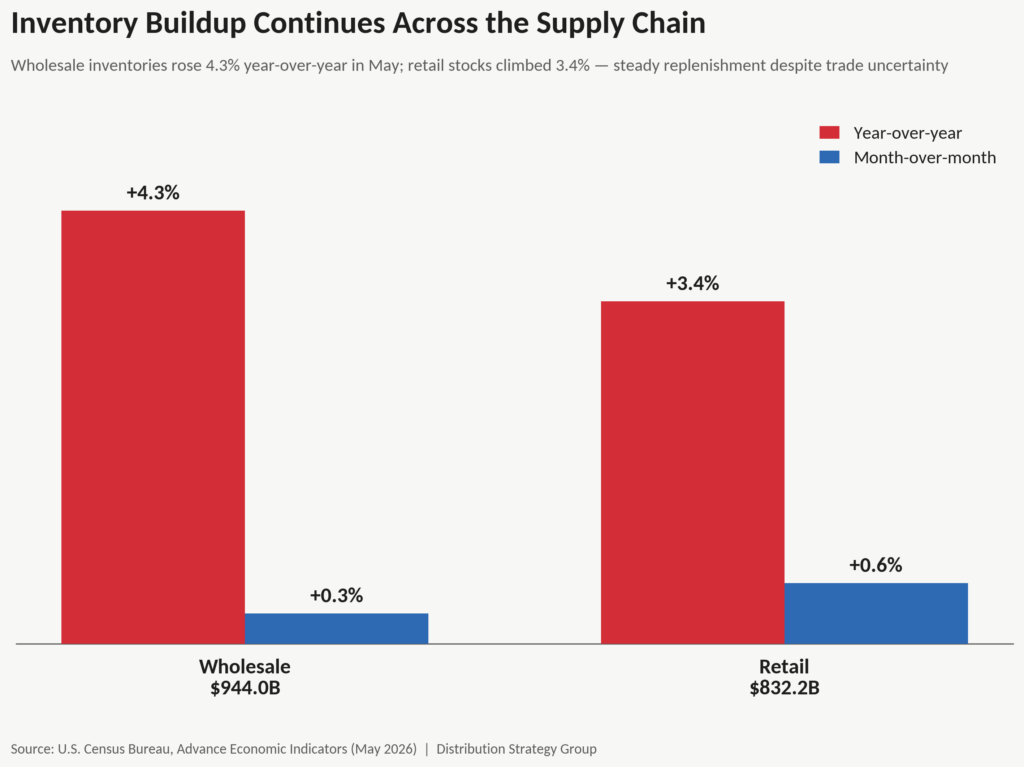
Retail inventories also expanded, rising 0.6% from April to $832.2 billion. Compared with a year earlier, retail inventories increased 3.4%. The April-to-May gain followed a 0.7% increase recorded in April.
The U.S. trade deficit in goods widened to $105.8 billion in May from $83.0 billion in April as exports declined and imports accelerated.
Goods exports fell $11.8 billion to $207.7 billion, while imports increased $10.9 billion to $313.4 billion, reflecting stronger inbound shipments and softer foreign demand for U.S. products.
For distributors, the report points to continued inventory replenishment as companies position themselves to meet customer demand while navigating shifting trade flows and evolving tariff policies. Higher inventory levels can improve product availability but also increase carrying costs and working capital requirements if demand slows.
The advance report provides an early snapshot of U.S. inventory and trade activity before the Census Bureau releases its full monthly wholesale and retail trade reports.
Do not miss any content from Distribution Strategy Group. Join our list.
Share this article:
