


Why This Matters to Distributors: Wesco’s strategy highlights how AI is changing the role of distribution. Rather than competing primarily on product availability, distributors are moving deeper into engineering, power infrastructure, project management, and lifecycle services. As customers build AI infrastructure, distributors that can solve complex technical problems across an entire project may be better positioned to capture larger contracts, deepen customer relationships, and create more durable growth.
Artificial intelligence is becoming much more than a data center growth story for Wesco International.
The Pittsburgh-based distributor says the rapid expansion of AI infrastructure is creating opportunities well beyond supplying electrical products, allowing the company to expand into power systems, engineering, cooling, installation, and lifecycle services that support customers from project design through ongoing operations. That broader strategy helped drive record second-quarter sales and backlog and prompted Wesco to raise its full-year 2026 outlook.
“We’re not a one-trick pony,” Chairman, President and Chief Executive Officer John Engel told analysts during the company’s earnings call. While data centers remain the company’s fastest-growing market, he said Wesco continues to benefit from infrastructure investment, utility modernization, manufacturing reshoring, and industrial expansion. Excluding data center projects, the company still generated mid-single-digit sales growth during the second quarter.
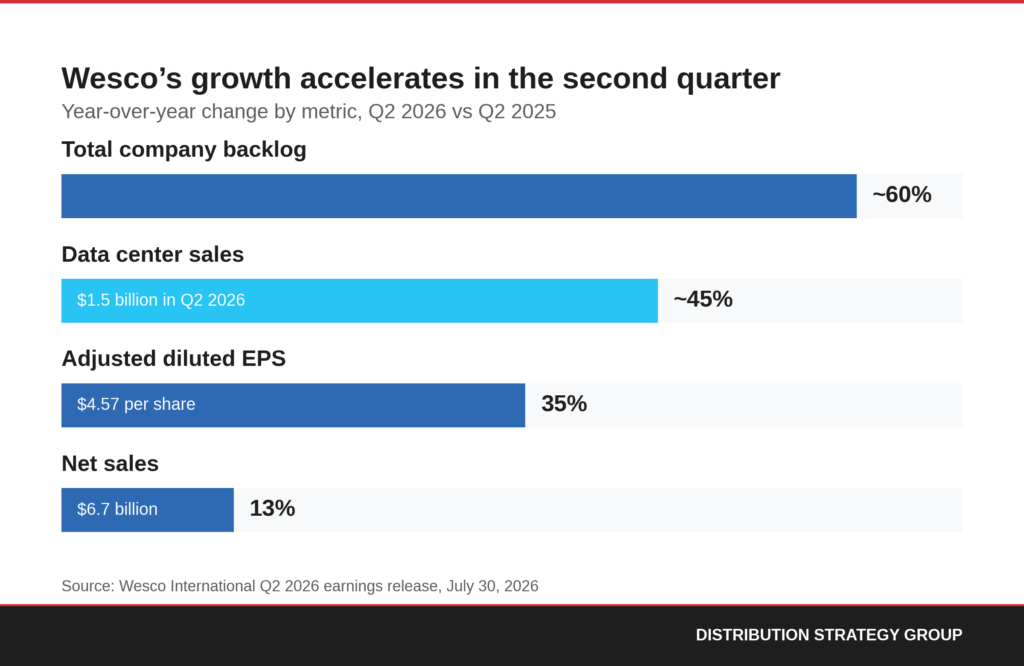
Wesco reported second-quarter sales of $6.67 billion, up 13.0% from $5.90 billion a year earlier. Net income increased 10.5% to $209.0 million from $189.2 million.
For the first six months of 2026, sales increased 13.4% to $12.75 billion from $11.24 billion in the same period last year. Net income rose 23.7% to $362.8 million from $293.2 million.
Data center sales reached $1.5 billion during the quarter, an increase of about 45% from a year earlier. But management repeatedly emphasized that the company’s strategy is evolving from supplying products into data centers to supporting the entire AI infrastructure ecosystem.
Engel described the opportunity as a “One Wesco” strategy spanning all three of the company’s operating businesses. Instead of focusing solely on electrical distribution, Wesco now provides communications infrastructure, power systems, engineered cooling, installation, maintenance, and technical services throughout the life cycle of AI facilities.
That strategy expanded further with the July acquisition of Singapore-based Newark Engineering. The company designs and supports mission-critical cooling systems for data centers, adding thermal management expertise that Engel said allows Wesco to engage customers earlier in project planning while expanding opportunities to provide services after facilities become operational.
Another milestone came during the quarter when Wesco secured a multiyear grid services contract with a hyperscale data center operator.
Engel described the award as a significant step in expanding the company’s role in end-to-end power infrastructure. Wesco developed its grid services business internally over the past five to six years, initially serving electric utilities before expanding into data centers, renewable energy projects, and other large industrial customers with complex power requirements.
Chief Financial Officer Indraneel Dev said customers increasingly are bringing Wesco into projects earlier to help address power infrastructure challenges created by AI computing. That earlier involvement enables the company to provide a broader range of products and technical services while increasing opportunities to cross-sell across its communications, electrical and utility businesses.
The company’s growth remained broad-based during the quarter.
Communications and Security Solutions reported 18% sales growth, driven primarily by continued investment in data centers. Electrical and Electronic Solutions increased 11%, supported by construction projects, industrial demand and original equipment manufacturers serving semiconductor, electrification, and AI markets. Utility and Broadband Solutions grew 7% as utility investment strengthened and broadband project activity accelerated.
Wesco also reported record backlog for the third consecutive quarter, with companywide backlog increasing by about 60% from a year earlier. Communications and Security Solutions backlog increased approximately 95%, Electrical and Electronic Solutions backlog rose about 30%, and Utility and Broadband Solutions backlog climbed about 80%, reflecting multiyear customer commitments across all three businesses.
Engel said those commitments reinforce management’s view that AI infrastructure is only one of several long-term demand drivers. He pointed to electric grid expansion, power modernization, manufacturing reshoring and what he described as the initial stages of an industrial “supercycle” as additional sources of future growth.
Reflecting that confidence, Wesco raised its full-year outlook. The company now expects organic sales growth of 9% to 11%, up from its previous forecast of 5% to 8%, citing accelerating customer demand, record backlog, and continued momentum across all three operating businesses.
Do not miss any content from Distribution Strategy Group. Join our list.
Share this article:
