

Why This Matters to Distributors: The Silver tier may be the AI Top 25’s most practical benchmark for distributors. These companies have moved beyond pilots and put AI into production, but their results also expose the challenges that come next, including uneven measurement, leadership changes and the difficulty of turning individual deployments into lasting, companywide capabilities.
The most instructive companies in Distribution Strategy Group’s AI Top 25 may not be the ones at the top.
Eleven of the 26 distributors recognized in DSG’s benchmark landed in the Silver tier, where AI has moved beyond experimentation and into day-to-day operations but has not yet reached the scale, longevity or documented results of the Platinum and Gold companies.
That makes Silver a useful measure of where much of distribution is heading next.
These companies are using AI for product search, routing, customer service, quoting, product identification and other operating functions. Some can point to measurable gains. Others have meaningful deployments but limited public evidence of results. And several show how quickly an ambitious AI strategy can be complicated by executive turnover, corporate restructuring or the difference between a projected benefit and a proven return.
DSG evaluated more than 300 North American distributors over two years, drawing on earnings calls, executive interviews, vendor case studies and public disclosures. Companies whose AI claims consisted primarily of pilots, announcements or stated ambitions rather than sustained operating use were screened out.
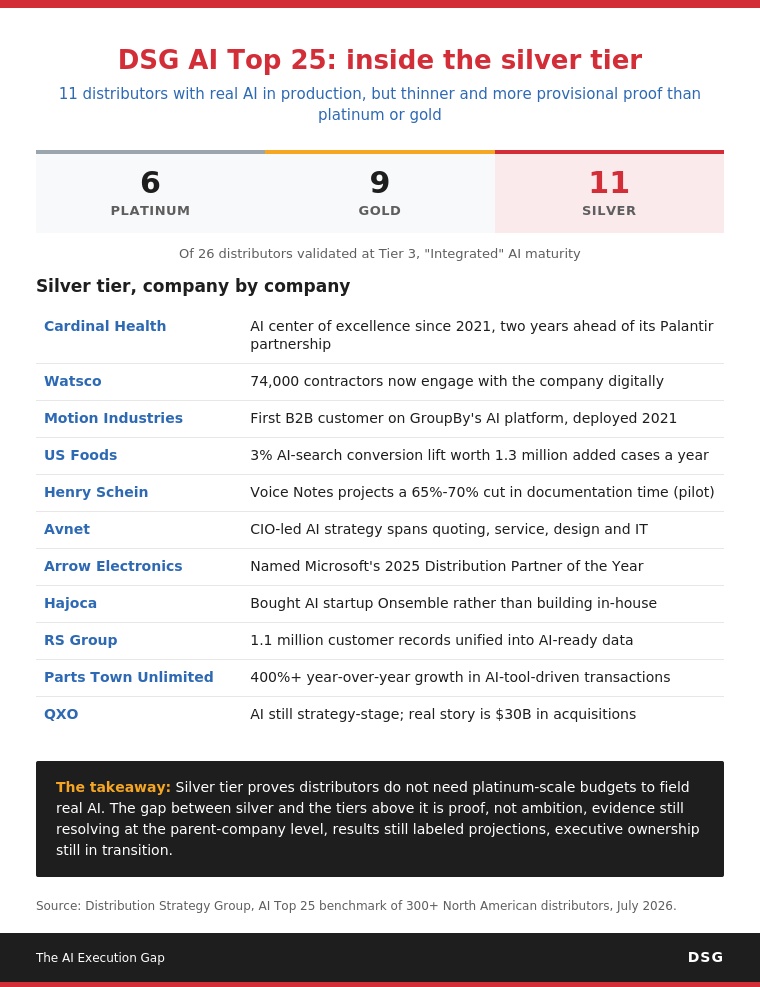
Every Silver-tier company cleared that threshold. What separates Silver from Platinum and Gold is not simply whether the technology works. It is how broadly AI has been deployed, how long it has been operating, how clearly results can be measured and how much of the supporting evidence comes directly from the distributor.
Cardinal Health and Motion Made Early AI Moves
Cardinal Health and Motion Industries stand out for investing in AI before generative AI became a corporate priority across distribution.
Cardinal Health established an enterprise AI center of excellence in 2021, two years before its Palantir Foundry partnership and well before ChatGPT accelerated corporate interest in generative AI. The company now operates 74 Swisslog-powered AutoStore robots at a Fort Worth, Texas, fulfillment center using a cloud-based, AI-enhanced warehouse management system.
Motion Industries was also an early mover.
The distributor deployed GroupBy’s AI-powered product discovery platform on motion.com in November 2021, becoming the vendor’s first business-to-business customer. The deployment came several years before many distributors began publicly discussing AI-powered product search.
More recent evidence is harder to isolate at Motion itself. Parent company Genuine Parts Co.’s internal ChatGPC large language model has roughly 6,000 active users, according to CEO Will Stengel, but public disclosures do not clearly break out adoption within Motion.
That distinction should become easier to track as Motion separates into a standalone public company under the Global Industrial name.
US Foods and Parts Town Put Numbers Behind AI
US Foods and Parts Town Unlimited provide some of the Silver tier’s clearest examples of AI producing measurable business results.
US Foods said AI-powered search on its MOXe ordering platform generated a 3% increase in conversion, representing roughly 1.3 million additional cases annually. A networkwide deployment of Descartes’ AI-powered routing technology also produced a 2.3% improvement in delivery efficiency.
Parts Town has reported similarly specific results.
The company relaunched its PartPredictor parts-identification tool in May and said it produced a 54% increase in conversion and more than 400% year-over-year growth in transactions generated through the tool.
Those customer-facing applications operate alongside an increasingly automated fulfillment network that includes 85 AutoStore robots and 2.3 miles of conveyor systems.
Henry Schein demonstrates why DSG also examined how companies characterize AI results.
Its Voice Notes documentation tool, built on Amazon Bedrock, is projected to reduce clinical documentation time by 65% to 70%. Amazon’s case study, however, describes the figure as a pilot projection rather than a measured production result.
The distinction matters. A projected productivity gain can support further investment, but it is not the same as a documented return from a system operating at scale.
Avnet and Arrow Show Why AI Sales Are Not AI Maturity
Avnet and Arrow Electronics illustrate another challenge in evaluating technology distributors: separating internal AI maturity from customer demand for the products needed to build AI infrastructure.
Avnet chief information officer Max Chan has directed a retrieval-augmented generation strategy spanning quoting, customer service and product design.
At the same time, Avnet reported a 34% year-over-year sales increase last quarter, driven in part by demand for AI infrastructure components. That growth reflects customers buying products used to build AI systems. It should not be confused with evidence that Avnet’s internal AI deployments generated the increase.
Arrow has stronger outside validation of one of its internal AI programs.
Its ArrowSphere Assistant earned Microsoft recognition as its 2025 Distribution Partner of the Year, an uncommon example in DSG’s research of a major technology company recognizing a distributor’s AI program by name.
Arrow, however, has operated under an interim CEO since September, adding a leadership variable as the company works to expand its AI initiatives.
Hajoca and RS Group Take Quieter Routes
Not every meaningful AI strategy begins with a large internal development team.
Hajoca, one of the most decentralized distributors in DSG’s benchmark, acquired Onsemble, an eight-employee AI startup serving plumbing contractors, in June 2025 rather than building the capability entirely in-house.
The acquisition offers another model for distributors without large centralized technology organizations: acquire a focused AI capability and integrate it into an existing business rather than attempt to develop everything internally.
RS Group represents an even less visible approach.
The company’s investor disclosures provide relatively little detail about its AI program. But a vendor case study documents the unification of more than 1.1 million customer and contact records through Informatica’s master data management platform.
That work may lack the visibility of a generative AI assistant or automated warehouse, but it addresses one of the biggest obstacles distributors face when deploying AI: fragmented and inconsistent data.
DSG’s broader research has repeatedly found that data governance and data quality are prerequisites for generating measurable returns from AI.
QXO’s AI Ambition Still Needs More Evidence
QXO sits near the edge of the Silver tier for a different reason: its AI ambitions are easier to document than its results.
The company hired Target’s former head of AI as chief AI officer in November 2024 and outlined an “AI-everywhere” strategy intended to embed the technology throughout the business.
That executive has since left the company, and DSG’s research found less evidence of mature, documented AI deployments than at many of the other Silver-tier distributors.
QXO’s more clearly demonstrated strength so far has been acquisition activity, with roughly $30 billion across three deals completed within about 14 months.
The company has laid out an aggressive AI strategy. The next test is whether it can show where those systems are operating, how broadly they have been deployed and what measurable results they are producing.
Silver May Be the Benchmark Most Distributors Need
For distributors that did not make DSG’s AI Top 25, Silver may be a more useful benchmark than Platinum.
The tier shows that meaningful AI deployment does not require the scale of Ingram Micro or Sonepar. But it does require more than an AI strategy, a vendor announcement or a successful pilot.
The Silver companies that stand out have generally done four things: identified a specific business problem, put AI into production, assigned ownership and begun measuring what changed.
Their weaknesses are equally instructive.
Leadership transitions at Arrow, Motion and QXO, evidence that sometimes remains at the parent-company level and results that in some cases are still projected rather than measured show how quickly AI maturity can become difficult to sustain or verify.
For distributors moving from experimentation to deployment, that may be the central lesson of the Silver tier: Getting AI into production is no longer enough. The harder work is proving that it works, scaling it across the business and making it a durable part of operations.
Do not miss any content from Distribution Strategy Group. Join our list.
Share this article:
