


Why This Matters to Distributors: The companies at the top of DSG’s AI 25 show what artificial intelligence can look like at scale. But the Gold tier offers a more practical lesson for many distributors: Start with a costly business problem, put AI into production, measure the results, and expand from there.
The biggest artificial intelligence lessons in wholesale distribution may not come from the companies at the very top of Distribution Strategy Group’s AI 25.
They may come from the next tier down.
DSG evaluated more than 300 North American distributors and identified 26 with verified AI in sustained production use. The companies in the Platinum, Gold and Silver tiers have demonstrated what DSG classifies as “Integrated” AI capability — production deployments with measurable business impact rather than pilots, partnerships, or announcements alone.
The six Platinum companies — W.W. Grainger, Wesco International, Sonepar, Fastenal, Ingram Micro and ADI Global Distribution — represent the industry’s most advanced AI operators.
But immediately behind them is a group that may offer a more attainable roadmap for the broader distribution industry.
The Gold tier includes Sysco, Builders FirstSource, Ferguson Enterprises, Graybar Electric, MSC Industrial Direct, Border States Electric, Rexel USA, Cencora and McKesson.
Their AI strategies differ widely. Some are focused on sales and quoting. Others are applying AI to inventory, purchasing, software development, warehouse automation, or administrative work.
What increasingly connects them is execution. They are moving AI into specific business processes and, in several cases, putting hard numbers around the results.
For distributors still trying to move beyond experimentation, that makes the Gold tier worth studying.
Adoption Matters More Than Another Pilot
Sysco provides one of the clearest examples.
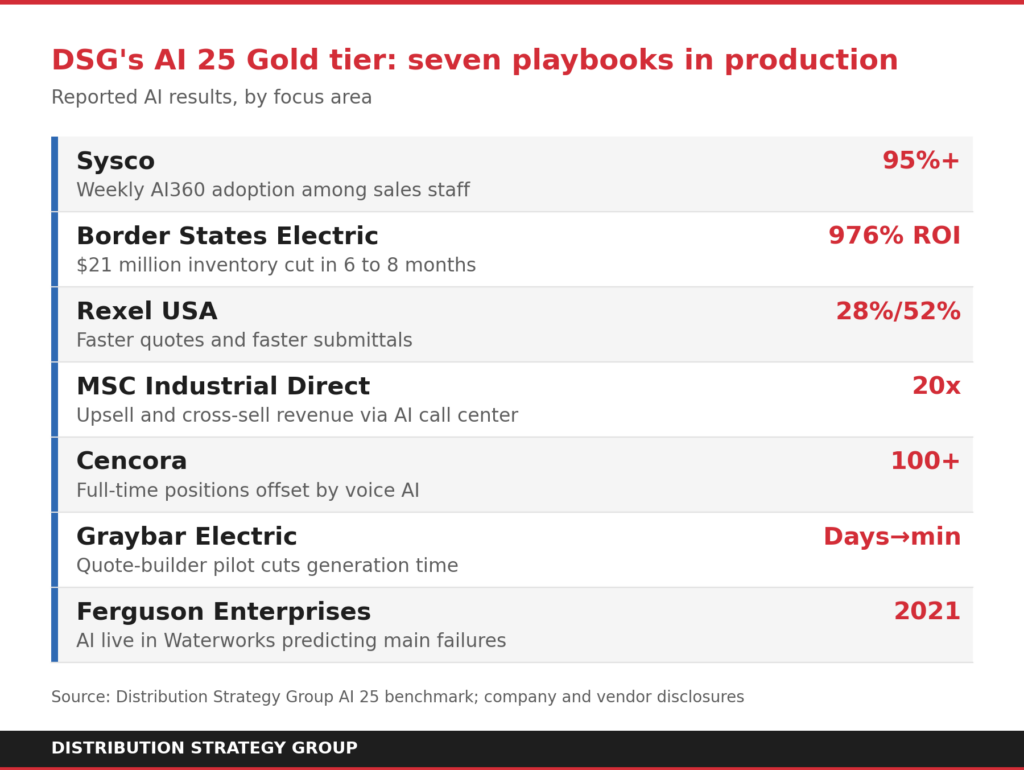
More than 95% of Sysco’s sales employees use its AI360 platform weekly, the company said on its January earnings call. Sysco said heavier users outperform lighter users and has reported four consecutive quarters of improving new-customer wins that it credits partly, though not exclusively, to the platform.
Sysco has also developed SAGE, short for Sysco Agentic Ecosystem, as an enterprise-wide AI layer spanning sales, supply chain, customer experience, and back-office functions. The system generates next-best-action recommendations across those operations.
The lesson is not that other distributors need to replicate AI360.
It is that adoption should be measured as closely as development.
A distributor can have dozens of AI pilots and still achieve little business impact if employees do not use them. Sysco’s 95%-plus weekly adoption rate provides a concrete benchmark for an increasingly important question: Once an AI application works, can the organization get employees to make it part of their daily workflow?
Start With an Expensive Business Problem
Border States Electric offers another model.
Its machine-learning lead-time prediction system produced a reported 976% return on investment, a 1.3-month payback period and a $21 million inventory reduction within six to eight months, according to a Nucleus Research case study. The system covered a $600 million, 300,000-item network.
Technology provider GAINS separately reported that the system automated 90% of purchase orders to vendors and improved lead-time accuracy by 65%.
What makes the Border States case significant is not simply the size of the reported return.
The company applied AI to an old distribution problem.
Lead times, purchasing, inventory levels and product availability were major operating issues long before generative AI arrived. Border States did not need to invent an AI use case. It applied machine learning to a costly business process where improvement could be measured.
That suggests a different starting point for distributors.
Rather than asking where the company can use AI, executives can identify where the business is spending too much money, consuming too much employee time, or making too many repetitive manual decisions — and then determine whether AI can improve the process.
Quoting Is Emerging as a Major AI Opportunity
Rexel USA demonstrates another increasingly important use case: quoting.
More than 50% of Rexel’s U.S. quoting teams and more than 65% of its U.S. inside sales teams use AI-powered tools, according to parent company Rexel’s February 2026 results presentation.
Its Parspec deployment has more than 1,000 users and has reduced average quote-preparation time by a reported 28% and submittal-preparation time by 52%. Rexel has also deployed Revalgo for AI-powered sales-order processing.
Quoting sits at the intersection of several persistent distribution challenges: labor, speed, product data, and customer response time.
Rexel also demonstrates that distributors do not necessarily need a single AI provider.
The company is combining specialized tools for quoting and order processing under a broader corporate strategy. That approach could be more attainable for many distributors than waiting for one platform capable of handling every use case.
Starting Early Creates an Advantage
MSC Industrial Direct provides another lesson: AI experience compounds.
MSC has used Proton.ai’s AI-driven sales technology since 2021, giving the distributor one of the longer deployment histories in DSG’s benchmark.
A Proton case study credits MSC’s AI-powered call center with generating 20 times the upsell and cross-sell revenue of its previous system and a 13% conversion rate on AI recommendations. Those figures are vendor-reported.
MSC has provided its own financial target. The company said it expected $10 million to $15 million in annual savings by 2026 from AI-driven inventory forecasting and distribution center improvements.
The distinction between those sources matters, but so does MSC’s five-year history with the technology.
Companies that began deploying AI several years ago have accumulated something competitors cannot immediately buy operating data, employee experience, and knowledge about how to integrate the technology into existing workflows.
For distributors waiting for AI technology to mature further, MSC provides a counterargument. There is value in starting because the experience gained along the way becomes an asset of its own.
Human Oversight Remains Part of the Model
Cencora offers another lesson, particularly for distributors operating in regulated or high-risk industries.
The pharmaceutical distributor uses Infinitus AI voice agents to automate benefit-verification calls. According to an Infinitus case study, the system offsets work equivalent to more than 100 full-time positions, operates four times faster than manual processing and can absorb tenfold increases in volume.
Cencora also uses AI-assisted literature reviews, but it explicitly keeps expert human judgment in the process. The company reported 81% to 83% agreement between AI and human reviewers and 93% agreement on certain review criteria.
That distinction is important.
AI maturity does not necessarily mean eliminating people from a process. It means determining where automation can operate independently and where human review remains necessary.
For distributors handling pharmaceuticals, safety products, engineering specifications or other high-consequence products and decisions, governance can be as important as the technology itself.
A Disciplined Pilot Can Be More Valuable Than a Big AI Claim
Graybar provides another useful lesson because its public AI record is more nuanced.
Deloitte reported that Graybar’s natural-language quote builder reduced quote-generation time from hours or days to minutes. But Deloitte also described the system as a narrowly scoped pilot with a human reviewer in the loop rather than a completed enterprise rollout.
Graybar paired the pilot with margin-impact tracking as part of a broader modernization of its core systems.
DSG’s validation process also removed a previously circulated claim tying a specific pricing technology provider to a 10% margin improvement because the vendor attribution and figure could not be verified against primary sources.
Both points matter.
Distributors should not confuse a promising pilot with a scaled deployment. They should also be skeptical of dramatic AI return claims that cannot be traced to reliable evidence.
Sometimes a carefully measured pilot says more about an organization’s AI maturity than an extensive list of announced AI projects.
AI Does Not Have to Start Across the Enterprise
Ferguson Enterprises offers another approach.
Its strongest documented AI deployment is concentrated in its Waterworks business. Ferguson’s relationship with VODA.ai dates to 2021, with the company using VODA’s daVinci machine-learning technology to help utility customers predict water-main failures.
DSG found less public support for some broader AI claims previously associated with Ferguson and removed claims that could not be verified against public records.
That narrower deployment still carries an important lesson.
A diversified distributor does not necessarily need to begin with an enterprise-wide AI program. It can start with the business unit, customer problems, or operating process where the data is strongest, and the potential return is easiest to demonstrate.
Success there can create the case for expansion elsewhere.
What the Gold Tier Tells Distributors
Taken together, the Gold-tier companies tell a different story than the Platinum leaders.
Platinum shows where AI can go interconnected systems spanning multiple business functions, supported by large datasets, strong governance, and increasingly sophisticated technology platforms.
Gold offers a clearer view of how distributors can get there.
Sysco demonstrates the importance of employee adoption. Border States shows the potential payoff from attacking inventory and purchasing problems. Rexel illustrates AI’s growing role in quoting and order entry. MSC shows the advantage of starting early. Cencora demonstrates the importance of human oversight. Graybar shows the value of disciplined pilots and measurement. Ferguson demonstrates that meaningful AI can begin inside one part of the business.
The technologies and use cases differ. The management practices behind them are much more consistent.
Across DSG’s benchmark, successful distributors established executive ownership, invested in data quality, measured business results rather than technology activity and expanded applications that worked. They also treated AI as a multiyear business initiative rather than a one-time technology purchase.
That may be the most important lesson from the next tier of the AI 25.
Most distributors do not need to become Grainger, Ingram Micro or Sonepar overnight.
They need to identify an important business problem, establish a baseline, put AI into production, drive adoption, measure the result, and determine whether the application deserves to scale.
Then they need to do it again.
That is how AI moves from experimentation into the operating business and how today’s Gold-tier practices could become tomorrow’s industry standard.
Do not miss any content from Distribution Strategy Group. Join our list.
Share this article:
