



Why This Matters to Distributors: Canadian wholesale trade is adopting AI at less than half the rate of Canadian businesses overall. More significantly, wholesale has remained near the bottom of the industry rankings as national AI adoption has more than tripled since 2024. The widening gap suggests distributors that move AI beyond pilots and into core operations could gain an increasingly meaningful competitive advantage.
Canadian wholesalers remain among the country’s slowest adopters of artificial intelligence, even as AI use across the broader economy continues to accelerate.
Just 7.9% of wholesale trade businesses reported using AI to produce goods or deliver services during the previous 12 months, according to recent Statistics Canada data. That put wholesale trade ahead of only agriculture, forestry, fishing, and hunting, at 4.5%, among the industries measured. Construction had the third-lowest adoption rate at 9.2%.
The results show a substantial gap between wholesale trade and the broader Canadian economy.
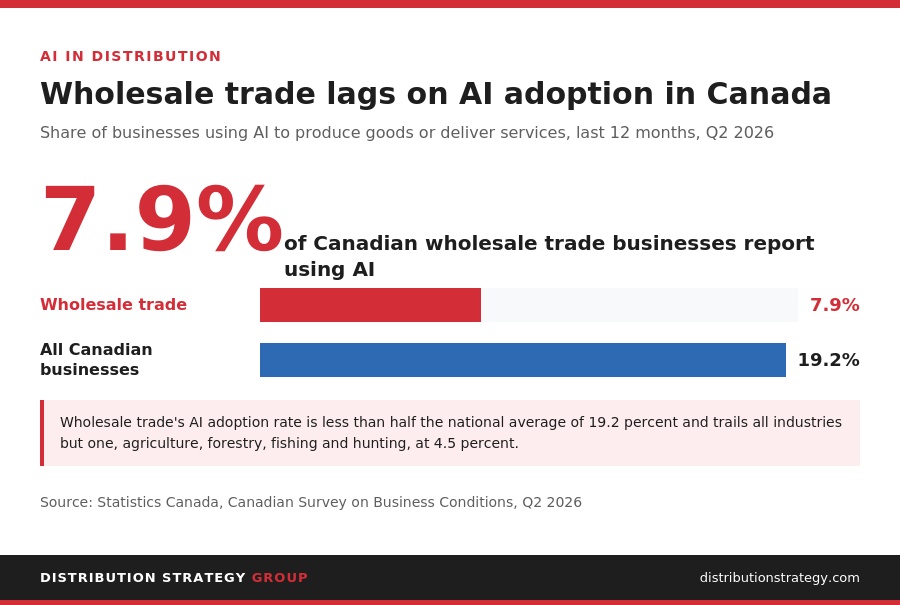
Overall, 19.2% of Canadian businesses reported using AI in the second quarter of 2026, up from 12.2% a year earlier and more than triple the 6.1% recorded in the second quarter of 2024.
Statistics Canada based the findings on its Canadian Survey on Business Conditions, conducted from April 1 through May 6. The agency received responses from 9,251 businesses from a stratified sample of 21,105.
Information and cultural industries led the country in AI adoption at 42.3%, followed by finance and insurance at 40.4% and professional, scientific, and technical services at 32.4%. The same three sectors also led to adoption a year earlier.
Among Canadian businesses using AI, data analytics was the most common application, reported by 36.6%. Text analytics followed at 34.5%, while 28.2% reported using virtual agents or chatbots.
Company size also tracked with AI adoption. Among businesses with 100 or more employees, 27.8% reported using AI, compared with 19.9% of businesses with one to four employees.
Cybersecurity or privacy concerns were the most cited barriers, reported by 13.4% of businesses. Cost was cited by 10.6%.
Statistics Canada did not provide a separate breakdown of the barriers facing wholesalers or the AI applications being used specifically within wholesale trade. The agency’s forthcoming TechStat program is scheduled to begin publishing dedicated data on AI adoption and its impact in 2027.
For distributors, the latest numbers suggest wholesale trade’s low adoption rate is not simply a one-quarter setback. The sector has trailed information, finance and professional services in every survey cycle since Statistics Canada began asking these questions in 2024, even as AI adoption across Canadian businesses has more than tripled.
The numbers also underscore the scale of the challenge facing distributors. While some large distributors are moving AI into pricing, inventory management, sales, customer service and other operating functions, Canada’s overall wholesale adoption rate remains in the single digits.
Closing that gap will depend not only on what the industry’s largest companies do, but also on how quickly midsize and independent distributors move AI beyond experiments and pilot programs and into everyday operations.
Do not miss any content from Distribution Strategy Group. Join our list.
Share this article:
