

Why It Matters to Distributors: The expansion of AI hiring and the recruitment of senior technology leadership signal a shift toward data-driven operating models, where competitive advantage will increasingly depend on how effectively distributors can deploy and scale AI across core business functions.
Wholesale distribution is moving from AI experimentation to targeted hiring, with public job postings showing a growing push toward machine learning, agentic AI, data governance, and AI product roles tied to core commercial and operating functions. The trend is visible at companies including Home Depot, Grainger, QXO, Ferguson and Global Industrial, where openings are focused less on broad “innovation” mandates and more on production systems tied to customer service, pricing, workflow automation, and enterprise data infrastructure.
The clearest signal that AI is becoming a leadership priority came from Home Depot on March 31, when it named Franziska “Fran” Bell executive vice president and chief technology officer, effective April 6. The company said Bell, most recently Ford Motor Co.’s chief data, AI and analytics officer, will lead the strategy, development and alignment of technology, product management, data, and AI, and will drive enterprise-wide integration of agentic AI and machine learning for associates, DIY customers, and Pro customers. Home Depot CEO Ted Decker said Bell’s expertise would help the retailer “remove friction” and improve the customer experience.
That hire matters beyond one company. It shows that large distributors and distributor-adjacent players are no longer treating AI as a side project inside IT. They are recruiting senior leaders with deep AI and analytics backgrounds from outside traditional distribution, a sign that boards and CEOs increasingly view AI as a core operating capability rather than a support tool. That interpretation is reinforced by the types of jobs now being posted below the executive level.
A review of current public postings on April 7 found at least 13 clearly identifiable AI-specific or AI-adjacent openings across five large companies: five at Home Depot, three at Grainger, two at QXO, two at Ferguson and one at Global Industrial. That is not a census of all wholesale-distribution AI jobs, and it excludes openings that may sit behind internal search tools or private recruiting channels. But it does provide a conservative snapshot of visible demand among some of the sector’s largest operators. The count is based on publicly accessible postings reviewed individually, not on a third-party estimate.
Home Depot’s postings are among the most expansive. A manager, AI platform engineering role lists pay of $140,000 to $240,000 and says the hire will lead development of the company’s enterprise generative AI platform, including GenAI services, agentic workflows, and multi-model orchestration. A staff machine learning engineer role focused on generative AI lists pay of $120,000 to $190,000 and calls for work on LLM applications, retrieval-augmented generation pipelines, production monitoring, and workflow optimization. A senior systems engineer, CoreAI-agentic solutions role lists pay of $90,000 to $180,000 and is focused on the infrastructure behind Home Depot’s generative AI and agentic systems. Separate postings include a data scientist, contact center AI role and a data science senior manager, AI strategy and transformation, whose job description says the role will help execute “Project Orion,” including enterprise data products, GenBI and semantic or intelligence layers to accelerate AI adoption.
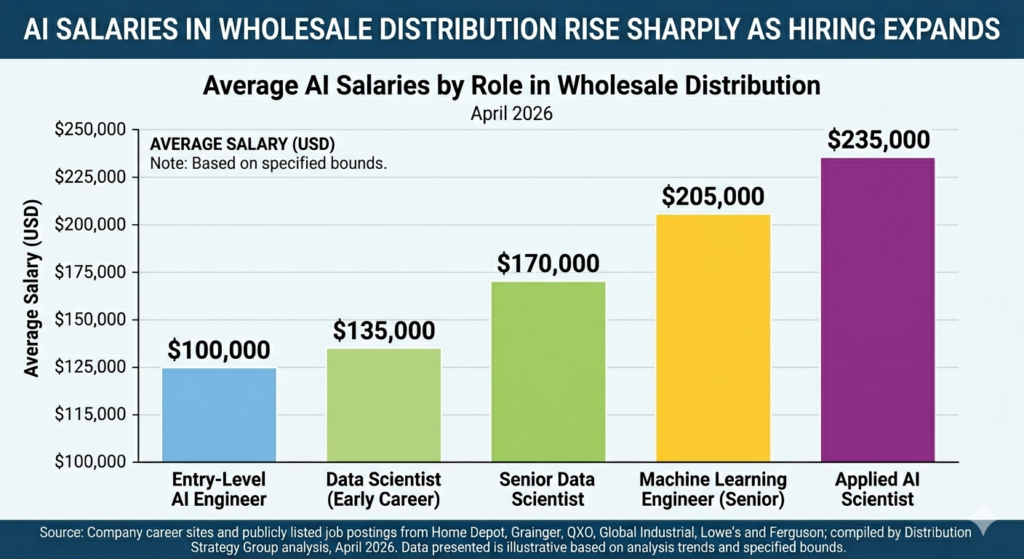
Grainger’s hiring shows a similarly practical focus, especially around customer-facing productivity. Its manager, applied machine learning posting lists anticipated base pay of $148,900 to $248,200 plus an incentive target of up to 15%. The description says Grainger’s product discovery team is building AI agents to assist customer service agents in real time during phone calls by surfacing product information, detecting customer sentiment, recommending next best actions, and automating post-call documentation. The posting also calls for production deployment experience, LLM or SLM fine-tuning, prompt engineering, PyTorch, agentic AI frameworks such as LangGraph or LangChain, and event-driven architecture experience. Grainger also has a machine learning engineer II opening with listed base pay of $149,999 to $262,200, as well as an applied machine learning internship.
QXO’s postings suggest an especially aggressive buildout around agentic systems. A staff AI engineer opening in Seattle lists base pay of $160,000 to $288,000, plus bonus and equity, and says the role will design, build, and operate intelligent agent systems, integrate AI agents with APIs and data sources, and deploy and monitor AI systems in production. A senior AI engineer posting says the company wants someone to build “production-grade AI agents” using agentic frameworks, model-context-protocol servers, and LLM orchestration libraries; public job-board syndications list the base pay around $150,000 to $220,000 or $222,000, depending on the posting version. Even allowing for some variation across syndication sites, the ranges point to the same conclusion: QXO is paying up for applied AI talent that can move systems into production.
Ferguson’s visible openings show another important trend: companies are not only hiring engineers, but they are also building governance and product-management layers around AI. Ferguson has posted a principal artificial intelligence product manager role whose description says the company is building its AI product capability “from the ground up” and that the position is the first dedicated product-management hire on the AI team. It also has a senior manager for its artificial intelligence center of excellence, described as the architect of Ferguson’s AI governance infrastructure and operating frameworks. Those postings indicate a move from scattered pilots toward a more formal AI operating model.
Global Industrial’s public opening underscores a point many distributors are learning the hard way: AI hiring is not just about flashy engineering roles. Its director, data governance position in Port Washington lists a base pay range of $160,000 to $200,000. That is not labeled as an AI job, but it is foundational to AI scale because distributors typically cannot deploy reliable pricing, search, quoting or service agents without stronger product, customer, and transactional data controls. In practice, many of the most important AI hires in 2026 may sit in data architecture, governance, and enablement rather than in pure model development.
What is happening in distribution also fits the broader labor-market evidence. Stanford’s 2025 AI Index, drawing on Lightcast data, said AI-related jobs accounted for 1.8% of all U.S. job postings in 2024, up from 1.4% in 2023. PwC said in its 2025 AI Jobs Barometer that U.S. workers with advanced AI skills earned a 56% wage premium and that AI-exposed U.S. industries saw revenue per employee jump 27%. Those are economywide figures, not wholesale-only data, but they help explain why distributors are paying more for these roles and why they are trying to attach AI hiring directly to productivity and revenue use cases.
Wholesale distribution, however, still appears to be at an earlier stage than software, finance, or telecom. A January study from the Federal Reserve Bank of Kansas City, using Lightcast data, found that overall, AI jobs remain concentrated in a few industries, while AI pricing jobs have become more broad-based across sectors. The authors said larger firms are more likely to adopt AI pricing technology and that the share of AI pricing jobs increased more than tenfold from 2010 to 2024 even as pricing employment overall declined. For distributors, which is a meaningful signal because pricing is one of the first areas where AI can produce measurable margin impact without requiring a full reinvention of the business model.
That helps explain the pattern emerging in distributor hiring. The current wave is clustering around a few use cases with hard economics behind them: customer-service assistance, search and product discovery, pricing optimization, workflow automation, enterprise data products, and governance. In other words, companies are hiring where AI can either lift conversion, protect gross margin, reduce labor friction, or improve digital self-service. The postings from Home Depot, Grainger, and QXO all fit that pattern.
Compensation tells the same story. Among the postings reviewed, listed base-pay ranges run from roughly $90,000 to $180,000 for senior infrastructure-oriented roles at Home Depot, $120,000 to $190,000 for staff generative AI engineering there, $148,900 to $248,200 for Grainger’s applied machine learning manager, about $150,000 to $220,000-plus for QXO’s senior AI engineer and $160,000 to $288,000 for its staff AI engineer. Global Industrial’s data-governance director’s role is listed at $160,000 to $200,000. Taken together, those postings show that distributors are now competing for AI talent at compensation levels that would have been unusual for the sector only a few years ago.
The bigger question is how this is going. The honest answer is that hiring is accelerating, but adoption is uneven. Large companies with scale, centralized data teams, and the budget to pay for specialized talent are pulling ahead. The Kansas City Fed’s work suggests that larger firms are more likely to adopt AI pricing because the fixed costs of adoption favor scale. That same logic applies more broadly across distribution, where smaller operators may adopt vendor tools but struggle to build in-house AI teams.
So, the most useful estimate today is not a national headcount of wholesale-distribution AI jobs, because no public source appears to provide a real-time, wholesale-only tally comparable to BLS payroll data. The best public benchmarks are broader: Stanford and Lightcast’s 1.8% share of AI-related U.S. postings in 2024, PwC’s wage-premium data, and a company-by-company review of visible openings. Based on that review, large distributors and adjacent players are clearly hiring, but selectively: the market is still concentrated in a small number of enterprise roles rather than broad-based hiring across the sector.
The bottom line for distributors is that AI hiring is no longer theoretical. It is moving into the org chart, the pay structure, and the operating model. The leaders are hiring not just data scientists, but platform engineers, AI product managers, governance leaders, and senior executives who can connect AI to pricing, service, digital commerce, and branch operations. That is usually what happens when technology shifts from pilot to production.
Do not miss any content from Distribution Strategy Group. Join our list.
Share this article:
