Why This Matters to Distributors: $1.4 trillion in utility investment and more than $300 billion in annual hyperscale data center spending are flowing through the electrical and industrial supply chains that wholesale distributors serve. But the window to build the capabilities needed to compete for that volume is closing.
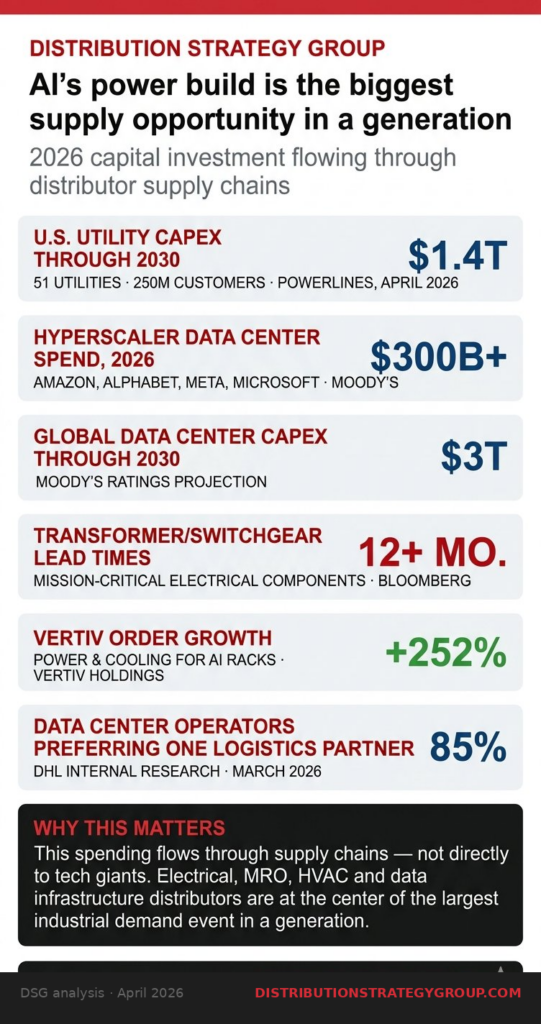
America’s investor-owned utilities have committed $1.4 trillion in capital spending through 2030. That’s a 27% increase over last year’s $1.1 trillion projection and one being driven by the power demands of artificial intelligence data centers. The figure, drawn from a PowerLines analysis of 51 utilities serving 250 million customers released April 14, effectively doubles the total utility infrastructure investment of the prior decade, compressed into five years.
That spending does not flow through Amazon, Google, or Microsoft. It flows through supply chains. The distributors who handle electrical components, MRO supplies, cooling systems, and data infrastructure stand at the center of what may be the most concentrated industrial demand event in the history of the U.S. wholesale channel.
The hyperscale capital commitments driving demand is without precedent. Microsoft Corp. has committed more than $80 billion in capital expenditure for fiscal year 2026, with quarterly spending reaching $37.5 billion in the second quarter. That’s a 66% year-over-year increase. Meta Platforms Inc. is projected to spend between $80 billion and $100 billion in 2026, up from $70 billion the prior year. Alphabet Inc. has announced between $175 billion and $185 billion in total 2026 capital expenditures, with $70 billion to $74 billion allocated specifically to data center construction and networking.
Combined, the four major hyperscalers (Amazon, Alphabet, Meta, and Microsoft) are on pace to spend more than $300 billion on data center infrastructure this year, according to Moody’s Ratings, which projects $3 trillion in global data center capital expenditure over the next five years.
The scale of individual projects underscores the trajectory. In Abilene, Texas, more than 6,000 workers are constructing an eight-building data center campus that OpenAI will use when completed later this year. The facility will consume 1.2 gigawatts of power, or enough electricity for one million American households. The Abilene campus is one node in a national construction surge that has made data centers the single largest driver of new power infrastructure investment in the country.
A Supply Bottleneck in the Wholesale Channel
The demand surge has created a materials bottleneck that runs directly through the wholesale distribution channel. Domestic manufacturing of transformers, switchgear and batteries has not kept pace with project volume, forcing developers to rely on imports and pushing lead times for mission-critical electrical components such as medium-voltage gear, power transformers, and switchgear beyond a year in many markets.
For electrical distributors, that supply constraint functions simultaneously as a capability test and a competitive filter. Distributors with pre-established supplier relationships, global sourcing networks, and the technical expertise to manage component allocation across large construction projects are capturing a disproportionate share of the available volume. Those without those capabilities are watching the business go to peers who built for it.
WESCO International Inc. is the clearest example in the wholesale channel of a company that positioned itself for this market before the boom arrived. The Pittsburgh-based distributor completed its $4.5 billion acquisition of Anixter International in 2020 and used the combined platform to build deep capability in data center supply chains.
By early 2025, WESCO had moved from a broad-line hardware distributor to what the company describes as an AI-driven supply chain orchestrator, supported by a multibillion-dollar backlog in data center and renewable energy projects. The company’s Communications and Security Solutions segment — its most direct exposure to data center infrastructure — posted accelerating revenue as AI construction demand intensified.
WESCO and ABB are now working together to address the lead time problem directly. The partnership helps developers, contractors and operators accelerate deployment timelines for electrical infrastructure at a moment when sourcing alternatives are constrained. The geography of the buildout is compounding the challenge.
Traditional data center hubs in Northern Virginia and Silicon Valley are facing power limitations, pushing hyperscalers toward alternative regions (Iowa, Nebraska, Nevada, Georgia, and Texas) where generation capacity is more accessible, but distribution infrastructure is less developed. That geographic expansion is generating demand in markets where electrical distributors have historically had less coverage.
Utility Spending Creates Demand Across Verticals
The utility investment surge extends beyond connecting data centers to the grid. It represents a broad recapitalization of U.S. electrical infrastructure, with data center load growth as the primary catalyst. Duke Energy Corp. has committed $102.2 billion in capital investment. Southern Co. has pledged $81.2 billion. U.S. data centers consumed more than 4% of total electricity in 2023, according to the MIT Energy Initiative. That share is projected to reach 9% by 2030, implying the addition of multiple large states’ worth of generating capacity in under a decade.
Every kilowatt of new generating and transmission capacity requires switchgear, transformers, cable, conduit, wire management systems, and associated MRO supplies. The downstream demand from utility capital expenditure programs extends well beyond the electrical distribution channel. Industrial distributors serving the construction trades, HVAC distributors supplying the mechanical systems that cool data center power infrastructure and safety and PPE distributors serving a large skilled-trades workforce are all exposed to the same demand driver.
The data center construction wave is generating volume in specific product categories: electrical components and cable for power delivery; cooling systems for GPU-dense server racks that now exceed 100 kilowatts per unit; networking hardware; server enclosures; and prefabricated power modules designed for modular construction approaches. Vertiv Holdings Co., a supplier of power and cooling systems for data centers, reported a 252% increase in orders as rack densities climbed past 100 kilowatts per unit. The company projects approximately $13.5 billion in organic revenue for 2026, up about 28%. That order volume reaches the market through Vertiv’s distributor relationships across the electrical and data infrastructure channel.
Logistics Consolidation Poses a Competitive Threat
The demand picture is not uniformly favorable for distributors. DHL Group announced in March that it is expanding its North American logistics network with 10 new facilities dedicated specifically to data center supply chains, adding more than 7 million square feet of capacity for servers, power systems, and networking hardware. The expansion targets hyperscale and colocation operators and is supported by DHL’s internal research showing 85% of data center operators prefer a single end-to-end logistics partner —while only 43% currently have one.
That preference for consolidation is a direct competitive signal for distributors serving data center construction customers. Logistics providers, third-party logistics companies, and systems integrators that can offer end-to-end project services — procurement, kitting, white-glove handling, rack pre-configuration, and direct job-site delivery — are competing for the same project spend that electrical distributors have historically controlled. For distributors that have built project logistics capability, the DHL expansion validates the direction the market is moving. For those that have not, it signals the direction of the threat.
A Demand Cycle with No Clear End
The AI data center buildout is not a single-cycle event. The revival of nuclear power as a baseload electricity source signals how far the investment horizon extends. Constellation Energy Corp. is restarting Three Mile Island Unit 1 in 2027, with 835 megawatts of capacity, under a 20-year power purchase agreement with Microsoft. Small modular reactors are under evaluation as longer-term solutions for data center campuses that require carbon-free power running continuously. The infrastructure chain required to support that buildout — from reactor to substation to switchgear to end facility — will generate sustained demand across the wholesale channel well beyond the current construction cycle.
Google CEO Sundar Pichai described the core challenge directly during a recent earnings call. “Scaling compute capacity while managing the power, land, and supply chain constraints necessary to meet demand for AI services remains a persistent concern,” Pichai said.
For distributors with technical expertise, global sourcing capability, and project logistics depth to serve the data center supply chain, that persistent concern represents a persistent revenue opportunity. For those without it, the capacity buildout underway represents a structural shift in demand that grows harder to enter as the cycle matures.
Do not miss any content from Distribution Strategy Group. Join our list.
Share this article:
