

Distributors deploying agentic AI are learning a hard lesson: technology rarely fails because of what it cannot do. It fails because of what it does not know.
An agent may resolve an order exception without knowing a customer has a no-substitution clause. A replenishment agent may recommend a buy without knowing the SKU is on promotional hold. A transfer workflow may reroute inventory without knowing the receiving branch is closed for physical inventory next week. In each case, the agent acts logically, but not operationally correctly. The result is not one exception resolved. It is two created.
The distribution industry is at an inflection point. A December 2025 survey of 233 distribution executives by Distribution Strategy Group found that 63% are piloting or exploring AI, while only 27% are implementing it at scale. The industry has moved beyond curiosity and into execution. The hard part now is making AI show up in actual operational performance. That operationalization problem is where many distributors are getting stuck.
The fix requires two things distributors consistently underinvest in: a governed operational knowledge layer that tells agents what they need to know before they act, and a health-metric framework that tells operators whether those agents are working the way they were designed to.
The Operational Knowledge Layer: Making Agents Fit to Act
A knowledge assistant is not a chatbot or a static knowledge base. It is a governed, queryable operational context layer that makes product rules, customer terms, supplier conditions, operational policies, and compliance constraints available at decision time to both people and AI agents. The difference between an agent that handles exceptions reliably and one that creates new problems is always the quality of this layer.
At one large wholesale distributor, computer vision monitored inventory flow and routine claims were resolved autonomously by adjusting inventory, issuing supplier claims, and notifying stakeholders without human initiation. Inspection cycles compressed from days to minutes. The DC manager described the role shift directly:

That shift happened because the operating knowledge underneath the agents was explicit and maintained: what constitutes a damage claim, what the approved resolution path is, and which vendors have agreed to which procedures. Without that context layer, the same agents would have required constant human intervention to catch misapplied resolutions.
The hesitation many distributors feel about giving agents more autonomy is real and legitimate. In the DSG survey, 33% of respondents cited lack of internal skills as their biggest AI obstacle and 19% pointed to resistance to change. That concern is not irrational. It is the correct response to an agent operating without reliable context about financially sensitive inventory, supplier reliability issues, customer-specific exceptions, or distorted demand signals. The knowledge layer provides the context foundation. Governance comes from how that knowledge is owned, refreshed, measured, and corrected over time.
Where to Start
Build the knowledge layer for the first workflow you are deploying, not for everything at once. For order exception resolution, the most common starting point, the minimum viable context usually covers four domains: approved substitutions by SKU, customer substitution permissions, active holds and restrictions, and carrier priority rules.
One frequently overlooked entry point is the ERP. The DSG survey found that 62% of distributors using AI have already deployed it in order automation, such as reading email or PDF orders and feeding them into the ERP without human touch. That same structured product and customer data is often the foundation of a usable knowledge layer. If your ERP provider has embedded AI capabilities, start there before evaluating standalone tools.
The survey article by DSG also offered another piece of advice that applies directly here: run fewer, better-scoped deployments. The same discipline applies to building the knowledge layer. Build what one workflow needs, deploy it, and let real operations tell you what to add next.
Critically, this is an operations initiative, not just an IT initiative.T can enable the infrastructure, but it does not own the operational truth. Customer service knows which accounts prohibit substitutions. Category management knows which SKUs are restricted. Procurement knows which suppliers have special handling requirements. Assign domain ownership to those teams and create a maintenance cadence from day one. A stale knowledge layer is worse than none because agents will act confidently on outdated context.
Agent Health Metrics: Knowing Whether Agents Are Working
Once agents are running, most distributors keep measuring what they always have: fill rate, order cycle time, inventory turns, and labor productivity. These are the right business outcomes. They are not sufficient to manage the agents producing them.
Business metrics tell you what agents produce. Health metrics tell you how well the agents are functioning and whether they are drifting before the business metrics move. Experienced distribution operators share a common posture on this: trust but verify. One regional supply chain manager put it plainly: “It’s not enough to know what the model says, you also have to understand when not to trust it.” Agent health metrics make that posture operational rather than reactive.
Four metrics give distributors the essential visibility:
AGENT HEALTH METRICS: QUICK REFERENCE
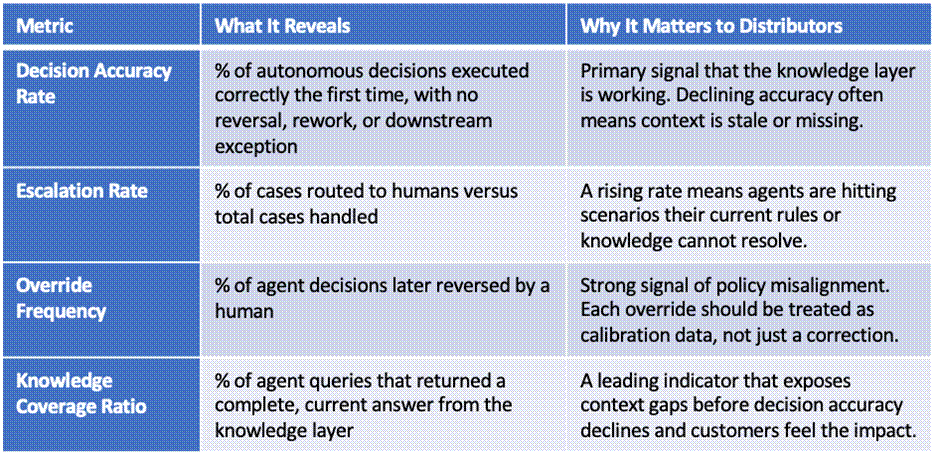
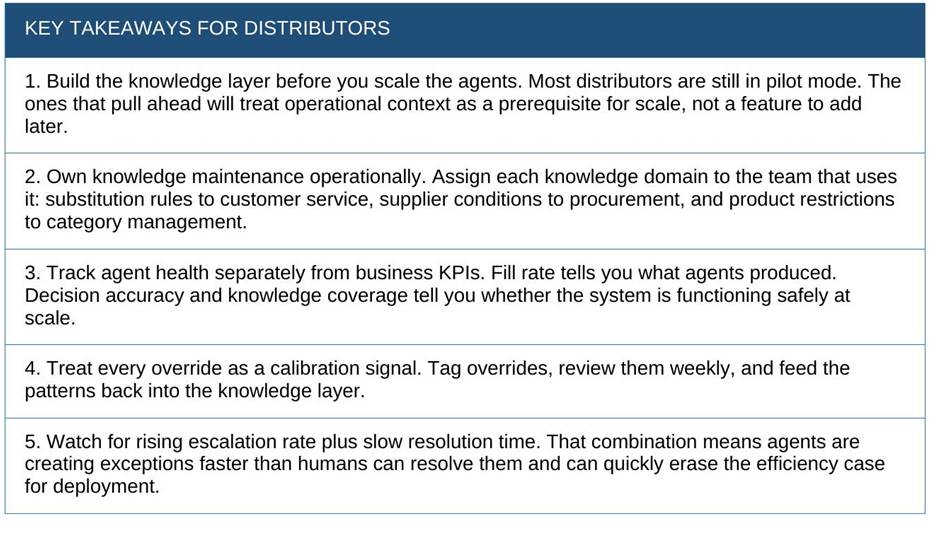
Two patterns warrant immediate attention when they appear together. Decision accuracy declining alongside rising override frequency usually means the knowledge layer has drifted: policies have changed, customer terms have been updated, or new holds have been added, but the context layer has not caught up. The fix is a knowledge audit, not a change to agent logic.
Escalation rate rising alongside slow escalation resolution is the more dangerous combination. Agents are stacking exceptions faster than human reviewers are clearing them. High-volume distributors running seasonal peaks are especially exposed because of agent volume and exception frequency spikes at the same time. Left unaddressed, that backlog erodes the efficiency gain that justified deployment. Catch it in the weekly health review before it reaches customers.
- Assign ownership by workflow. The operations manager who owns exception resolution should own the health metrics for that agent. Not IT. Not a central analytics team.
- Review weekly in the first 90 days, then biweekly once the deployment stabilizes. Monthly is usually too slow to catch calibration drift before it shows up in fill rates or service failures.
- Set explicit thresholds. Decision accuracy below 90%, knowledge coverage ratio below 85%, or escalation rate above 15% should each trigger an active review rather than wait for the next scheduled meeting.
- Tag every override with a reason code and review them weekly. Operators who do this consistently find that trust in agent output builds faster because earned trust comes from visible patterns of reliable performance, not from blind faith in the system.
Making It Operational
The distributors that get durable value from agentic AI will not be the ones that moved fastest. They will be the ones that built the knowledge layer first and the oversight discipline alongside it: a governed operational context layer that keeps agents informed, and a health-metric framework that keeps operators in control.
Neither is glamorous. Both are what make the difference between agents that create operational advantage and agents that compound operational errors.
Share this article: