Why This Matters to Distributors: The CAPE portal gives distributors a formal path to recover IEEPA tariff costs that squeezed margins for the past year — but only importers who act promptly maintain clean entry records and coordinate early with customs brokers are likely to see refunds quickly.
U.S. Customs and Border Protection opened the federal government’s tariff refund portal Monday, giving wholesale distributors and other importers their first formal opportunity to recover billions of dollars in duties the Supreme Court ruled unconstitutional in February.
The portal — known as CAPE, for Consolidated Administration and Processing of Entries — went live at 8 a.m. EST Monday inside the Automated Commercial Environment, the digital filing system that customs brokers and importers already use for daily entry filings. The launch follows the Supreme Court’s Feb. 20 ruling in Learning Resources v. Trump, which held that the International Emergency Economic Powers Act, or IEEPA, does not grant the president authority to impose tariffs — striking down duties on imports from China, Canada, and Mexico.
The financial exposure is significant. Customs and Border Protection estimate $127 billion — about 82% of IEEPA duty payments — are eligible for reimbursement in the portal’s first phase. Total government exposure across all phases could reach $175 billion, according to CBP filings.
For wholesale distributors that spent the past year absorbing or passing along IEEPA tariff costs, the portal represents the first concrete mechanism for recovery. CBP says it will issue refunds within 60 to 90 days of an accepted claim, paid electronically via automated clearing house transfer and inclusive of statutory interest.
The process, however, is neither automatic nor simple.
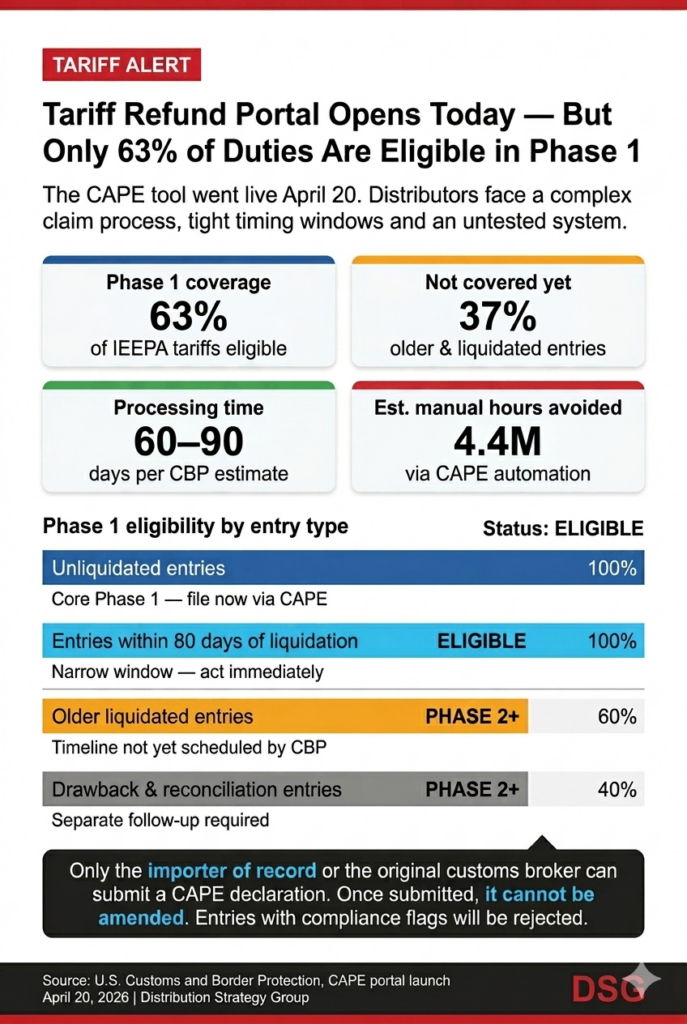
To file a claim, an importer of record or its authorized customs broker must hold an active account in the Automated Commercial Environment portal, have current bank account information on file with CBP for electronic payment and submit a CAPE Declaration — a comma-separated values file listing every entry for which IEEPA duties were paid. Only the importer of record or the broker who originally filed those entries can submit a declaration, a restriction that complicates recovery for distributors that spread import activity across multiple brokers or ports.
Once a CAPE declaration is accepted, it cannot be amended. Entries with compliance flags will be rejected and require separate follow-up. Phase 1 covers only unliquidated entries and those liquidated within the past 80 days. A window CBP estimates it captures 63% of eligible tariffs. The remaining 37%, including older liquidated entries, drawback claims and reconciliation entries, will be addressed in later phases that CBP has not yet scheduled.
The legal picture adds further uncertainty. The Trump administration could still appeal the Court of International Trade’s order directing CBP to begin reimbursements. Treasury Secretary Scott Bessent has publicly predicted the refund process “could be a mess” lasting months or years — and the president himself has suggested litigation could run two to five years.
Processing this volume of refunds under CBP’s existing procedures would have required more than 4.4 million working hours, according to a March CBP court filing — the agency’s own rationale for building CAPE from scratch in under 45 days.
For distributors, the window to act is open. Whether the system delivers on its promise is a question that will take months to answer.
Do not miss any content from Distribution Strategy Group. Join our list.
Share this article:
