


Why This Matters to Distributors: QXO’s plan to bundle insulation, roofing, lumber and construction supplies into a single platform for homebuilders and general contractors is one of the most aggressive consolidation strategies in building products distribution in years, and one that could structurally reshape supplier relationships and customer expectations across the sector.
QXO Inc. has detailed its strategic rationale for acquiring TopBuild Corp., telling investors the deal will give the combined company approximately 22,000 daily job site visits and a platform to cross-sell insulation, roofing, lumber and building materials to homebuilders and general contractors across North America.
The company released a 53-question investor Q&A Monday outlining its value creation plan for TopBuild, which QXO says complements its earlier acquisitions of Beacon Building Products and Kodiak Building Partners.
QXO described the TopBuild opportunity as more strategic and commercial than the Beacon integration, which the company characterized as centered on controllable execution, procurement improvement, and targeted technology upgrades. TopBuild, QXO said, starts from a stronger margin base with expert operators and talented management already in place.
“The upside is more strategic and commercial,” QXO said in the investor document. “It’s driven by cross-selling, upselling, procurement efficiency, private label expansion, pricing strategy, and proximity to the customer, delivered on a larger combined platform.”
The 22,000 daily job site visits TopBuild generates were cited as a central strategic asset. QXO said that real-time job site intelligence will allow the company to optimize inventory placement across its network, proactively cross-sell, increase wallet share and align procurement. The company said it wants to be seen by customers as “an integral partner who can solve their problems from start to finish,” including helping large customers formulate project bids.
QXO identified the Kodiak and TopBuild businesses as the strongest cross-selling opportunity within its combined platform, citing direct overlap with homebuilders and general contractors who purchase across lumber, insulation, siding, decking, windows, doors, and roofing. The company said demand for one-stop sourcing is especially strong in the builder segment, where customers want fewer supplier relationships. QXO said it has received substantial inbound interest from regional builders actively asking what more the company can provide.
On technology, QXO outlined a plan to roll out a fully integrated digital platform across its operations in waves, targeting completion in the first quarter of 2027 for Beacon and the third quarter of 2027 for the remainder of the business. The platform will include enterprise resource planning, point-of-sale, warehouse management, transportation management, human resources management, procure-to-pay tools and last-mile delivery capabilities. Additional initiatives include an AI-enabled CRM system, a Looker-based business intelligence platform and a comprehensive ecommerce platform.
“The most striking takeaway is the pervasive underinvestment in technology across the industry,” QXO said. “It shows up in three ways. First, core systems are often outdated or missing entirely, particularly in areas like warehouse management, inventory planning, transportation, and CRM. Second, there’s limited focus on the customer’s digital experience, which reduces stickiness and leaves upsell opportunities on the table. Third, technology teams are typically understaffed and over-oriented toward maintenance rather than transformation.”
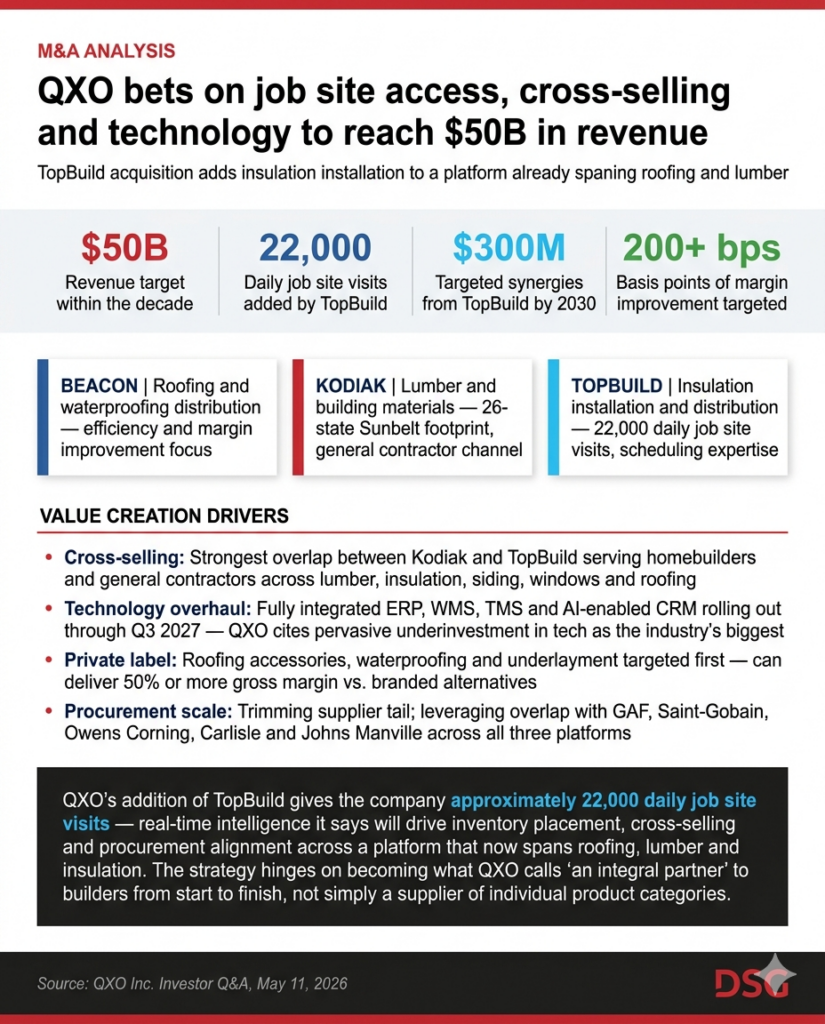
The company projects approximately $300 million in synergies from the TopBuild combination by 2030, with the majority tied to revenue and gross profit rather than headcount reduction.
“This is not a headcount-reduction or cost-slashing strategy,” the company said.
Private label was identified as an additional margin driver, particularly in roofing accessories, waterproofing, underlayment, ridge caps, and complementary categories. QXO said private label products in the right categories can deliver as much as 50% or more gross margin compared with branded alternatives, while also strengthening supplier leverage and enabling higher sales commissions.
QXO said its overall growth algorithm targets $50 billion in revenue within the decade, driven by cross-selling, pricing discipline, procurement efficiencies, private label expansion, routing improvements, and execution rather than reliance on macroeconomic tailwinds.
For wholesale distributors competing in the building products space, QXO’s strategy represents a direct challenge to fragmented operators that lack the technology, procurement scale, and job site presence the combined company is assembling. The pace of three simultaneous large-scale integrations will evaluate whether the company can maintain service levels while delivering on its financial targets.
Do not miss any content from Distribution Strategy Group. Join our list.
Share this article:
