


Why This Matters to Distributors: The tariff refund process rewards companies that documented how they billed tariff costs and penalizes those that did not. Distributors that passed costs through as undifferentiated price increases have limited legal standing to recover those costs, while importers that kept clean records and filed early are already receiving payments. The documentation decisions made in 2025 are now determining who gets money back in 2026.
Two federal court rulings in less than three months have invalidated the legal basis for the Trump administration’s primary tariff programs, setting off a complex refund process that is producing unequal outcomes across wholesale distribution supply chains.
The U.S. Supreme Court ruled in February 2026 that tariffs imposed under the International Emergency Economic Powers Act of 1977 were unconstitutional. On May 7, the U.S. Court of International Trade struck down a second round of tariffs, a 10% global surcharge the administration imposed under Section 122 of the Trade Act of 1974 just hours after the Supreme Court’s February ruling. The court found the administration failed to meet the statutory requirement of a “large and serious United States balance-of-payments deficit” needed to invoke Section 122 authority.
Together, the two rulings expose two rounds of tariff collections to potential refund claims. U.S. Customs and Border Protection has estimated it owes $35.46 billion in refunds on 8.3 million shipments under the first ruling alone, according to a court filing. The government launched a refund portal called the Consolidated Administration and Processing of Entries on April 20. By April 26, importers and customs brokers had submitted approximately 75,300 declarations covering more than 11.2 million individual entries, according to a Customs and Border Protection declaration filed with the Court of International Trade.
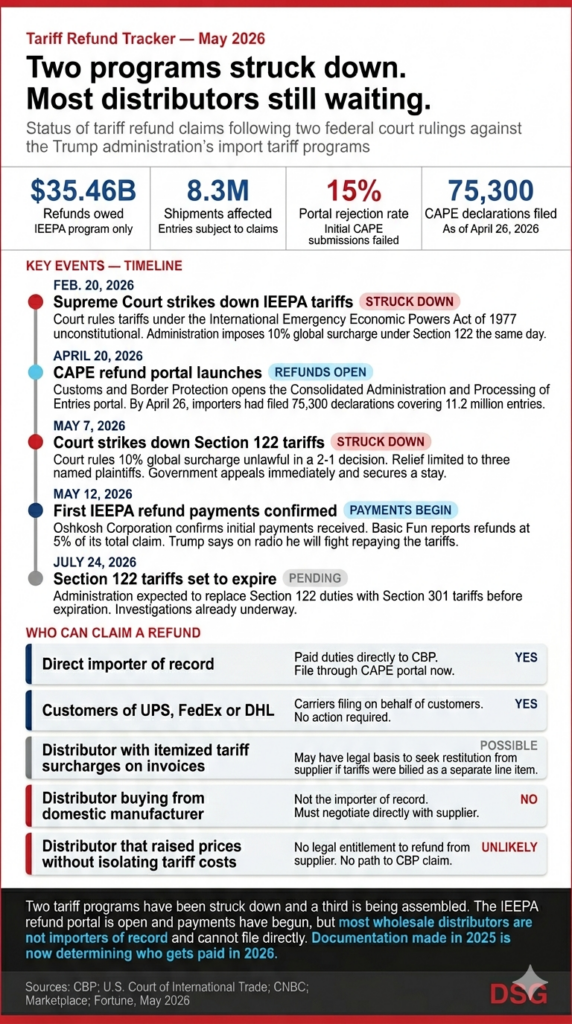
Refunds are moving but unevenly. Oshkosh Corporation confirmed May 12 that it had begun receiving payments. Basic Fun, the company behind Care Bears and Tonka trucks, said its initial refunds represented only 5% of its total claim. Large logistics companies including UPS, FedEx and DHL said they would file on behalf of their customers. Approximately 15% of initial portal submissions were rejected during validation, according to legal practitioners tracking the process.
For wholesale distributors, the refund situation is more complicated than it appears. Only importers of record — the companies that paid duties directly to Customs and Border Protection — are eligible to file claims. Distributors that purchased products from manufacturers or importers who passed tariff costs down the supply chain through higher prices cannot file directly with the government. Rich Leao, president and chief executive officer of Norman S. Wright Mechanical Equipment Corporation, an heating, ventilation and air conditioning equipment supplier near San Francisco, described the structural problem plainly. “There lies the problem, because it has to be the importer that has to apply for the credit,” Leao said. His company absorbed tariff costs passed through by manufacturers but has no direct path to a government refund.
That dynamic is generating a secondary dispute across the distribution industry: whether importers who received government refunds will pass any portion back to the customers they originally charged. The answer depends on how tariff costs were billed. Peter Furth, chief executive officer of FFF Associates, said the obligation is clear in his case because his company broke out tariff charges as separate line items in customer contracts tied explicitly to the current tariff rate. “To me it’s clear I owe the money back to the customer,” Furth said. “And by the way, I need to tell you, my customers believe it’s very clear to them as well. They’ve already asked.” Rachel Brewster, a law professor at Duke University, said businesses that simply raised prices without isolating tariff costs face a different calculation. “If you just agree to pay a price for the good, then it’s not clear that you have any legal entitlement to get that tariff back,” Brewster said.
The Section 122 ruling adds another layer of uncertainty. The May 7 Court of International Trade decision was narrow. The court issued a permanent injunction blocking Section 122 tariff collection only for the three named plaintiffs: Burlap and Barrel Inc., Basic Fun Inc., and the State of Washington. It declined to issue a nationwide injunction. The federal government has already appealed and secured a temporary stay from the U.S. Court of Appeals for the Federal Circuit. Section 122 tariffs continue to be collected from all other importers while the appeal proceeds.
The administration has signaled it intends to use Section 301 of the Trade Act of 1974 as its next tariff mechanism. Investigations already underway are expected to produce new tariffs timed to take effect before Section 122 duties expire July 24, 2026.
President Trump added to the uncertainty May 12. In a radio interview on WABC, Trump called the refund situation “crazy” and said he would fight repayment. “In theory, you have to pay the tariffs back. We’ll fight that,” Trump said.
For distributors, the practical steps are clear. Companies that imported directly and paid duties under the International Emergency Economic Powers Act should be filing claims through the Consolidated Administration and Processing of Entries portal. The first phase covers entries finalized within the past 80 days and excludes entries subject to pending administrative protests. Distributors that absorbed tariff costs passed through by suppliers face a different task: reviewing supplier contracts and invoices to determine whether tariff charges were separately itemized, which may support a claim for supplier-level restitution.
The broader trajectory signals continued disruption. Two successive tariff programs have been struck down on constitutional and statutory grounds, and a third mechanism is being assembled in parallel. For wholesale distributors managing supplier contracts, import costs and customer pricing, the legal landscape that shaped purchasing and pricing decisions over the past year may look significantly different by year-end.
Do not miss any content from Distribution Strategy Group. Join our list.
Bottom of Form
Share this article:
