


Why This Matters to Distributors: Henry Schein’s strategy reflects a broader shift across wholesale distribution as companies simplify their organizations, embed AI into customer workflows, and use technology to improve productivity, deepen customer relationships, and capture market share.
Henry Schein Inc. is moving to reshape one of the world’s largest healthcare distributors around artificial intelligence, a leaner leadership structure and faster execution, as CEO Fred Lowery outlined an ambitious transformation strategy during his first earnings report since taking the helm.
The strategy comes alongside stronger second-quarter results and a major leadership reorganization announced last week that integrates the company’s global supply chain and distribution operations while eliminating layers of management. Together, the moves signal Henry Schein’s effort to evolve beyond its traditional role as a healthcare products distributor and become a technology-enabled business focused on helping dental and medical practices operate more efficiently.
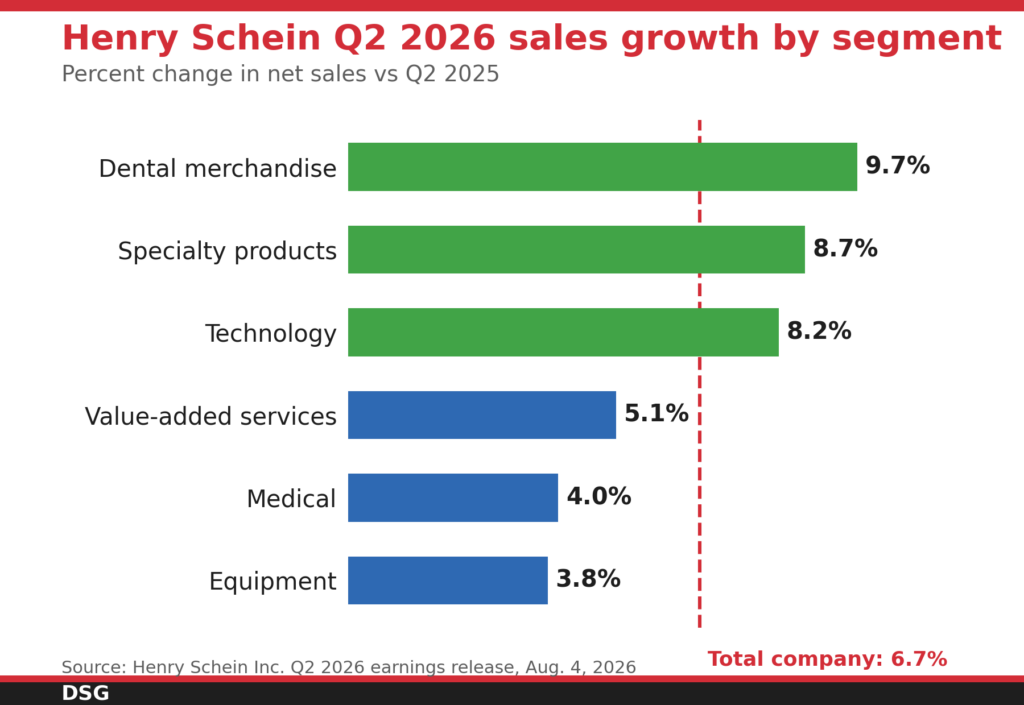
Second-quarter net sales increased 6.7% to $3.46 billion from $3.24 billion a year earlier, while net income attributable to Henry Schein rose 9.3% to $94 million from $86 million. For the first six months of 2026, sales increased 6.5% to $6.83 billion from $6.41 billion, while net income climbed 2.6% to $201 million from $196 million.
The stronger first half performance led the company to increase its expectations for the year. Henry Schein now expects sales to grow from 4.5% to 5.5%, compared with its previous forecast of 3% to 5%.
While the financial results were solid, Lowery made clear that the company’s longer-term strategy—not quarterly performance—was the priority.
“Henry Schein has great assets and capabilities and our customer reach is really unmatched,” Lowery told analysts. “After my first few months at the company, I have an increased conviction that there’s significant opportunity to improve our revenue growth and improve our profitability.”
He said the company is focused on four priorities: accelerating growth, simplifying the business, improving execution, and strengthening customer relationships.
Before reporting earnings, Henry Schein announced one of the most significant leadership changes in its history.
The company replaced its long-time executive management committee with a new Henry Schein leadership team and combined its global supply chain organization with its worldwide distribution business. Chief operating officer Michael Ettinger, chief strategy officer Mark Mlotek and senior vice president of global supply chain Jim Mullins will transition to senior advisor roles later this year after helping oversee the change.
Lowery said integrating supply chain and distribution will reduce complexity and improve the company’s ability to respond to customers.
“By bringing our supply chain teams closer to the customers served by our distribution businesses and enabling direct management of our corporate functions, these changes will further expedite prioritization, accelerate decision making and advance efforts to simplify our operating model,” he said.
The restructuring reflects a growing trend across wholesale distribution as companies flatten management structures to respond faster to changing customer demand, supply chain disruption, and rapidly evolving technology.
Henry Schein’s Global Distribution and Value-Added Services segment continued to drive growth during the quarter.
Segment sales increased 6.6%, including 4.5% internal growth. Global dental distribution merchandise sales rose 9.7%, dental equipment sales increased 3.8%, medical distribution sales climbed 4.0%, while value-added services revenue increased 5.1%. Specialty products sales rose 8.7%, and technology revenue increased 8.2%.
Lowery said the gains reflect both new customer wins and stronger relationships with existing accounts.
“We’re expanding our share of wallet and converting occasional buyers to actively engaged customers,” he said.
Later in the call, he said promotional programs introduced last year continue to generate repeat business.
“We’ve really converted many of those customers into actively engaged customers that are continuing to buy from us.”
The results indicate Henry Schein is growing through market share gains, improving customer retention and healthier demand across dental markets rather than depending primarily on price increases.
Artificial intelligence was the dominant theme throughout Lowery’s remarks.
Rather than presenting AI as a future opportunity, he described it as a practical tool that helps healthcare providers improve productivity while strengthening Henry Schein’s competitive position.
“We’re advancing our Henry Schein One technology platforms, including AI-enabled solutions to improve workflows and collections, enhance practice performance and strengthen patient engagement,” Lowery said.
13,000 customers now use the company’s Dentrix Ascend and Dentally cloud practice-management platforms. Henry Schein is embedding AI into clinical documentation, insurance eligibility verification, claims management, treatment planning and revenue cycle management while developing an MCP layer that will allow practices to use AI agents to analyze operational data across multiple software systems.
“Our customers are looking to Henry Schein to help them operate more efficiently,” Lowery said. “These technology solutions uniquely position us to address this growing need.”
Henry Schein joins a growing list of distributors, including W.W. Grainger, Sysco, and DNOW, that are embedding AI into customer-facing applications and internal operations to improve productivity, automate routine work, and strengthen customer relationships.
Lowery also outlined a multi-year initiative expected to generate more than $200 million in operating improvements through shared services, procurement consolidation, pricing analytics, and additional supply chain automation.
“We’re driving operational rigor by delivering what we expect to be at least $200 million in operating income improvements from value creation initiatives over the next few years,” he said.
Chief financial officer Ron South said Henry Schein expects to exit 2026 with an annualized $125 million run rate from those initiatives, with benefits continuing into 2028. About 60% of this year’s improvements are expected to come from lower administrative costs, with the remainder driven by stronger gross margins.
Lowery said the effort is intended to change the way the company operates—not simply reduce expenses.
“This is not just about $200 million,” he said. “It’s about creating a high-performance culture of accountability and continuous improvement while also increasing customer satisfaction.”
Henry Schein’s strategy echoes one of the strongest themes emerging from second-quarter earnings across wholesale distribution. As pricing power moderates, leading distributors are increasingly competing through AI, software, operational excellence, and customer productivity. By reorganizing leadership, integrating supply chain and distribution, and embedding AI into everyday customer workflows, Henry Schein is positioning itself to compete less as a traditional distributor and more as a technology partner to healthcare providers.
Do not miss any content from Distribution Strategy Group. Join our list.
Share this article:
