



Why This Matters to Distributors: Earnings reports from some of the largest public distributors show artificial intelligence moving into sales, customer workflows and operating productivity while also driving demand for data center infrastructure. For the broader industry, AI is beginning to shift from experimentation to a business tool tied to specific operating and growth priorities.
Artificial intelligence is taking on a more concrete role at some of the largest public distributors.
Recent earnings reports and investor calls show companies beginning to talk less about AI as a broad technology initiative and more about where they are putting it to work. The early focus is on improving sales productivity, automating work, building AI into customer-facing software, and capturing demand created by the rapid expansion of AI data centers.
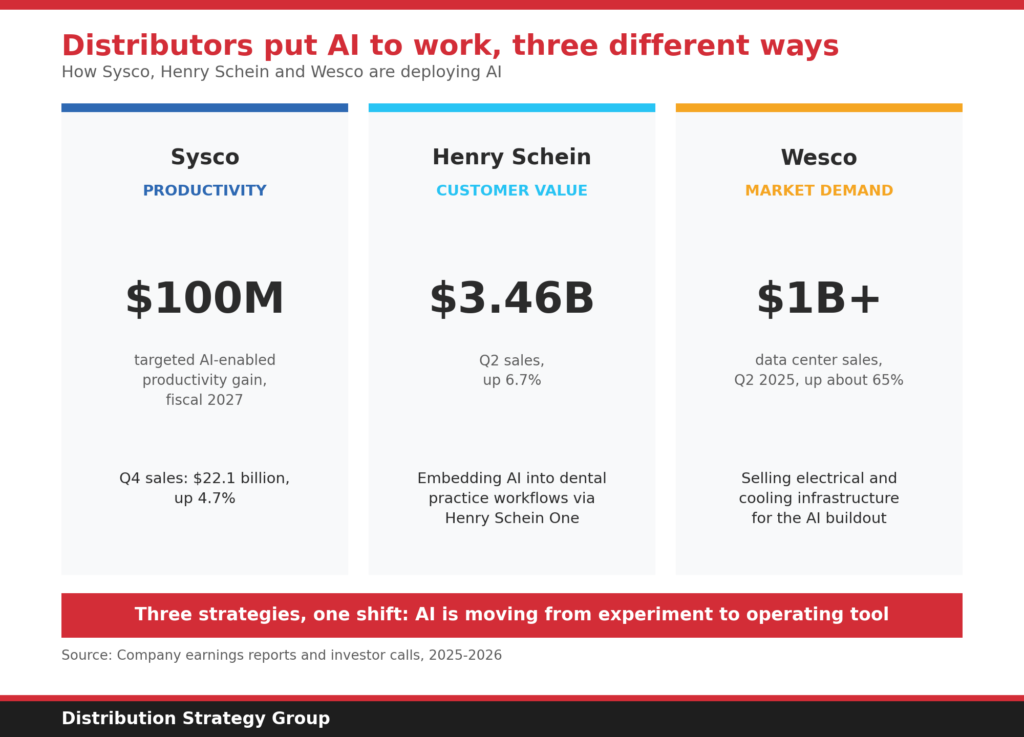
Sysco Corp., Henry Schein Inc., and Wesco International Inc. illustrate three different approaches. Sysco is targeting productivity. Henry Schein is embedding AI into customer workflows. Wesco is selling the physical infrastructure needed to support the AI buildout.
Other large distributors have disclosed less about specific AI deployments and returns, underscoring how uneven adoption remains across the industry.
The emerging picture is not one of an overnight transformation. Instead, distributors are deploying AI against individual business problems where they believe they can produce measurable results.
Sysco Targets $100 Million in AI-Enabled Productivity
Sysco has put one of the clearest numbers behind its AI strategy.
The Houston-based foodservice distributor expects AI-enabled initiatives to contribute about $100 million in productivity benefits in fiscal 2027 as it expands the use of technology across sales and other operations.
The company has been deploying AI-enabled selling tools designed to help sales representatives work more efficiently and improve customer engagement.
Sysco reported fiscal fourth-quarter sales of $22.1 billion, up 4.7% from a year earlier, while continuing to invest in technology, supply-chain productivity, and sales execution.
The significance for distributors is less about Sysco’s size than about where it is applying the technology.
Sales organizations generate substantial amounts of repetitive work, from preparing for customer calls and searching for product information to identifying opportunities and determining which accounts need attention. AI can reduce some of that work without requiring a distributor to redesign its entire sales organization.
At Sysco’s scale, incremental improvements across thousands of employees can produce significant savings. For smaller distributors, the dollar amounts will be different, but the underlying business case is similar: reduce administrative work and give employees more time to sell and serve customers.
Henry Schein Takes AI to the Customer
Henry Schein is pursuing AI from another direction.
The Melville, New York-based medical and dental distributor is expanding AI capabilities within Henry Schein One, its dental practice-management software business.
During its second-quarter earnings call, management discussed plans to push AI further into clinical and business workflows. Henry Schein One also is developing a Model Context Protocol layer designed to allow dental practices to use AI applications and agents to interact with their own business data.
That moves AI beyond an internal productivity initiative.
Henry Schein is using the technology to expand the software and services it provides customers, potentially making the distributor more tightly integrated with the daily operations of dental practices.
The strategy follows a broader trend in distribution. Companies have spent years moving beyond product fulfillment by adding digital ordering, inventory management, analytics, vending, and other services designed to deepen customer relationships.
AI potentially adds another layer. A distributor that can help customers analyze operating data, automate routine work, or identify business opportunities becomes more than a source of products.
Henry Schein reported second-quarter sales of $3.46 billion, up 6.7% from a year earlier.
Its approach illustrates how distributors with specialized industry data, software and customer relationships could turn AI into a customer-facing service rather than treating it primarily as a cost-cutting tool.
Wesco Captures Demand From the AI Data Center Buildout
At Wesco, the AI opportunity extends beyond how the distributor operates internally.
AI is creating demand for products Wesco already sells.
The Pittsburgh-based electrical, communications and utility distributor has identified the expansion of AI data centers as a significant growth opportunity. Those facilities require electrical equipment, power distribution, networking infrastructure, cooling systems and related products and services.
That makes Wesco part of the physical supply chain behind AI.
The scale of that opportunity was already becoming apparent last year. Wesco said data center sales exceeded $1 billion in the second quarter of 2025 and increased about 65% from a year earlier.
The company also has expanded its capabilities around the market. In July, Wesco acquired Newark Engineering Group, adding data center cooling and lifecycle service capabilities.
The strategy highlights an AI opportunity that extends well beyond software.
Electrical, HVAC, industrial and technology distributors can benefit from AI investment without developing their own AI products. The buildout of data centers and computing infrastructure requires enormous amounts of power, cooling, networking equipment, and technical support.
For those distributors, the strategic question is not simply how to use AI internally. It is how to position inventory, technical expertise, engineering services, and supply-chain capacity around customers investing in AI infrastructure.
Public Disclosure Remains Uneven
Not every major distributor is providing the same level of detail.
Grainger reported second-quarter sales of $5.02 billion, up 10.3% from a year earlier, and continues to invest heavily in digital capabilities, technology, and data. But its second-quarter earnings materials did not make AI a central part of the company’s discussion with investors.
Fastenal also continues to expand its technology-enabled distribution model through e-commerce, automated supply, and onsite programs, but AI was not a major theme in its second-quarter earnings materials.
That does not mean those companies are not using AI.
It does show that the industry remains at various stages in publicly connecting AI investments with specific operating results.
For distributors evaluating competitors, that distinction matters. Announcing an AI initiative is different from identifying where the technology is deployed, how employees or customers are using it and what financial or operating results it is producing.
Three AI Strategies Begin to Emerge
The earnings season so far points to three distinct ways AI is affecting distribution.
The first is productivity. Sysco is applying AI to sales and operations with the goal of reducing work and improving employee output.
The second is customer value. Henry Schein is embedding AI into software and workflows used by customers, extending its role beyond product distribution.
The third is market demand. Wesco is benefiting from the infrastructure investment required to build and operate AI data centers.
Those approaches are not mutually exclusive. Large distributors could pursue all three.
The biggest companies have advantages. They have larger technology budgets, more proprietary data, and thousands of employees across whom even modest productivity improvements can generate significant returns.
But the earnings reports also suggest that distributors do not need an enterprise-wide AI transformation to get started.
The more immediate questions are narrower: Where can AI eliminate repetitive work? Where can it make salespeople or other employees more productive? Where can it create a new service for customers? And where is AI changing what customers are buying?
For distributors, that may be the most important message coming out of earnings season.
AI is beginning to move from a technology discussion to an operating and growth strategy — and the companies furthest along are increasingly being asked to show what it does for the business.
Do not miss any content from Distribution Strategy Group. Join our list.
Share this article:
